note
Affiliate disclosure: this review contains affiliate links to AI Media Machine. If you buy through one, I earn a commission at no extra cost to you.
Nobody paid for this review, I was not given a free copy, and nothing critical below was softened for the commission. How I handle affiliate links is covered in the disclaimer.
AI Media Machine sells twelve AI tools for video creators as a single $297 payment, forever, with no subscription. A countdown on the page warns that the price returns to $997 when it hits zero. The page adds, in its own words, that this is not a marketing trick.
So I opened the page source to see what the timer was counting down to.
It is counting down to nothing. The deadline is not a date on a server. It is generated inside your browser the moment you arrive, set to twenty one minutes and forty seven seconds from now, and saved to your own local storage.
The developer left a comment next to it explaining that the odd number was chosen deliberately so it would not look round.
That one file changed how I read everything else on the page, so this AI Media Machine review checks the rest the same way: the claim on one side, the vendor's own code, contracts and archives on the other, with the date I read each one.
What I found is not a scam. It is a real product wrapped in machinery designed to stop you thinking for twenty one minutes.
Is AI Media Machine worth it? The short answer
AI Media Machine is worth $297 only if you are already paying monthly for three or more of the categories it bundles and you will genuinely use 600 credits a month. For everyone else the free alternatives cover the best tool in the set, and the buying pressure on the page is manufactured.
It is worth considering if you run paid video ads at volume, you currently rent an avatar tool, a voiceover tool and a music tool separately, and a fixed one time cost genuinely beats your renewal dates.
It is not worth it if you are new, unsure, or buying because a timer told you to. The single most valuable tool in the bundle, the Winning Ads Finder, does a job that Meta and TikTok both give away free and without an account.
And it needs one specific piece of care whoever you are. The sales page promises thirty days to change your mind. The vendor's own terms and the ClickBank checkout both say sixty. Buy on the sixty, because that is the number that binds.
The tools are real and the company has traded since 2008. The marketing around them is the part that does not survive being checked.
AI Media Machine at a glance
The specification, taken from the sales page, the ClickBank order form and the vendor's own documentation on 12 September 2026 rather than from other reviews.
- Price: $297 one time, stated as reduced from $997. The same product is also sold elsewhere on the site at $37 a month.
- Vendor: BlueFx INC, founder Szilard Gyorfi, trading since 2008, sold through ClickBank under the nickname bluefx02 since January 2024.
- Headline tools: twelve, including Winning Ads Finder, Video Analyzer and Ad Cloner, AI Cinematographer, Talking AI Avatar, Script to Video, Thumbnail Maker, Voiceover Studio, Music Maker, Ebook Writer, Content Multiplier and Logo Generator.
- Total tools claimed: twenty plus, with Image Maker, Video Swap, YouTube Repurpose and Viral Trends named but not detailed.
- Monthly allowance: 600 credits, described as roughly 100 short videos, refreshed monthly for life.
- Avatars and voices: 200 plus avatars, 57 voices, plus voice cloning.
- Order bumps: $67 video template pack, $37 music pack. Post purchase upsell $99.
- Guarantee: sixty days at the ClickBank checkout, thirty days according to the sales page.
- Statement descriptor: CLKBANK*AIMediaMachine.
One row does most of the work. The allowance is 600 credits total, not 600 per tool, and the feature list is written to obscure that.
AI Media Machine pros and cons
The balance sheet, drawn from the evidence in the rest of this review rather than from the sales page.
What AI Media Machine gets right:
- A genuine one time price on the ClickBank route. $297 buys it outright with no renewal, and ClickBank confirms no rebill on the listing.
- A real sixty day exit. Administered by ClickBank as retailer, not by vendor goodwill, and twice the window the page advertises.
- A traceable operator. BlueFx has sold After Effects templates since 2008 under a named founder, which is rare in this category.
- The bundle is genuinely broad. Avatars, voices, music, thumbnails and scripts in one login is less administrative work than five separate subscriptions.
- The credits refresh monthly. Unlike lifetime deals that hand you a fixed pool once, this one resets.
- No approval gate for affiliates, which usually signals a vendor confident enough to let anyone look.
What AI Media Machine gets wrong:
- The countdown is fabricated, and the page's own source code carries a comment admitting the number was picked to look organic.
- The price has not moved since April 2024, through two different stories about why it is about to rise.
- The lifetime promise has no contract behind it. The linked Terms of Service governs After Effects zip files and never mentions AI, credits or accounts.
- The Privacy Policy link on the sales page returns a 404.
- The same product is sold at $37 a month on the same domain, and the two pages disagree by a factor of four about what rival tools cost.
- The four monthly limits are alternatives dressed as inclusions, all drawing on one 600 credit pool.
- It invites you to clone anyone's voice, which is the buyer's legal exposure and not the vendor's.
How I researched this AI Media Machine review
I have not spent six months running paid campaigns out of this bundle, and reviews that pretend otherwise are why this whole category feels untrustworthy.
What I did instead is what I do before any tool touches real work: check every claim against something the vendor did not write in order to sell you.
That meant reading the sales page line by line, then reading the page source, because a marketing page is an argument but its JavaScript is a machine and machines cannot hedge.
It also meant pulling the same URL out of the Wayback Machine at five points between April 2024 and June 2026, to see which promises had ever actually moved.
That technique is worth stealing for any software purchase. A sales page tells you what a company wants you to believe today. An archive of that same page tells you whether the urgency it is selling has ever once been real.
Then I walked the funnel to the ClickBank order form, read the vendor's Terms of Service, Privacy Policy and Earnings Disclaimer, and compared each against the headline claims.
Every price and quotation below carries the date I read it, and every source link goes to the page I read it on, so you can check my work.
It is the same approach I used on Speechelo, where the vendor's own support desk quietly contradicted the licence the sales page was selling.
What AI Media Machine actually is
AI Media Machine is a browser based bundle of AI generation tools sold under one login, built around a single workflow: find a competitor's advertisement that is already working, have the software take it apart, then rebuild it with your product in place of theirs.
The vendor calls that the Clone and Profit System, and it is the organising idea of the product rather than a side feature.
Around it sit the generators. AI Cinematographer builds video from an image or a prompt.
Talking AI Avatar produces presenter clips from a library of over 200 synthetic people, and Script to Video turns a single sentence into a captioned short.
Then the supporting set: a voiceover studio with 57 voices, a music generator, a thumbnail maker, a logo generator, an ebook writer and a content repurposer that turns one video into blog posts and captions.
The last piece is a monetisation layer. Top Offers Finder preloads over fifty affiliate products that pay $50 or more per sale, so a buyer with no product of their own has something to advertise.
That last inclusion tells you who the offer is really aimed at. A tool for established businesses does not need to supply its customers with something to sell.
Who is behind AI Media Machine
The vendor is BlueFx INC, and the founder is named openly on the page as Szilard Gyorfi. That openness is worth something in a category full of invented personas.
BlueFx is not new. The company has sold After Effects templates and video training since 2008, the footer carries a 2009 to 2026 copyright, and the site still runs a template store alongside the AI product.
The page states 18 years in marketing, over 100 products launched, $60,000 of personal advertising spend and 36,000 customers served. None of those figures are independently verifiable, so I report them as claims.
One of them does not hold still. The lifetime page says 18 years and the company's other live page for the same product says 16. Same founder, same site, same week.
That history is also why the order bumps at checkout are After Effects templates and a music pack rather than anything AI made. They are the back catalogue.
So the picture is a long running small video company that pivoted into reselling AI generation, not a new operation with no history. That matters for the odds it is still running in three years.
How the AI Media Machine workflow actually goes
The advertised sequence has four steps and the page is admirably clear about all of them, which is unusual and worth crediting.
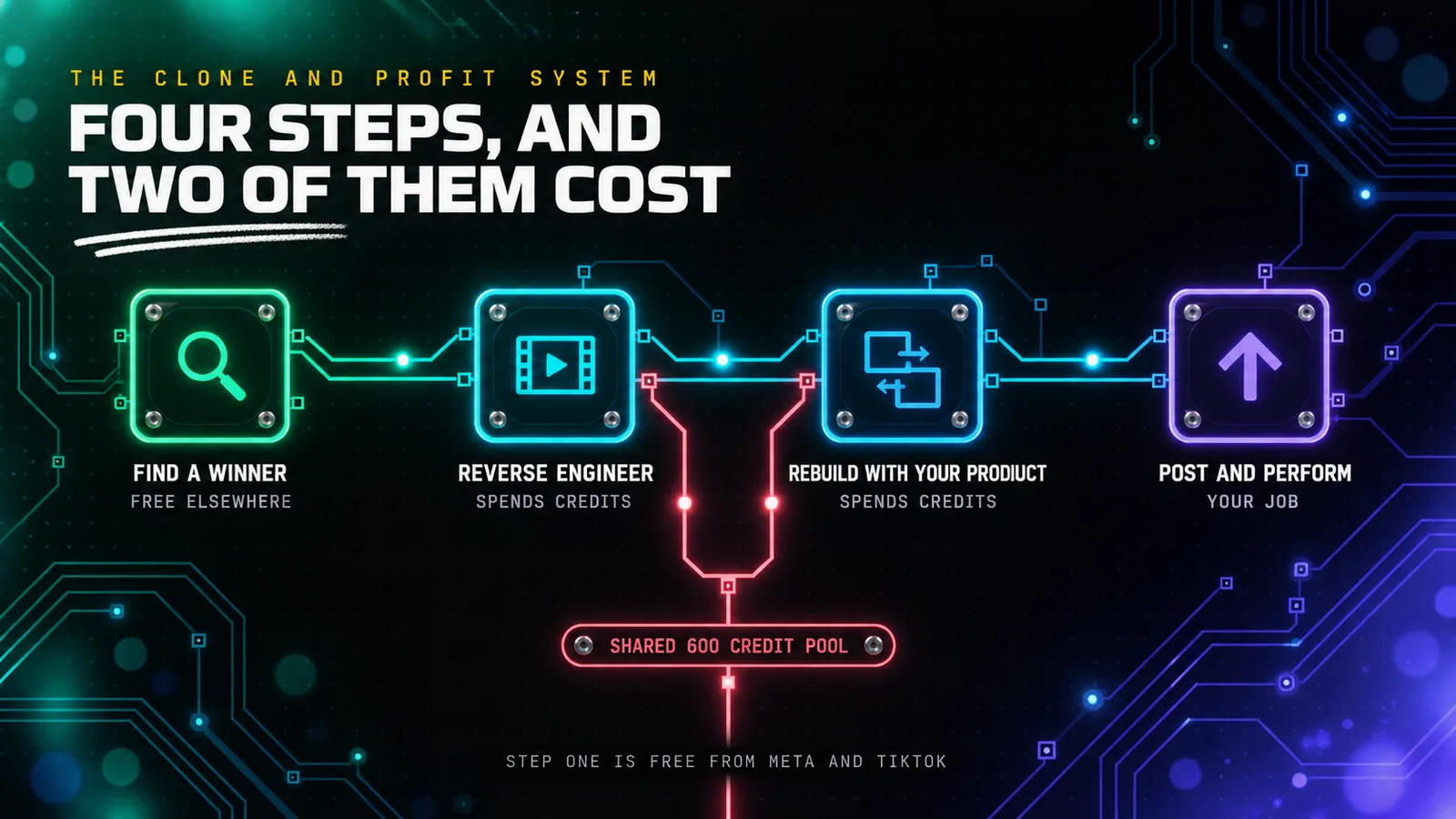
Step one, find a winner. You browse the Winning Ads Finder, a feed of Facebook and TikTok advertisements currently running, and pick one performing well in your niche.
Step two, clone it. You send that video to the Video Analyzer, which breaks down the hook, the script, the shot sequence and the timing, and returns what the page calls the entire blueprint.
Step three, rebuild. AI Cinematographer reconstructs the same structure with your product, your brand and your message swapped in.
Step four, post. The page's summary of this step is simply: proven format, your product, you just post it.
Two things are worth saying plainly about that sequence. The first is that it works, in the sense that reverse engineering a successful advertisement is ordinary, legal competitive research that agencies have always done.
The second is that the step the page skips is the one that costs money. Steps two and three both spend credits from the same 600 credit monthly pool, so the workflow's throughput is capped well below what the tool list implies.
The AI Media Machine countdown timer is written by your own browser
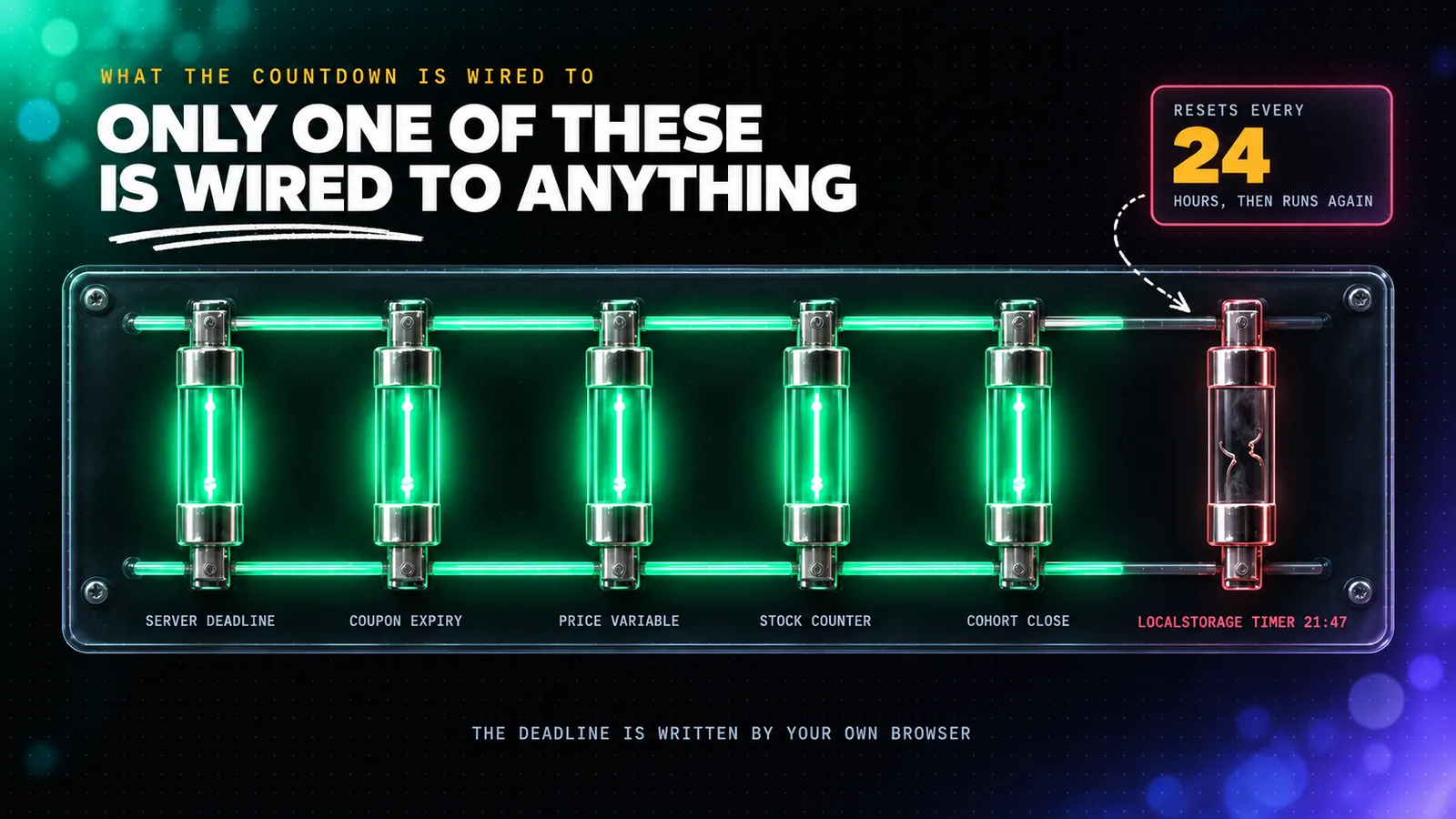
The AI Media Machine countdown is not counting down to a real deadline. It is a twenty one minute and forty seven second timer generated by JavaScript in each visitor's own browser, stored in that browser's local storage, and reissued every twenty four hours. No price changes when it reaches zero.
The sales page says the lifetime licence returns to $997 when the timer hits zero, and adds directly: that is not a marketing trick. The page's own JavaScript disagrees, and it is not ambiguous.
Here is the timer, copied from the inline script on the page the affiliate link sends you to, fetched on 12 September 2026.
var KEY = 'amm_founding_deadline';
var WINDOW_MS = (21 * 60 + 47) * 1000;  // 21:47 - deliberately not a round number
var COOLDOWN_MS = 24 * 60 * 60 * 1000;  // once it runs out, stay expired for a day

var deadline = parseInt(localStorage.getItem(KEY) || '0', 10);
if (!deadline) {
  deadline = now + WINDOW_MS;
  localStorage.setItem(KEY, String(deadline));
}
There is no date anywhere in it.
The comment is the vendor's own. Deliberately not a round number is a note the developer wrote to explain why the window is 21:47 rather than 20:00, and the reason is that odd numbers read as real.
The second comment is worse. The cooldown keeps the timer hidden for a full day after it expires, and the code says why: so that a reload right after zero cannot resurrect the countdown.
That is a deliberate design decision to prevent the obvious test. Refresh the page the second the clock runs out and a naive implementation hands you a fresh twenty one minutes, which anyone would notice. This one waits a day, then quietly reissues the same window.
So the scarcity survives casual scepticism by design. It does not survive opening the file.
Nothing in that code touches a price. There is no server call, no coupon expiry, no price variable. When the timer ends the page hides the clock, and the $297 button carries on working exactly as before.
A countdown is a claim about the future, and this one is a claim the page is not in a position to make. The number on screen describes how long you have been reading, and nothing else.
I want to be precise about what this does and does not prove. It does not prove the software is bad, that the company is fraudulent, or that $297 is the wrong price. It proves one specific sentence on the page is false, and that the falsehood was built on purpose.
The same $297 has been ending soon since April 2024
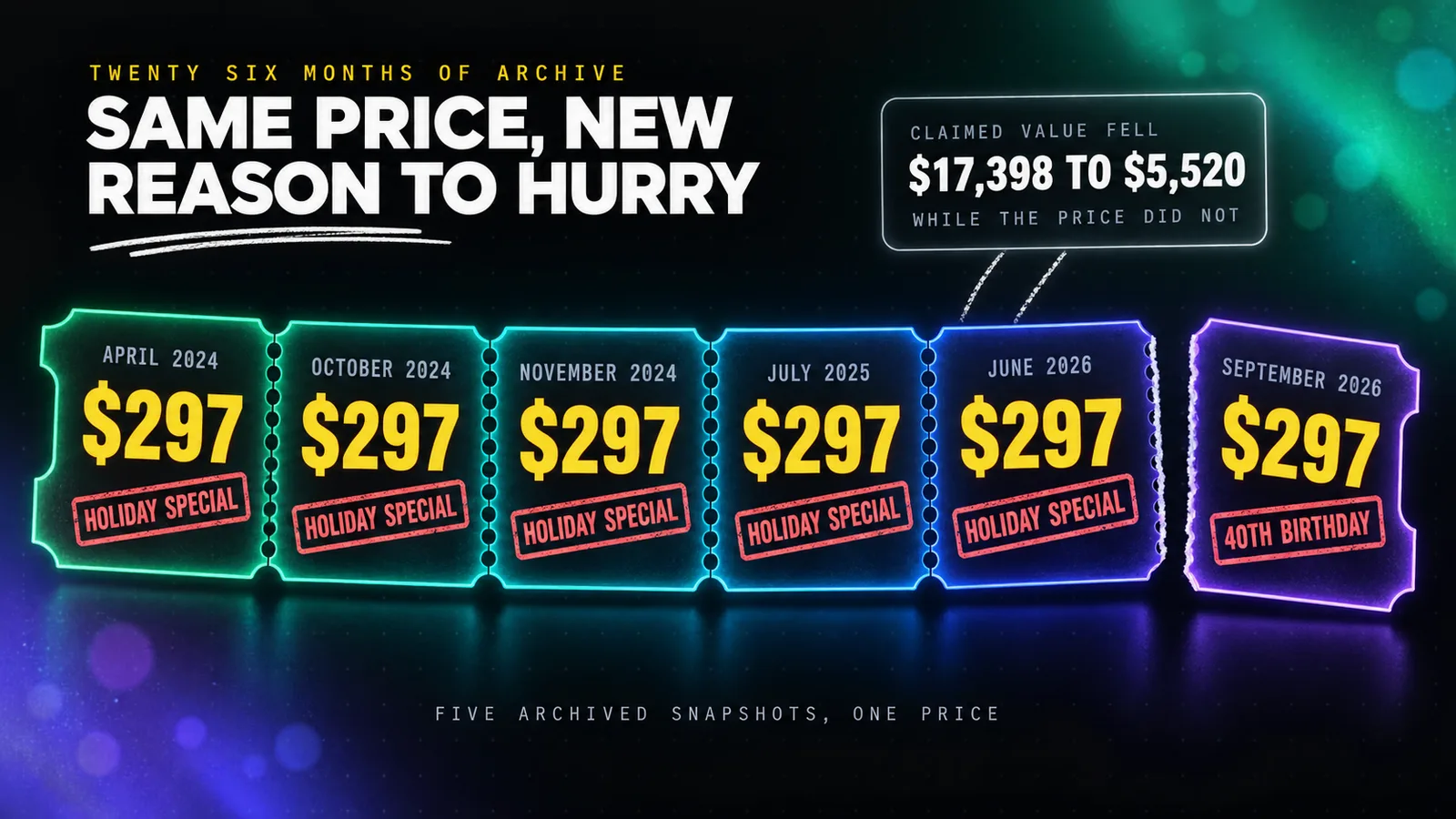
AI Media Machine has cost $297 continuously since at least 18 April 2024, and every archived version of the sales page in between says the offer is about to end. The Wayback Machine holds five distinct versions of that page, and the price is identical in all of them.
If the timer were the only pressure device I would call it sloppy rather than deliberate. The archive removes that defence.
The affiliate link lands on the URL bluefx.net/ai-super-bundle-v2-partner, and I read all five snapshots on 12 September 2026.
The snapshots from 18 April 2024, 8 October 2024, 29 November 2024, 31 July 2025 and 15 June 2026 are character for character identical on the offer. Every one of them reads:
- access over $17,398.00 worth of our best tools
- Just $297
- Get 98.29% Off
- and the closing line: the only catch is that I am taking this offer down once the Holiday Special ends
A Holiday Special that ran without interruption for twenty six months, including through April, July, October, November and June. That is not a holiday. That is a wallpaper.
Then, somewhere between 15 June 2026 and today, the page was rebuilt. Same URL, same $297, new bundle, new reason.
The stated value fell from $17,398 to $5,520. The discount fell from 98.29 percent to 94.62 percent. The deadline stopped being a holiday and became the founder's fortieth birthday.
The price is the only number that never moved. Everything the discount is measured against was rewritten around it.
That reveals how the percentage is built. The headline discount is not calculated from a price anyone has ever paid, it is calculated backwards from whatever total value the page is claiming that season.
For the record, $297 off a stated $997 is a 70 percent discount. The 94.62 percent figure measures it against $5,520 of annual rentals instead, a different kind of number entirely, and it sits directly beside the struck through $997 as though it were the same one.
AI Media Machine pricing: what you actually pay
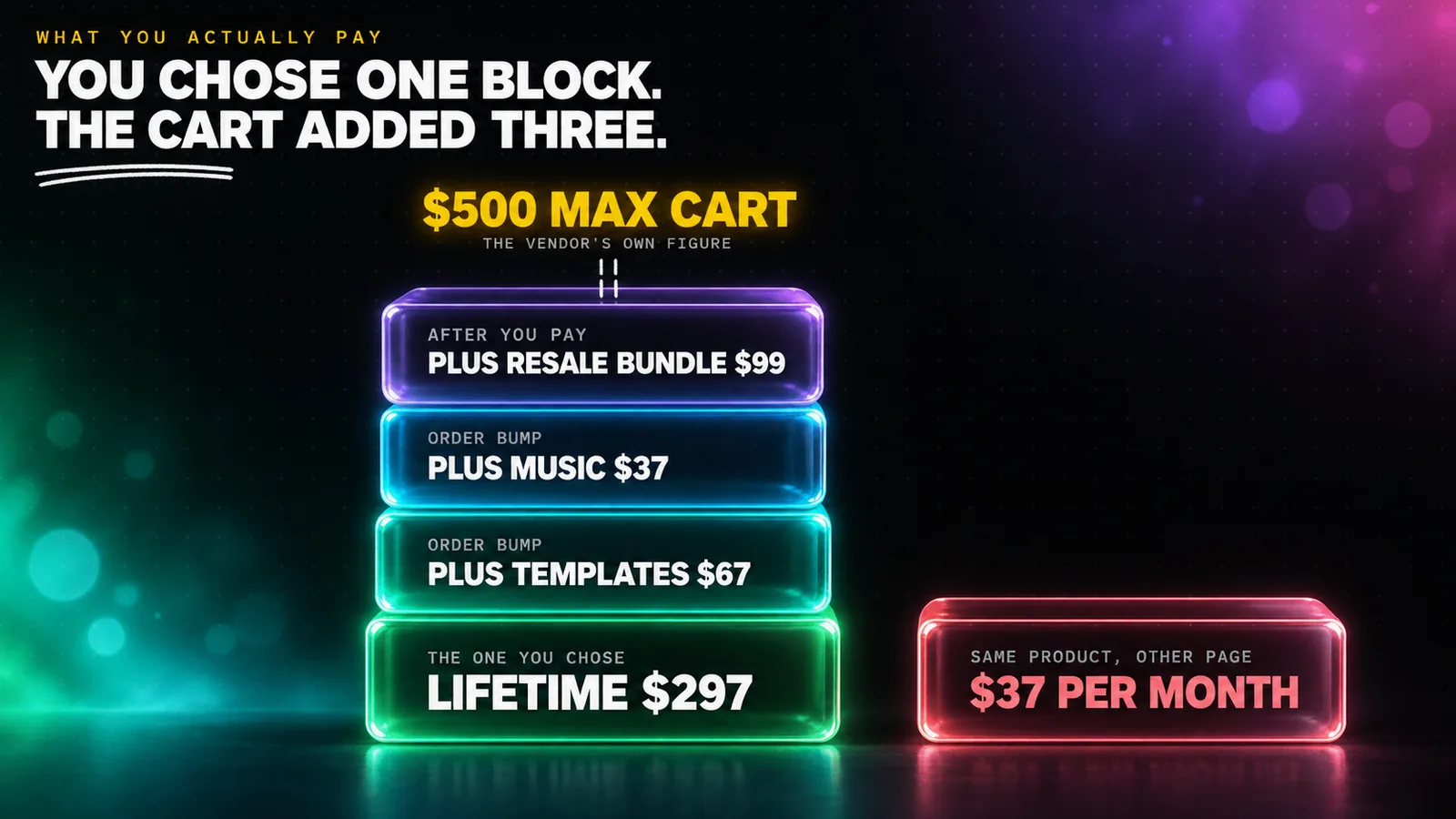
AI Media Machine costs $297 as a single payment through ClickBank, with two order bumps at checkout worth $104 together and a $99 upsell after purchase, so the maximum cart is $500. There is no subscription on this route and ClickBank records no rebill against the listing.
That is the clean version. Here is the full ladder, read off the live ClickBank order form on 12 September 2026.
- Main offer: $297, described at checkout as AI Media Machine Life Time (94% OFF).
- Order bump one: all 85 video templates BlueFx has made, $67.
- Order bump two: a 205 track royalty free music pack, $37.
- Post purchase upsell: a resale bundle, $99, which I could not inspect without buying.
- Maximum total: $500, a figure confirmed on the vendor's own affiliate page.
Both bumps are legacy After Effects assets rather than anything to do with the AI product, and the vendor's affiliate page describes both as high take rate, which is the language of something designed to be clicked rather than considered.
There is also a detail the sales page never mentions and Indian readers should know before the card goes in. The ClickBank order form rendered for India showed Rs 31,696.49 plus Rs 5,705.37 of GST, for a total of Rs 37,401.86.
That implies a conversion rate of about 106.7 rupees to the dollar, against a market rate near 95.6 on the same day. Add the tax and the delivered cost is roughly $391 for a product advertised at $297, or about a third more than the sticker.
ClickBank is the retailer, so that spread is platform behaviour rather than something BlueFx chose. It is still money, and no review I found mentions it.
Prices move, so verify the current figure on the official AI Media Machine page rather than trusting any review, including this one.
The AI Media Machine upsell ladder, mapped before you hit checkout
Three of the four charges arrive after you have already decided. Two order bumps sit as tick boxes on the checkout page beside a price you have accepted, and the $99 upsell appears only once your card has cleared, which is the wrong moment to be weighing anything.
The vendor's affiliate page prints the whole cart, because affiliates need to know what they earn on. Read as a buyer instead, it is a map of the pressure points.
- $297 main offer, the only item you actually chose.
- $67 order bump one, described to affiliates as high take rate.
- $37 order bump two, also described as high take rate.
- $99 post purchase upsell, a resale bundle.
- $500 full cart, which is the vendor's own headline figure.
High take rate is the phrase worth pausing on. It is an admission that these bumps are converting well, and the reason they convert is placement rather than merit. Both sit as pre purchase tick boxes beside a price you have already accepted.
Neither bump is an AI tool, and that does not make them worthless. It does mean they are unrelated to the thing you came for, and that After Effects templates are useless to a buyer who does not own After Effects.
There is one more figure that tells you how the funnel performs in practice. ClickBank publishes an average of $95.87 earned per sale on this listing, against a 50 percent commission on the whole cart.
Work that backwards and the average cart is around $192, not $297. That is an inference from two published numbers rather than a vendor disclosure, and I am labelling it as one, but the likeliest explanations are refunds pulling the average down or a cheaper route into the offer.
Either way it sits oddly beside the promoter the vendor showcases on its own affiliate page, who is shown earning $195.10 per order. That is roughly double the platform average for the same offer.
The same product is also sold at $37 a month
While mapping the funnel I found a second live sales page on the same domain, selling the identical product on a completely different model.
The ClickBank page sells $297 once and says, in bold, no subscription, ever. The page at bluefx.net/amm/ai-media-machine sells the same twelve tools for $1 up front and then $37 every month, describes that as a founding member rate, and urges you to lock it in before it rises to $97.
Both were live when I checked on 12 September 2026. Neither mentions the other.
That is not automatically dishonest. Plenty of companies sell one product two ways. It does become a problem when the two pages contradict each other about the evidence for the deal.
The lifetime page says the equivalent tools rent for over $460 a month elsewhere. The monthly page, selling the same bundle, says rival tools cost $110 to $220 a month.
That gap matters more than it looks, because the $460 figure is the foundation of everything. Multiply it by twelve and you get the $5,520 annual total. Measure $297 against that and you get the 94.62 percent discount in the headline.
The vendor's own second page puts the comparison basket at somewhere between a quarter and a half of the number the first page uses to justify the offer.The savings claim rests on a competitor price the same company contradicts elsewhere on its own website.
AI Media Machine credits: the 600 credit maths the feature list hides
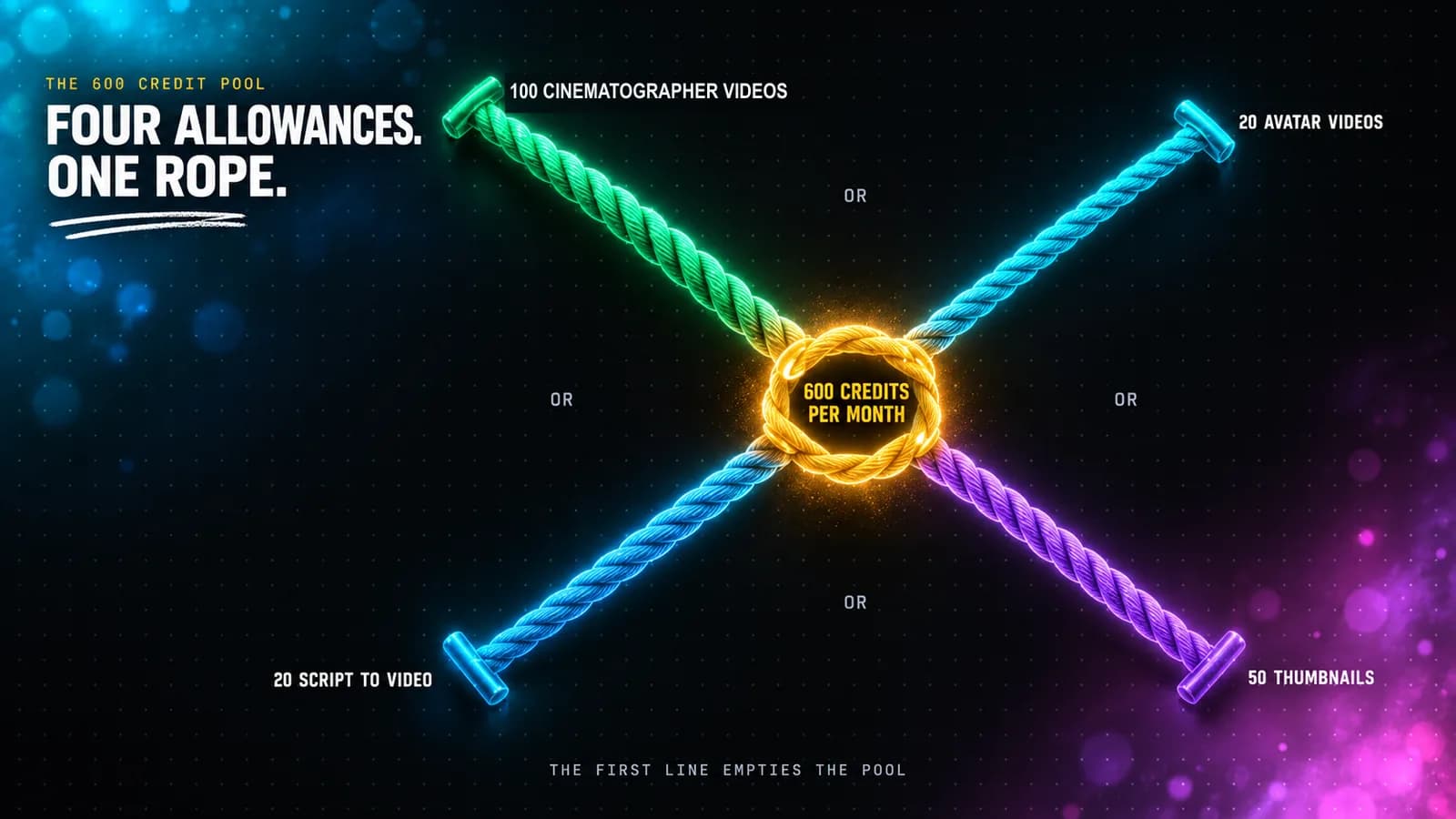
The account gets 600 credits a month, which the vendor equates to about 100 short videos. That is the total across every tool, not an allowance per tool, and the pricing block is laid out in a way that obscures it.
Here is the relevant block as printed under the heading All 20+ tools. Full access. No restrictions:
- around 100 AI cinematographer videos per month
- around 20 talking avatar videos per month
- around 20 script to video creations per month
- around 50 AI thumbnails per month
Four ticked lines, stacked like inclusions. Read casually, that is 190 outputs a month.
But the same page says 600 credits buys about 100 short videos in total. So the first line alone consumes the entire monthly allowance, and the other three are what you get instead of it rather than in addition to it.
They are alternatives presented in the visual grammar of a list of inclusions. No individual sentence is false, which is what makes the layout effective.
The consequence is easy to state. Generate a week of avatar clips and your cinematographer budget is gone. Make thumbnails for a back catalogue and you are buying top up packs, which the page mentions twice without printing a price beyond recharge packs start at $9.99.
Note also what the word unlimited is doing. It attaches to the ads finder, the analyser, voiceover, music, ebooks, content repurposing and logos.
Those are the cheap ones. Every tool that actually renders video is metered, which is a rational decision given what generation costs the vendor per second.
The cap is fair. The presentation is not.
AI Media Machine lifetime access: what it means when no contract covers it
The word lifetime carries the offer. It is in the page title, the buttons and the guarantee. So the reasonable question is which document defines it, and the answer is that none does.
The sales page footer offers two legal links. I followed both.
Terms of Service points to bluefx.net/terms. That page is the BlueFx terms and usage agreement, and it is the licence for the company's After Effects template business.
It governs pre-rendered video files, After Effects project files and music contained in the zipped download. It addresses Fiverr sellers and names Adobe After Effects.
It also explains that you may not place the products on a diskette.
What it never mentions, across the entire document: artificial intelligence, credits, monthly allowances, generated content ownership, account termination, or what becomes of a lifetime licence if the service is switched off.
Privacy Policy points to bluefx.net/privacy-policy-3, which returns a 404. The working policy sits at a different URL, runs to roughly 27,600 characters, and contains no occurrence of the words clone, likeness, biometric, training data or generated content.
For a product whose headline feature is cloning human voices, that is a conspicuous silence in the one document that is supposed to describe what happens to the data you upload.
So the position is this. You are buying a perpetual licence to a hosted AI service under a contract written for downloadable zip files, from a company whose privacy policy link on the checkout page does not resolve.
That is not evidence of bad intent. Small companies leave stale pages behind constantly, and I would guess neglect long before malice. But intent is not the point when the question is what you can enforce.
Lifetime, in practice, means for as long as BlueFx chooses to keep the servers on. Every lifetime software deal means that. The difference here is that there is no document that even attempts to say otherwise.
The one genuinely useful thing buried in that stale terms page is the refund clause, and it contradicts the sales page in the buyer's favour. More on that below.
"Clone anyone's voice" is not advice you should take
One line appears on all three of the vendor's funnels for this product, and it is the only thing in this review I would call actively dangerous to a buyer.
Describing the voiceover studio, the page offers 57 pro voices with real emotion and emphasis, or the option to clone ANY voice: your voice, a client's voice, anyone's.
The comparison section further down repeats it as clone anyone's voice instantly. The feature almost certainly works, and that is not the problem.
The problem is that a person's voice is now protected property in a growing number of places. Tennessee's ELVIS Act, in force since 1 July 2024, was the first American law to make a person's voice a property right and it covers simulations of that voice, not just recordings of it.
Under that Act the liability is not limited to the person who publishes the clip: it reaches anyone who makes available a tool whose primary purpose is producing unauthorised copies of someone's voice.The vendor's paperwork pushes all of that onto you anyway. Their earnings disclaimer and terms both assign liability to the user, and you are the one whose advertisement carries the voice.
Your voice is fine. A client's voice with written permission is fine, and is a genuinely useful feature for agencies whose clients hate recording. The word anyone's is the part that should never have been printed.
If you buy this, treat voice cloning as a consent gated feature regardless of what the marketing says, and get the permission in writing before the clip goes anywhere near a paid placement.
Is AI Media Machine legit? What real buyers say
AI Media Machine is a legitimate product rather than a scam. The company is real and traceable to 2008, the founder is named, ClickBank processes the payment as retailer, and the sixty day guarantee is genuine. What does not exist is an independent body of buyer reviews.
That last point deserves more honesty than review sites usually give it, so here is exactly what I found on 12 September 2026.
There is no Trustpilot profile for bluefx.net or for the product. There is no G2 listing and no Capterra listing. The only aggregator carrying anything is a coupon site with four reviews, and its summary still describes the retired $17,398 bundle that stopped being sold this summer.
Compare that with the other tools I have reviewed in this section. Speechelo had 247 Trustpilot reviews and Sqribble had 344, which gave me something real to weigh in both directions.
Here there is nothing to weigh. I am not going to manufacture a consensus out of four coupon site entries, and any review that tells you what buyers think of this product is telling you something it cannot know.
The testimonials on the sales page are the vendor's own and follow a familiar pattern: four first names, two of them from the same city, dates spread across 2025 and 2026. I cannot verify them and neither can you.
The vendor's own earnings disclaimer, last revised in January 2018, is more informative than any testimonial. It states that none of the stories on the site represent typical experience, and then says directly that you should assume you will obtain no results.
That sits awkwardly beside the sales page promising fifty preloaded affiliate products each paying $50 or more per sale, and the line about building a system that can pay you. The same contradiction ran through Paying Social Media Jobs, where a disclaimer quietly cancelled the headline.
What I can say with confidence is narrower than a verdict on quality, and it is worth stating as the limit of this AI Media Machine review: the company is real, the payment rail is real, the guarantee is real, and there is not yet enough independent buyer evidence to judge whether the output is good. That gap is the honest answer, and it is also a reason to lean on the sixty day window rather than on anyone's opinion.
AI Media Machine vs a free stack vs paying monthly
The right comparison is not against the $460 basket the sales page invents. It is against what you would actually do with $297 and an afternoon.
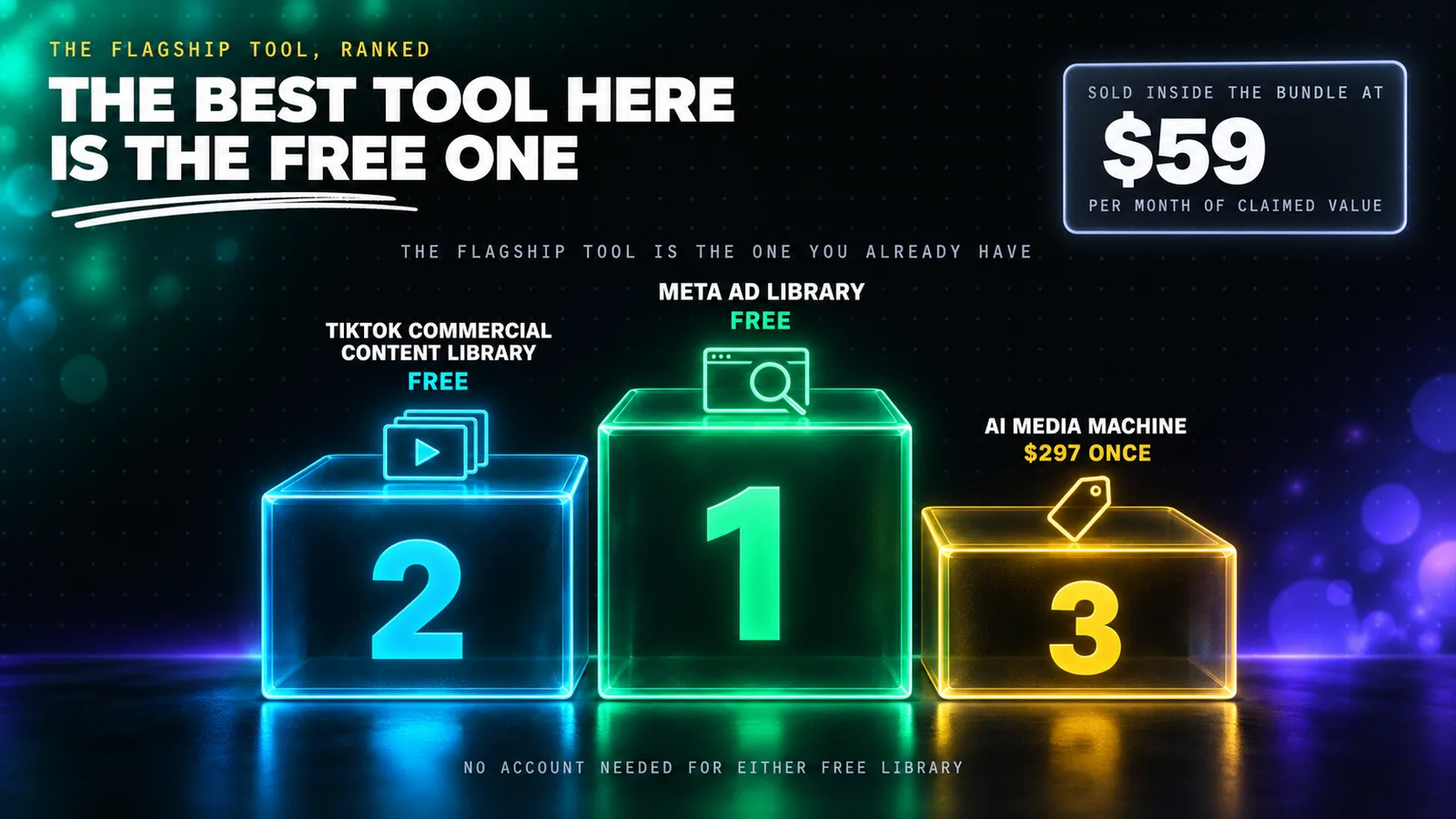
Against free tools, the flagship loses outright. The Winning Ads Finder is valued on the page at $59 a month. It searches Facebook and TikTok advertisements currently running.
Meta's Ad Library is free, public, requires no account, covers every active advertisement across Facebook and Instagram, and has an API. TikTok's Commercial Content Library is also free and needs no account. The single most expensive line item in the bundle duplicates two databases that the platforms are legally obliged to publish.
What you lose by going free is convenience, not access. The paid version adds a one click handoff into the analyser, which is real but is not a $59 a month feature.
Against a monthly stack, the arithmetic depends entirely on your usage. The two categories worth pricing properly are avatar video and synthetic voice, because those are the metered ones, and both have incumbents that publish their rates.
HeyGen is the closest comparison, and the numbers line up almost too neatly. Its Creator plan costs $29 a month and includes 600 credits, the identical monthly allowance quoted here, checked on both pricing pages on 12 September 2026.
Against HeyGen Creator alone, $297 once breaks even at roughly ten months. Credits are not interchangeable between platforms, so treat that as a sense of scale rather than a like for like swap, but it is the fairest single benchmark available.
ElevenLabs prices voice separately: a free tier with 10,000 credits a month and no commercial rights, then Starter at $6 a month for 30,000 credits with commercial use included. Voice is the cheapest thing in this bundle to replace.
So if you already pay HeyGen and ElevenLabs and expect to keep paying for two years, $297 once is straightforwardly cheaper. If you rent nothing today, $297 is $297.
Against the vendor's own monthly offer, the lifetime route wins if you stay past eight months. At $37 a month the subscription passes $297 somewhere in month nine, so anyone confident they will still be using this in a year should take the one time payment.
For the video generation piece specifically, the quality question is separate from the price question, and I have written up how the current models compare in my notes on which AI video generator is worth using for what.
The one honest argument for buying AI Media Machine
Everything above is critical, so the case for buying deserves stating as strongly as it can honestly be put.
The argument is fixed cost against a variable workload. Generative video pricing punishes bursts. Every metered tool charges per render, so the month you produce forty variations for a campaign is the month your bill triples.
A one time payment with a monthly credit refresh inverts that. Your worst month costs the same as your best month, which is a genuinely different risk profile from per credit pricing.
That matters to one specific person: someone running paid video advertising at volume, whose costs today scale with how much they experiment.
For that person, 600 credits a month forever at $297 is defensible, because the marginal cost of the hundredth test being zero changes how much you are willing to try.
So the honest buy case is bulk creative testing at a flat cost, for someone who already spends on ads and would otherwise pay per render.Everyone else is being sold a solution to a problem they do not have yet, by a timer that is not counting anything.
Free AI Media Machine alternatives worth trying first
Before spending $297, spend an afternoon establishing whether you would use any of this. Every category in the bundle has a free entry point.
- Competitor ad research: Meta Ad Library and TikTok's Commercial Content Library. Both free, both need no account, and between them they cover the flagship feature of the paid product.
- Synthetic voice: ElevenLabs gives 10,000 credits a month free, which is plenty to decide whether synthetic narration suits your content. Note the free tier carries no commercial rights, so publishing means the $6 Starter plan.
- Avatar video: HeyGen has a free plan of three videos a month at up to one minute each. That is enough to learn whether a synthetic presenter fits your brand before committing to $297.
- Video generation: the frontier model providers all offer limited free generation, and output quality is better judged on their own tiers than through a reseller.
- Thumbnails, logos and layout: Canva covers all three on its free plan and will beat a text prompt for anything brand critical, because you can position things exactly.
- Scripts and repurposing: a general purpose chat model handles script drafting and turning one video into captions and posts without a dedicated tool.
Run that stack for two weeks. If you find yourself hitting free limits constantly and genuinely wanting more renders, the paid bundle has a real case. If you produced three videos and stopped, you have saved $297.
How to judge any AI video lifetime deal in ten minutes
This article is about one product, but the method transfers, and the AI video lifetime deal category is now large enough that you will meet another next month. Four checks, no purchase required.
Open the page source and search for the timer. If the countdown is built from localStorage or a fixed offset rather than a date, the urgency is decorative. Search the file for localStorage and for setInterval.
Put the URL through the Wayback Machine. If the same price sits behind the same closing soon language across snapshots a year apart, the deadline is a fixture. This is the single highest yield check and it takes ninety seconds.
Find what the credits actually buy. Look for one shared pool behind several per tool numbers. If the tool specific limits cannot all be true at once, they are alternatives.
Read the terms and check whether they mention the product. A lifetime licence to hosted software governed by terms describing downloads is a contract written for a different business.
None of those four checks tells you whether the software is any good. They tell you whether the people selling it are being straight about the offer, which is a different and often more useful question.
Who AI Media Machine is for, and who should skip it
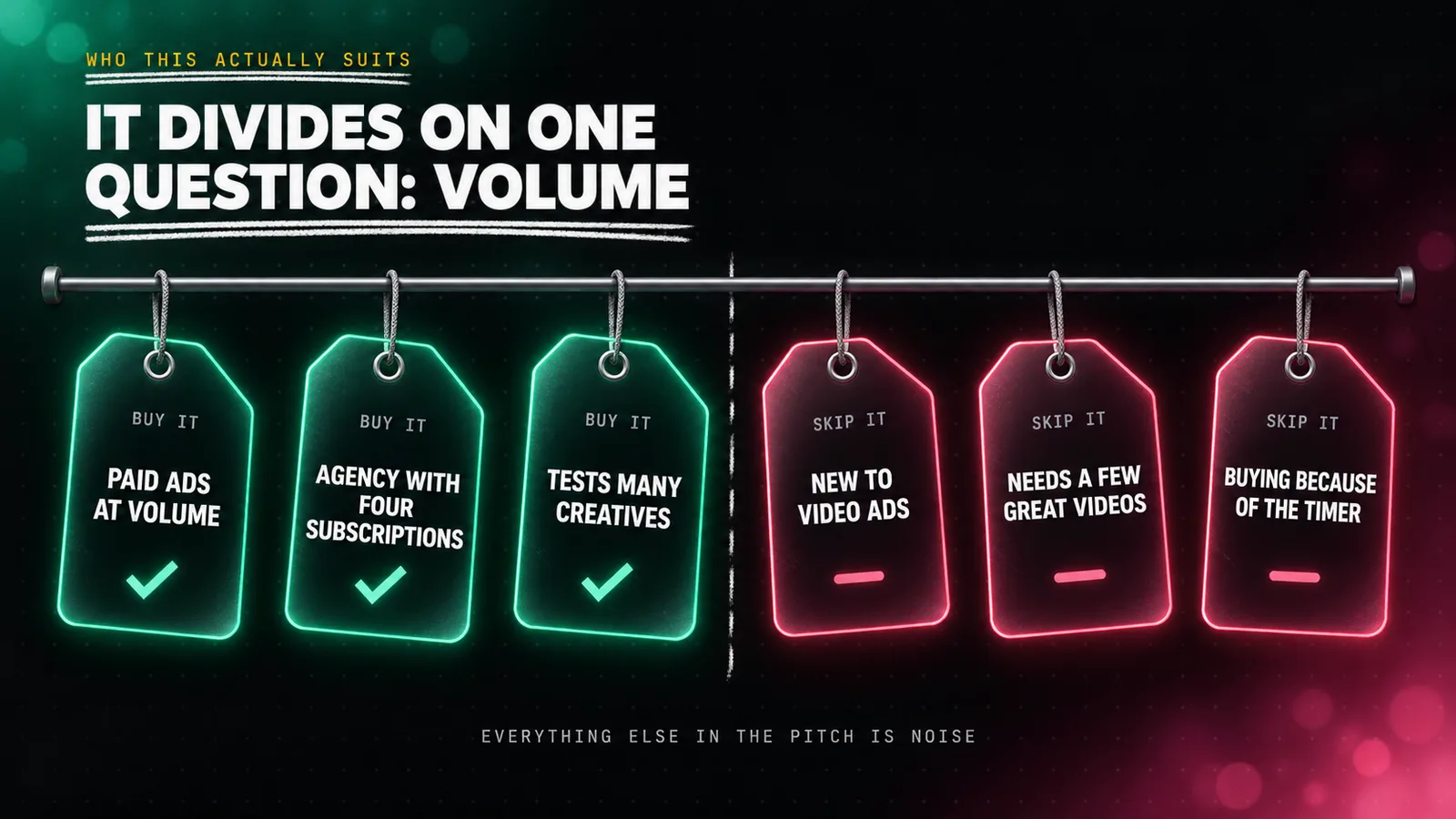
Buy it if you already run paid video advertising, you currently pay monthly for avatar video, synthetic voice or generative video, and you produce enough creative variations that per render pricing hurts. The flat cost genuinely suits that pattern.
Buy it if you are an agency or freelancer producing volume short form video for clients, you value one login over four subscriptions, and you will use a client's voice only with written permission.
Skip it if you are new to this. The bundle assumes you already know what a hook is, why an advertisement converts, and what you are selling. The preloaded affiliate products exist to paper over that gap and they will not.
Skip it if your requirement is a small number of high quality videos rather than a large number of test variations. Bulk capacity is the entire value proposition and you would be paying for throughput you do not need.
Skip it if the timer is why you are considering it. That is the clearest signal in this review: the one reason the page gives you to hurry is the one thing I can prove is untrue.
And skip it if you need contractual certainty about what you are buying. The lifetime promise is not covered by any document on the site, which may be fine for $297 and is not fine if you are building a business process on it.
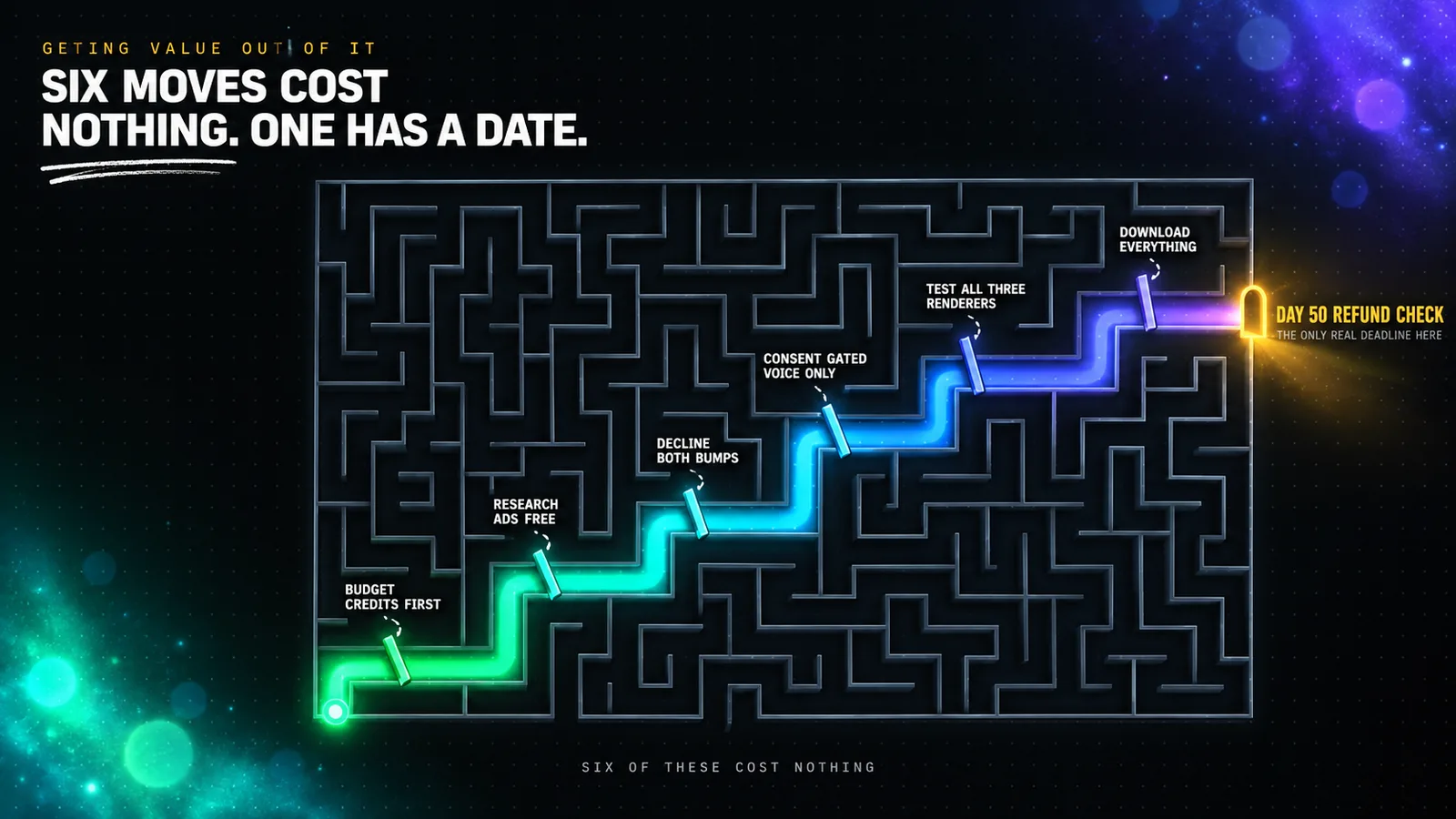
Getting better results out of AI Media Machine
If you do buy, these are the decisions that matter, drawn from the documentation and the funnel rather than the onboarding.
Budget your credits before your first session. Decide in advance whether this is an avatar month or a cinematographer month, because the pool is shared and the tool that renders long video will empty it fastest.
Do the ad research free and bring it in. Use Meta's Ad Library and TikTok's library to find the advertisement you want to study, then spend credits only on the analysis and the rebuild. That preserves the metered budget for the metered work.
Decline both order bumps on the first pass. The template pack and music library are legacy assets you can evaluate later, and adding $104 to a purchase you are still testing weakens the refund decision.
Clone only your own voice, or one you have permission for in writing. Treat the marketing line about anyone's voice as if it were not there.
Diarise day fifty. The real window is sixty days, and a reminder at fifty gives you ten days to decide with the product in front of you rather than the sales page.
Check the output before you scale. Render one video in each of the three metered tools in the first week, so you learn the actual quality ceiling while you still have most of the refund window left.
Keep your own copies of everything. A lifetime licence with no contract behind it is a reason to download finished assets rather than treat the platform as storage.
AI Media Machine refund policy: 30 days or 60?
The buyer gets sixty days. The sales page says thirty, five separate times, but the vendor's own Terms of Service and the ClickBank checkout both state sixty, and the checkout is the document that binds at the point of sale. This is the rare case where the small print is better than the advertising.
Here is each source, with what it says and when I read it on 12 September 2026.
- The sales page: 100 percent money back guarantee, full refund within 30 days. Repeated beneath every buy button.
- The vendor's Terms of Service: Refund Policy: 60 Day money back guarantee, followed by a promise to refund right away on an email within sixty days.
- The ClickBank order form for this product: ClickBank will allow for the return or replacement of any product within 60 days from the date of purchase.
- The earnings disclaimer: points the reader to the refund policy in the terms, which is the sixty day one.
ClickBank's own contract with sellers permits a window anywhere from no refunds up to sixty days, so a seller can shorten it. This one has not. Three of the four sources say sixty and the outlier is the marketing copy.
Why a vendor would advertise half the protection it offers, I cannot say. It is the only claim on the page that understates the deal rather than overstating it.
Practically: ClickBank is the retailer, so a refund request goes to ClickBank order support using the order number from your receipt email, not to the vendor's inbox. Your bank statement will read CLKBANK*AIMediaMachine, which is how you will find the charge.
So if you have decided to buy it, buy it in this order.
- Ignore the countdown entirely. You now know what it is counting. Close the tab, think for a day, and come back to the same $297.
- Screenshot the offer page before you pay, including the tool list and the credit allowance, because this funnel has already been rebuilt once this year.
- Take the front end only from the official AI Media Machine page and untick both order bumps. You can buy templates later, and you cannot unbuy them today.
- Keep the receipt email. The ClickBank order number in it is the only thing that makes a refund quick.
- Set a reminder for day fifty, not day twenty five. The window is sixty days whatever the sales page says.
- Spend the first week testing the metered tools, so that by day fifty you are deciding on output you have seen rather than on a feature list.
That sequence costs nothing and converts the single genuinely good thing about this offer, a sixty day exit, into actual protection rather than a line of copy.
AI Media Machine review: the final verdict
AI Media Machine is a real bundle of working AI tools sold behind marketing that does not survive ten minutes of checking. The software is not the problem. The page is.
The product exists, the company has traded since 2008, the founder is named, the payment runs through ClickBank and the guarantee is genuine and twice as long as advertised. Nobody is going to take your money and vanish.
Against that: a countdown whose own source code admits it was built to look convincing, a price unmoved since April 2024 behind two different expiry stories, a lifetime promise no contract covers, a dead privacy link, one credit pool presented as four allowances, and a second page selling the same product at $37 a month while contradicting the competitor prices that justify the deal.
So the verdict is narrow rather than flat. If you run paid video advertising at volume and pay per render today, $297 once for 600 monthly credits is a defensible purchase with a real sixty day exit. Take it, decline both bumps, and set a reminder for day fifty.
If that is not you, the flagship tool in the bundle is free from Meta and TikTok, and the rest is capacity you have not yet proven you need. Spend a fortnight on free tiers first.
And if the countdown is the reason you are reading this, that is the one thing here I can prove is untrue. Close the tab, come back in two days, and the price will be $297.
Whichever way you go, check the current offer on the official AI Media Machine page, because this funnel has been rebuilt once already this year and the figures above carry the date I read them. The ClickBank checkout pattern is the same one I mapped on an earlier review, so the bumps will look familiar.
This review sits in my Creator Tools section, where I check sales page claims against the vendor's own documentation before anyone spends. The pattern held again here, in the most literal way yet. The truth was in the page the whole time, four lines below the headline, in a file nobody was expected to open.
FAQ
- Is the AI Media Machine countdown timer real?
- No. The timer is built by JavaScript running inside your own browser. It sets a deadline of twenty one minutes and forty seven seconds from the moment you open the page, saves it to your browser's local storage, hides itself for twenty four hours once it expires, then issues a fresh window. The page says the price rises when the timer ends. Nothing in the code raises any price.
- How much does AI Media Machine cost in total?
- The main offer is $297 one time, shown as reduced from $997. At the ClickBank checkout there are two order bumps, a video template pack at $67 and a music pack at $37. A resale bundle upsell at $99 follows the purchase. Take everything and the cart reaches $500, which is the figure the vendor's own affiliate page quotes as a full cart.
- Is AI Media Machine a one time payment or a subscription?
- Both, depending which of the vendor's pages you land on. The ClickBank funnel sells it as $297 once with the words no subscription, ever. A second page on the same domain sells the same product for $1 up front and then $37 every month, described as a founding member rate. Both offers were live on 12 September 2026.
- What is the AI Media Machine refund window, 30 or 60 days?
- The sales page says thirty days, five separate times. The vendor's own linked Terms of Service says sixty, and the ClickBank checkout for this product states that ClickBank allows a return or replacement within sixty days of purchase. The window that binds is the one shown at checkout, so buyers get sixty days. ClickBank permits sellers anywhere from no refunds up to sixty.
- How many videos do the 600 monthly credits actually make?
- Around one hundred short videos in total, not per tool. The pricing block lists roughly one hundred cinematographer videos, twenty avatar videos, twenty script to video creations and fifty thumbnails as four separate ticked lines, but every one of them draws from the same pool of 600 credits. They are alternatives, so spending credits on avatars leaves fewer for everything else.
- Is AI Media Machine legit or a scam?
- It is a real product from a real company. BlueFx has traded since 2008, the founder is named and traceable, ClickBank handles the payment and the sixty day guarantee is genuine. The problem is not existence, it is the marketing around it: a fabricated countdown, a price frozen since 2024 behind rotating excuses, and a lifetime promise that no document on the site actually covers.
- What does AI Media Machine cost from India?
- The ClickBank order form rendered for India on 12 September 2026 showed Rs 31,696.49 plus Rs 5,705.37 of GST, totalling Rs 37,401.86. That implies a conversion rate of about 106.7 rupees to the dollar against a market rate near 95.6 the same day. The delivered cost works out around $391 for a product advertised at $297.
- Can I really clone anyone's voice with AI Media Machine?
- The sales page says you can clone your voice, a client's voice, or anyone's. Technically the feature exists. Legally that invitation is the buyer's risk, not the vendor's, because voice likeness is protected by right of publicity law in many jurisdictions and by newer statutes aimed specifically at synthetic voice. Clone your own voice, or one you hold written permission for, and nothing else.