note
Affiliate disclosure: this review contains affiliate links to Speechelo. If you buy through one, I earn a commission at no extra cost to you.
Nobody paid for this review, I was not given a free copy, and nothing critical below was softened for the commission. How I handle affiliate links is covered in the disclaimer.
Speechelo sells itself as a $47, one-time AI voice generator that turns any script into a human-sounding voiceover. I went looking for the catch and found it in the vendor's own help desk, three clicks from the sales page.
The article that gave it away answers a question no marketing page ever volunteers: can we use the generated voiceovers for commercial purposes?
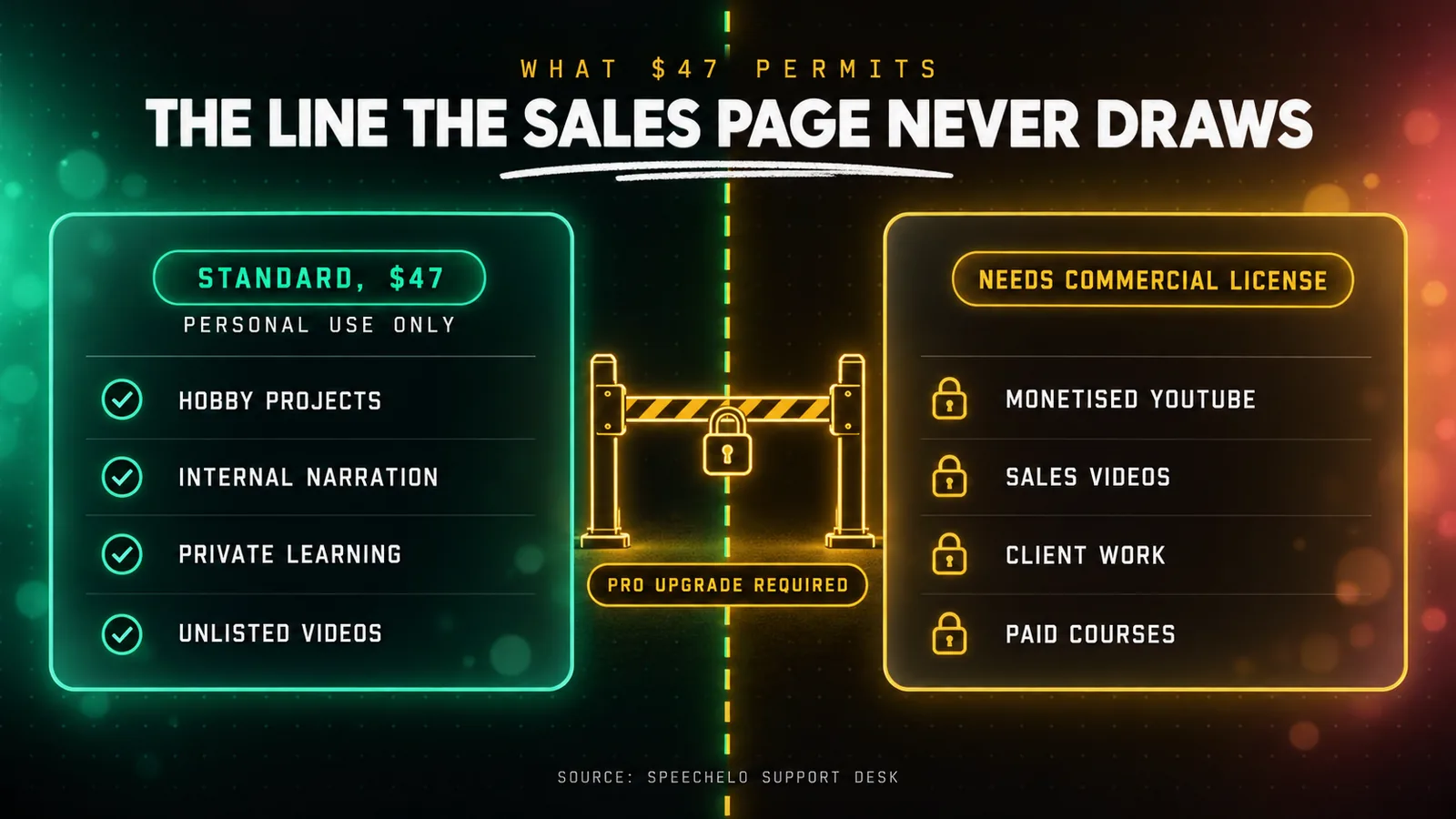
The answer, in Speechelo's own words, is that the standard version gives you personal usage rights only. The commercial license sits behind the Pro upgrade.
That one line reframes the entire offer. Almost everything Speechelo is sold for is commercial use: monetised YouTube videos, sales videos, client work, paid courses.
So the honest headline is not "$47 for unlimited AI voiceovers". It is "$47 for unlimited AI voiceovers you are not licensed to earn money from."
This Speechelo review works through the rest of the offer the same way: sales page claim on one side, the vendor's own documentation and buyer evidence on the other.
Is Speechelo worth it in 2026? The short answer
Here is the verdict before the sections that justify it.
Speechelo is worth buying if you need a large volume of adequate voiceover at a flat, one-time price, you are producing narration where "clear and understandable" beats "indistinguishable from a human", and you buy the Pro tier because you intend to monetise.
It is not worth buying if you are choosing a voice for anything where the voice itself is the product. Sales videos, podcasts, brand ads, client work with a quality bar. Modern AI voices left this engine behind, and the gap is audible in the first sentence.
And it is the wrong purchase entirely if you are buying the $47 tier expecting to make money from the audio, because the $47 standard license does not permit commercial use.
The product is real, the company is real, and the 60-day ClickBank guarantee is real. The marketing around all three is louder than they deserve.
Speechelo at a glance
The specification, gathered from the sales page and the vendor's support documentation rather than from other reviews.
- Price: $47 one time for the standard version, stated as 53% off a $97 regular price.
- Voices: over 30 in standard, 171 in Pro.
- Languages: English plus 23 others, so 24 in total.
- Length per voiceover: 700 words standard, 2,800 words Pro.
- Monthly volume cap: 500,000 characters per rolling 30 days on standard, 700,000 on Pro.
- Tones: normal, joyful and serious, with adjustable speed and pitch, plus optional breathing sounds and longer pauses.
- Output: MP3 download.
- License: personal use on standard, commercial use on Pro.
- API: none. The support desk says there is no integration and no timeline for one.
- Guarantee: 60 days, handled through ClickBank.
Read that list next to the sales page and the gaps announce themselves. Three of those ten lines appear nowhere in the marketing: the volume cap, the missing API, and the fact that the standard license covers personal use only.
Speechelo pros and cons
The balance sheet, drawn from the evidence in the rest of this review rather than from the sales page.
What Speechelo gets right:
- A genuine one-time price. No subscription, which is increasingly rare among AI voiceover tools.
- Unusually high volume for the money. 500,000 characters a month is roughly nine hours of finished audio.
- Almost no learning curve. Paste, pick, generate. Most buyers produce something usable in their first session.
- Breadth at the base tier. Over 30 voices across 24 languages, plus tone, speed and pitch controls.
- A refund route that works. 60 days, administered by ClickBank rather than by the vendor's goodwill.
- A real company behind it. An established product line and a support desk that publishes straight answers.
What Speechelo gets wrong:
- The $47 tier is personal use only. Commercial work needs the Pro upgrade, and the sales page does not say so.
- The voices are audibly synthetic. Current models from ElevenLabs and Murf are in a different class.
- A 700-word ceiling per voiceover. Long-form narration has to be generated in pieces and stitched.
- An undocumented 500,000-character monthly cap. Exceed it and the account is blocked until the window resets.
- No API, no voice cloning, MP3 only. Nothing here fits into an automated pipeline.
- A Trustpilot score of 1.6 out of 5. Misleading marketing is the single most common complaint.
- An upgrade page that invites accidents. Monthly and one-time Pro options sit side by side.
How I researched this Speechelo review
I have not spent six months producing client voiceovers in Speechelo, and reviews that pretend otherwise are the reason this whole category feels untrustworthy.
What I did instead is what I do before any tool gets near real work: check every claim against something the vendor did not write to sell you.
That meant reading the sales page line by line, then reading the vendor's own support knowledge base, where the answers are written for existing customers rather than prospects and are consequently far more honest.
It meant reading the full run of buyer reviews on Trustpilot, including the positive ones, and pricing the 2026 alternatives properly rather than against 2020 competitors.
It is the same method I used on Paying Social Media Jobs, where the vendor's own earnings disclaimer contradicted the headline on its own landing page.
It is also the standing method for every review in Creator Tools, where sales page claims get checked against the vendor's own paperwork before anyone spends.
Where something below is a first-hand pattern reported by buyers, I say so. Where it is a claim I could not independently verify, I flag that too.
What Speechelo actually is
Speechelo is a browser-based text-to-speech (TTS) tool, sold as AI voiceover software, that turns typed text into an MP3 voiceover. It is built for video creators rather than developers.
You paste a script, pick a voice and a language, choose a tone, and it returns an audio file. There is no timeline, no editor, and no video component. It makes narration and nothing else.
The pitch that made it sell is the inflection layer. Speechelo's support desk describes it as a custom engine that adds real inflections on top of the underlying voices, which is how it justifies the price against raw cloud text to speech.
That layer produces the breathing sounds, the pauses, and the joyful or serious tone settings. In 2020 it was a genuine differentiator.
Who makes Speechelo
The vendor is Vlad and Stoica, the pair behind the Blaster Suite product line: Video Marketing Blaster, Thumbnail Blaster, Lingo Blaster, Videly.
This matters. They are not an anonymous launch account. There is a company, a support desk with a real knowledge base, and a product line that has been selling for years.
Speechelo itself has been on the market since around 2020, which puts it in an unusual position for an AI product: it is six years old in a field that reinvented itself twice in that time.
That age explains most of the criticism it receives. It is not that Speechelo got worse. It is that everything around it got dramatically better while its voice roster largely did not.
How the Speechelo workflow actually goes
The three-step flow the marketing describes is accurate, and simplicity is genuinely the product's strongest feature.
Step one: paste the text. Up to 700 words on the standard tier. The editor takes plain text and reads punctuation as timing instructions.
Step two: pick the voice and tone. Choose a language, a voice from the roster, and one of normal, joyful or serious. Adjust speed and pitch if the default reading is off.
Step three: generate and download. Rendering takes a few seconds, you preview it in the browser, and you download an MP3.
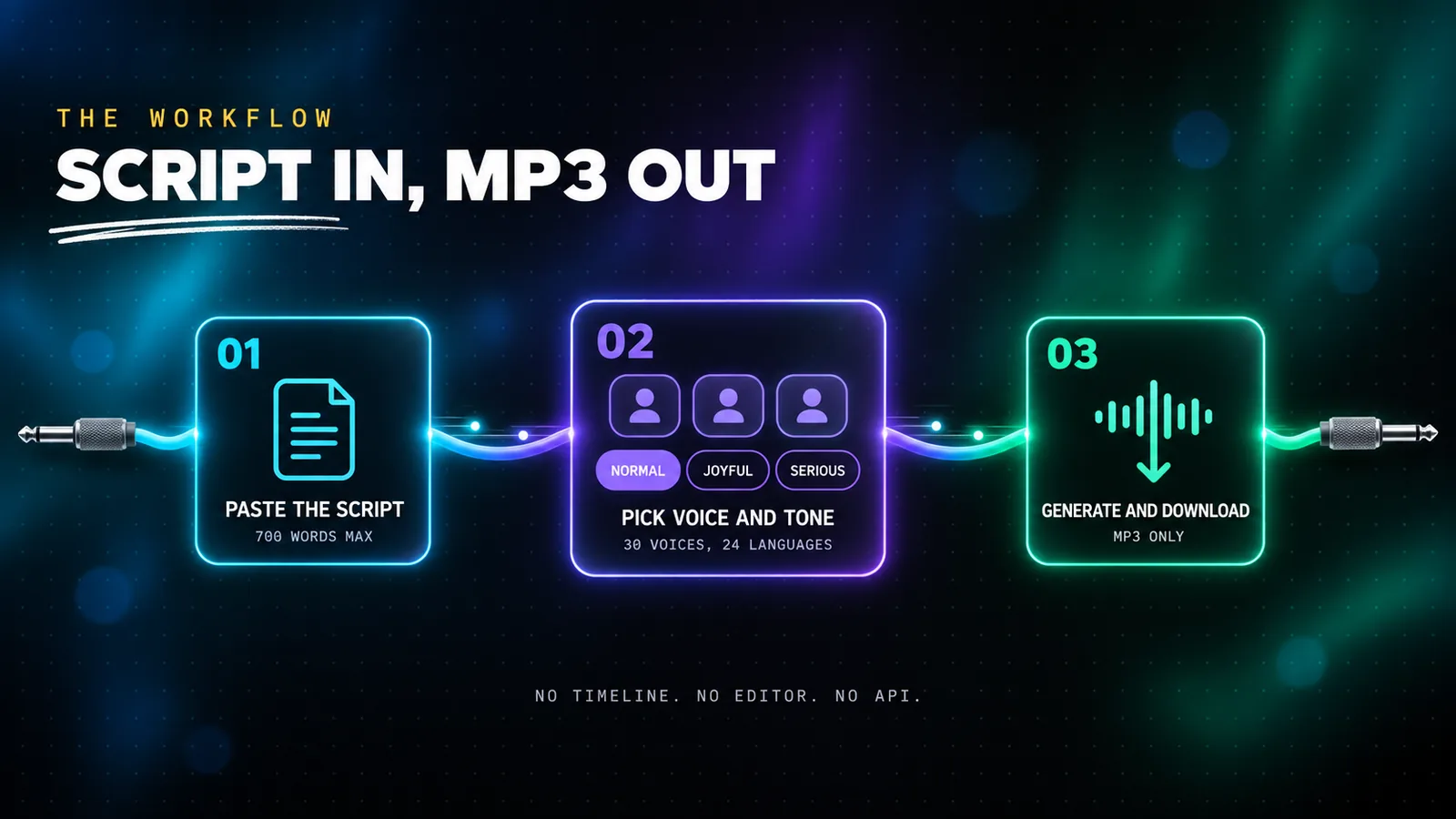
There is nothing to learn. If you can use a contact form, you can use Speechelo, and buyers who like it consistently name that as the reason.
The flip side is that there is nothing to grow into either. No pronunciation dictionary beyond spelling tricks, no voice cloning, no multi-speaker timeline, no API.
The Speechelo commercial license catch: what $47 actually permits
This is the section I would want to read before spending anything, so it goes before the pricing breakdown rather than after it.
Speechelo's support article titled Can we use the generated voiceovers for commercial purposes? answers plainly: the standard version gives you personal usage rights only, and the commercial license requires the PRO upgrade.
The Pro upgrade page confirms it from the other direction. Its commercial license bullet promises you can sell the voiceovers and keep all the money and all the profits, which is only a selling point if the tier below it cannot.
heads up
Read this before you buy the front end alone. If your voiceovers will appear on a monetised channel, in a sales video, in a paid course, or in anything you deliver to a client, the $47 standard license does not cover it. That is the vendor's own position, published on their own support desk, not my interpretation.
Now hold that against the marketing. The sales page and the affiliate pages promoting it lean on exactly those use cases: YouTube videos, sales videos, training courses, ads.
None of that is licensed at $47. The offer is technically accurate and practically misleading, which is a description that fits most of this product's marketing.
To be fair to the vendor, this structure is not unusual. Stock audio, font foundries and image libraries all split personal and commercial licensing the same way.
What earns the criticism is where each half of that split gets published. The restriction sits in a support article written for existing customers.
The commercial promises sit on the page taking your money.
There is one more wrinkle worth knowing. The support desk has a separate article on whether they provide a certificate or PDF for commercial license holders, which tells you the question comes up often enough to need a standing answer.
Speechelo pricing: the real number, not the headline
With the license understood, the pricing becomes readable. Here is the ladder as it stood when I checked the vendor's own pages in September 2026.
Standard, $47 one time. Over 30 voices, 24 languages, 700 words per voiceover, 500,000 characters per 30 days, MP3 export, personal use only.
Speechelo Pro. Offered on Speechelo's own upgrade page at $37 a month or $97 one time, down from a stated $237. It brings 171 voices, 2,800 words per voiceover, 700,000 characters per 30 days, a dialogue mode for multi-voice scripts, 40 background music tracks, and the commercial license.
Scriptelo, reported at $37 one time. A script-writing add-on. I could not verify this one from a vendor page, so treat the figure as reported rather than confirmed.
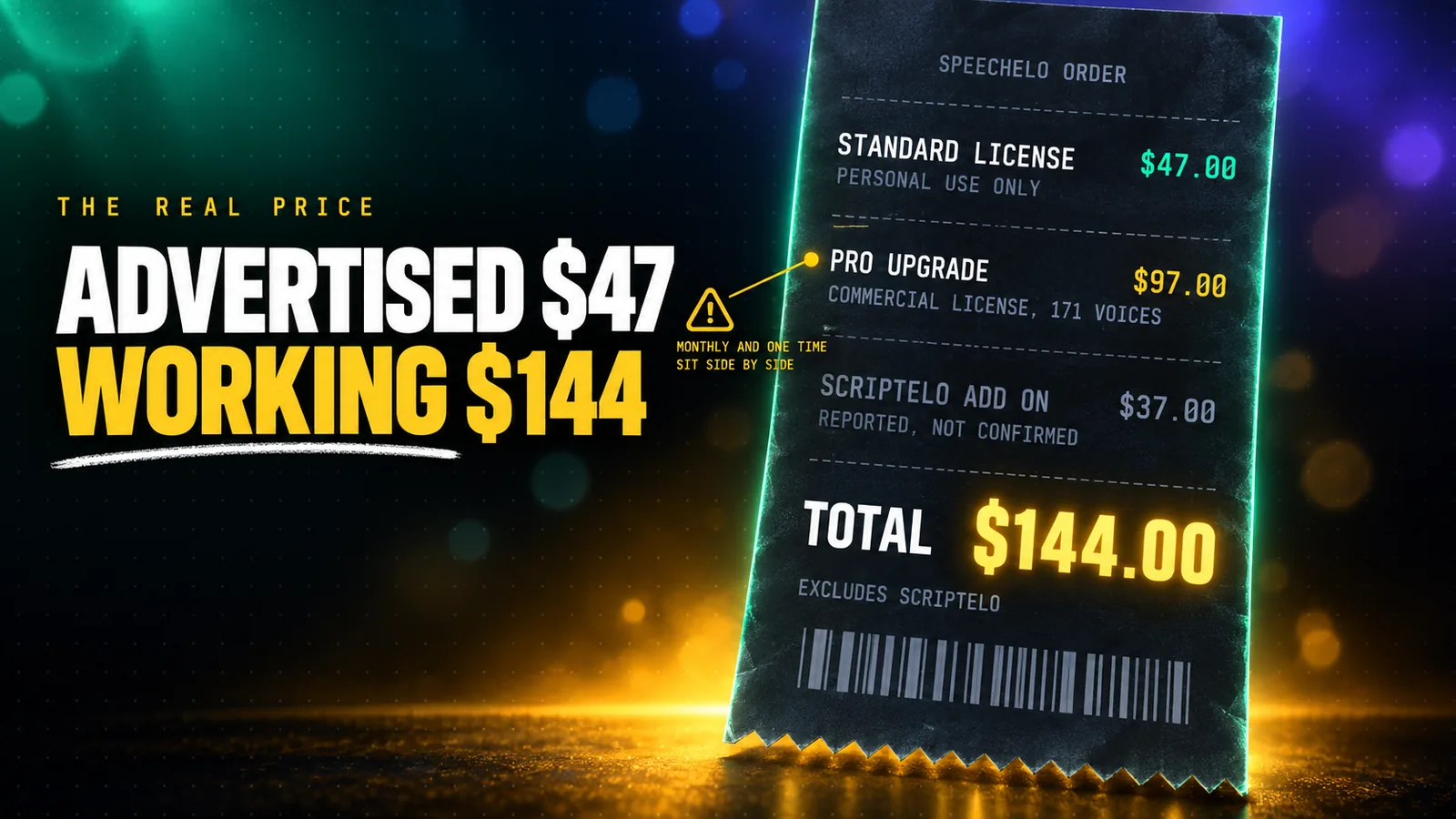
So the number that matters is this: a creator who intends to earn money from the audio pays $144 one time, not $47. That is the honest comparison figure for everything later in this review.
Two notes on the Pro page that deserve flagging.
First, it shows the recurring and one-time options side by side on the same screen. Buyer complaints about being charged monthly after expecting a single payment are the predictable result. Read the button before you click it.
Second, older reviews report Pro at $47 a quarter or $127 one time. Those are not errors. They are previous versions of the same offer.
Checkout terms on this product have changed more than once, so verify the current price on the official Speechelo page rather than trusting any review, including this one.
The Speechelo word limit and character cap nobody advertises
Four hard constraints shape what Speechelo can be used for, and only the first of them appears in the marketing.
700 words per voiceover on standard. This is the Speechelo word limit most buyers meet first, and it works out at roughly four to five minutes of speech. A 20-minute training video means generating and stitching four or five separate files. Pro raises it to 2,800 words, around 18 minutes.
500,000 characters per rolling 30 days. This is the one the sales page never mentions. The vendor's support article on monthly character limits puts it directly: generate more than half a million characters in 30 days and their system will block you until the window resets. Pro raises it to 700,000.
No API. A support article on API integration confirms there is none, and gives no timeline for one. Every voiceover is produced by hand in a browser, so there is no way to script a batch of 200 clips.
MP3 only. No WAV, no per-sentence stems, no timed transcript. For a video editor syncing narration to cuts, that last omission is a real workflow cost.
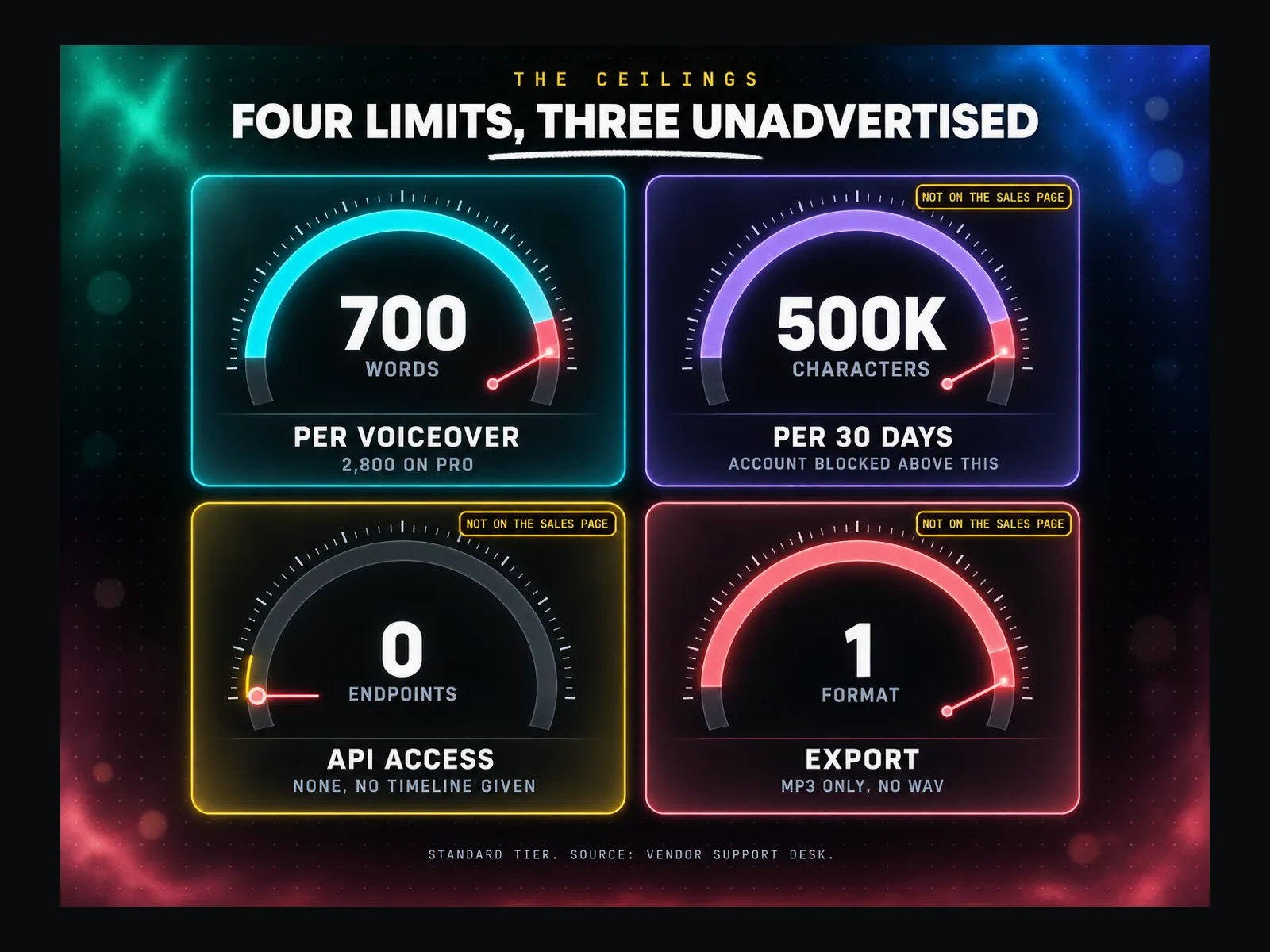
None of these make the tool useless. They do define its lane precisely: short to medium narration, made by hand, in moderate volume.
Worth saying clearly: half a million characters a month is not stingy. It is around 83,000 words, or roughly nine hours of finished audio.
The problem is not the size of the cap. It is that a cap exists at all on a page selling the word unlimited.
Speechelo voice quality: how good do the voices actually sound?
This is the question the whole purchase turns on, and it is the one where honesty costs the most.
The sales page calls the output human-sounding and claims 98% of people hearing a Speechelo voiceover cannot tell it is not a real human. It guarantees a refund if you can tell the voice is AI generated.
No methodology is published for that 98%. No sample size, no test design, no date. It is a marketing number, and the guarantee attached to it is subjective enough to be unenforceable in either direction.
Here is what the evidence actually supports. An independent hands-on test scored Speechelo voice quality at roughly 6 out of 10, calling it fine for training videos and simple projects but no match for ElevenLabs or Murf on natural delivery.
Buyer reviews are blunter. The recurring complaint on Trustpilot is that the voices sound barely better than a regular screen reader and struggle to carry emotion or nuance.
My read, weighing both: Speechelo produces competent, clearly intelligible narration that a listener will identify as synthetic within a sentence or two. That is not a scam. It is a 2020 product being measured by 2026 ears.
Why the gap opened
The inflection layer that made Speechelo impressive was a clever wrapper around the neural voices available at the time. The vendor's own support desk still keeps an article comparing the result to Amazon Polly, which tells you what these voices were benchmarked against.
Then the ground moved. Modern models generate emotion, pacing and emphasis as part of the speech itself rather than bolting rules on afterwards.
Once that happened, a rules-based inflection layer stopped being an advantage and became a ceiling. You can hear the seams: the joyful tone reads as faster and higher rather than actually cheerful.
Where it holds up and where it does not
It holds up for internal training narration, faceless documentary-style channels, e-learning modules, software walkthroughs and slideshow voiceover, where clarity matters and the voice is a delivery mechanism.
It falls apart for sales videos, brand advertising, podcasts, character work and anything read to an audience that is judging the speaker. The listener's attention lands on the voice, and the voice will not survive it.
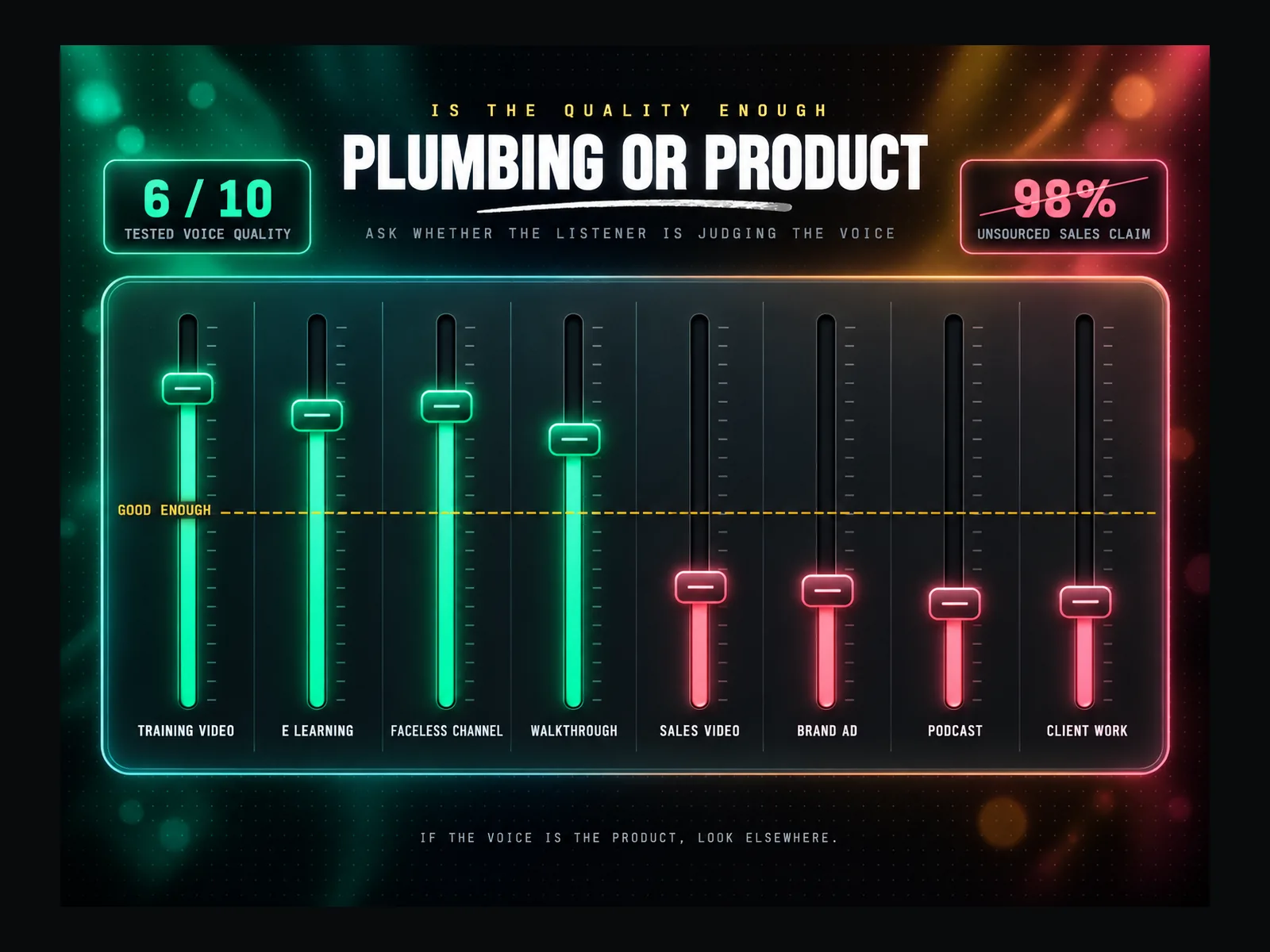
The rule I would apply: if the voice is the plumbing, Speechelo is fine. If the voice is the product, it is not.
Is Speechelo legit? What real buyers say
Yes, Speechelo is legit in the sense that matters. It is a real product from a registered company, it delivers working software, and ClickBank refunds buyers who ask inside the window.
It is also, on the evidence below, badly advertised. Those two things are not in conflict, and confusing them is why the word scam gets thrown around this product so often.
Speechelo's Trustpilot profile makes for uncomfortable reading. When I checked in September 2026 it stood at 1.6 out of 5 across 247 reviews, with 56% at one star and 22% at five.
That is a far worse picture than the InstaDoodle review turned up on the same kind of product, and the contrast is instructive.
Before treating it as a verdict, the fair caveat: Trustpilot skews negative for one-time purchases. Satisfied buyers of a $47 tool rarely write about it, while anyone who felt misled has a strong reason to.
But 247 reviews is a substantial sample, and the complaints are patterned rather than chaotic, which is what makes them worth reading.
The recurring complaints:
- Misleading marketing. Buyers report features advertised at the front-end price that turned out to need further purchases. The license split is the sharpest example.
- Robotic voices. The most common single criticism, and the one this review has already confirmed independently.
- Billing surprises. Buyers who believed they had bought Pro outright and found a recurring charge. The side-by-side pricing options on the upgrade page explain how that happens.
- A stale product. One reviewer described years of ownership with no meaningful improvement. Given how much text to speech advanced in that period, standing still is its own kind of decline.
- Slow vendor support on refunds. Reports of unanswered emails and delays.
The positive reviews, thin as they are, cluster on two things: support that resolved problems eventually, and software that was adequate for its price once expectations were set correctly.
Notice what is absent. Almost nobody says they paid and received nothing. The product exists, it works, and the money buys a functioning tool.
The anger is about the distance between what buyers thought they were purchasing and what the license and the voices actually delivered. That is a marketing failure, and it is fixable on your side of the screen by reading this far.
Speechelo vs ElevenLabs vs Murf
The decision almost always comes down to Speechelo against one of the modern subscription tools, so here it is stripped to what differs.
Speechelo is the flat-fee bulk option. One-time pricing, 30 voices standard and 171 on Pro, 24 languages, mid-tier quality, no API, generous monthly volume, personal use only until you buy Pro.
ElevenLabs is the quality pick. Its current models handle emotion, emphasis and pacing convincingly. There is a genuinely usable free tier at 10,000 credits a month, and commercial rights begin on the $6 Starter plan at 30,000 credits.
Murf is the production pick, starting around $23 a month. It is aimed at teams that need a shared workspace, voice consistency across a project and collaboration, rather than a single MP3.
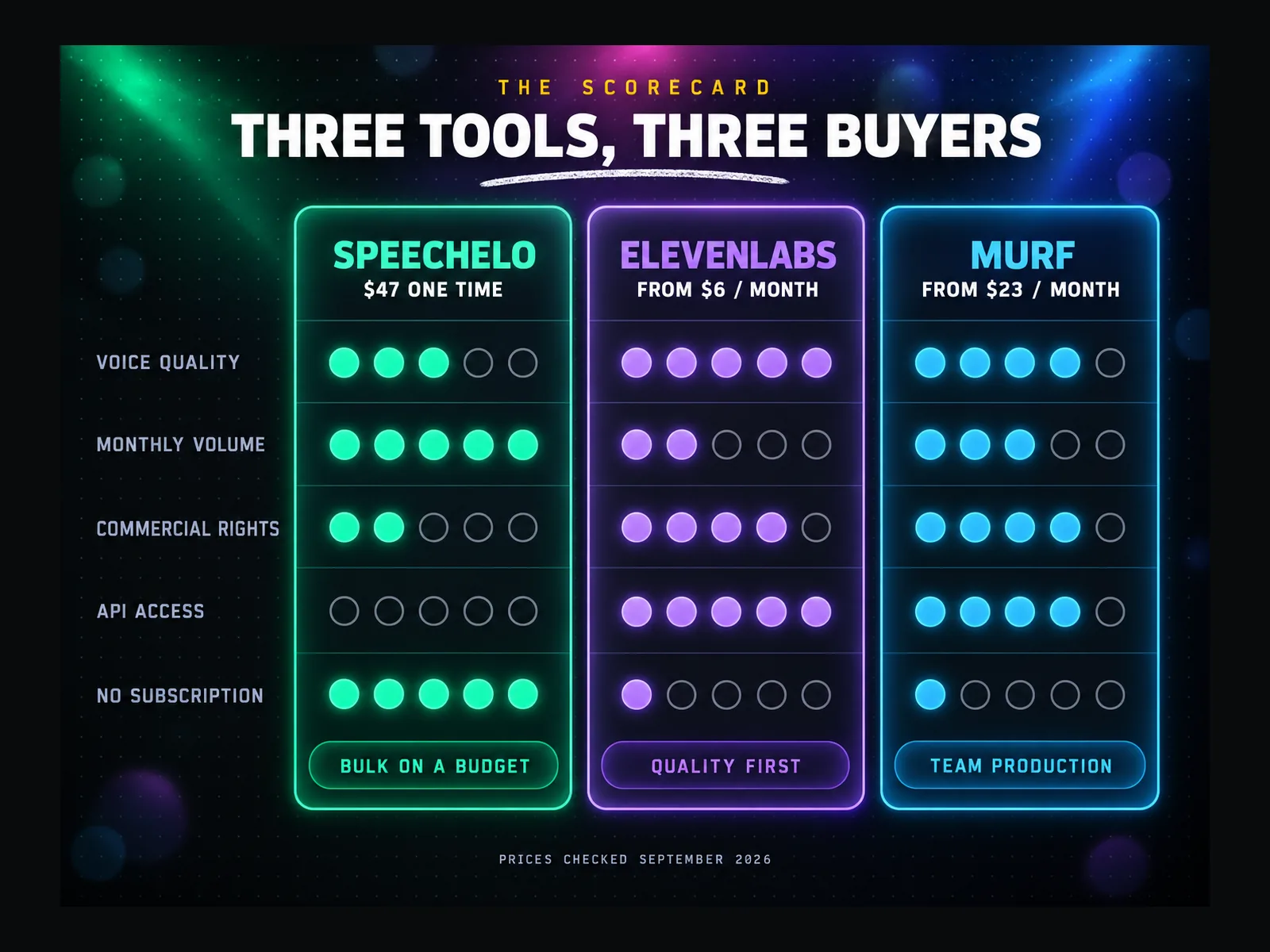
The three questions that settle it:
Is the voice the product? If a listener is judging the speaker, take ElevenLabs and stop reading here. No price advantage compensates for a voice the audience notices.
How much audio per month? This is the one axis where Speechelo genuinely wins, and it wins by a distance. The arithmetic is below.
Do you need it to fit in a pipeline? If yes, Speechelo is out. No API means no automation, ever.
The one argument that still works: volume per dollar
Run the numbers, because this is where Speechelo stops looking obsolete and starts looking like a specific tool for a specific buyer.
Speechelo standard allows 500,000 characters per 30 days. At roughly six characters per word that is about 83,000 words, and at a normal narration pace of 150 words per minute that is close to nine hours of finished audio every month.
ElevenLabs Starter at $6 a month gives 30,000 credits, which is around 5,000 words, or roughly half an hour of audio.
So on entry tiers, Speechelo permits something in the region of seventeen times the monthly output. That is not a rounding difference, it is a different category of use.
Put it in cost per hour of audio. A creator who buys the front end plus the one-time Pro upgrade spends $144 once, and if they use even half the allowance they are producing well over fifty hours of audio in the first year.
That is a couple of dollars per hour in year one and effectively nothing after, against a subscription that keeps billing whether you generate anything or not.
This is the honest case for Speechelo in 2026. Not quality, not features, not modernity. Bulk narration at a fixed cost, for a buyer whose quality bar is clear rather than convincing.
Faceless YouTube channels producing daily uploads, internal corporate training libraries, e-learning modules in volume, accessibility narration for a large text archive. Those buyers are real, and for them the numbers genuinely work.
Everyone else is paying $144 to avoid a $6 subscription that sounds substantially better.
Free Speechelo alternatives worth trying first
The most useful Speechelo alternatives cost nothing to try, which is exactly why you should try them before spending $47. Not to talk you out of the purchase, but because they calibrate your ear.
After ten minutes with a current text-to-speech engine you will know precisely what $47 is and is not buying.
ElevenLabs free tier. 10,000 credits a month, current-generation quality. The catch is that commercial rights start on the paid plans, so the free tier is for testing and personal projects only, exactly like Speechelo standard.
Microsoft Edge Read Aloud. Free, built into the browser, and its neural voices are better than most people expect. Not designed for producing files, but perfect for judging quality.
Google Cloud and Azure text to speech. Both run free monthly character allowances and sell voices well beyond that. They take some setup, they are cheap at volume, and they sit close to the quality baseline Speechelo's inflection layer was originally built on.
Spend twenty minutes generating the same paragraph in Speechelo's on-page demo, in ElevenLabs and in Edge. Whichever way you then decide, you will have decided with your ears rather than with a sales page.
If you want the wider view of where AI tooling sits right now, my notes on which AI video generator is worth using for what apply the same test-before-you-trust approach to video models.
Who Speechelo is for, and who should skip it
Everything above sorts into two lists.
Buy it if you are:
- A faceless or documentary channel producer shipping frequent uploads where narration is functional and volume is the constraint.
- A course or training creator making internal or e-learning modules, where clarity beats charisma and the audience is captive.
- Someone who cannot or will not hold a subscription, and would rather pay once and own the ceiling.
- A high-volume narrator who has genuinely modelled the character cap and knows nine hours a month covers them.
Skip it if you are:
- Producing anything where the voice sells. Ads, sales videos, brand work, podcasts. The listener will notice, and noticing is the failure.
- Buying the $47 tier to make money. The standard license does not permit it, and no amount of wanting changes that.
- Expecting 2026 quality. Test ElevenLabs free for ten minutes first and the comparison will make the decision for you.
- Needing automation, an API, WAV files or voice cloning. None of them exist here, and none are on a published roadmap.
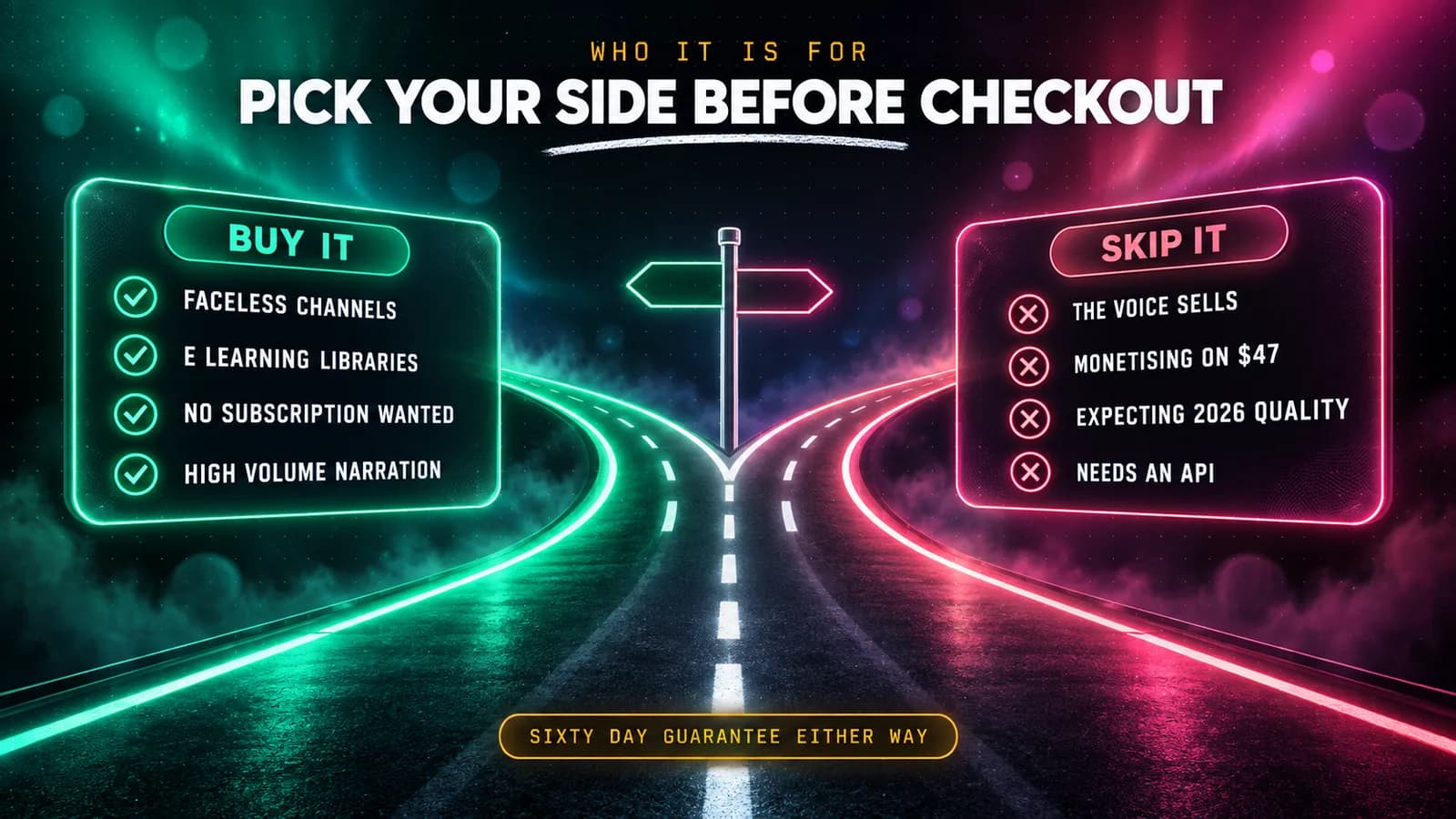
If you landed in the first list, the buying section below is the sensible way in. If you landed in the second, the most useful outcome of this review is the $47 you keep.
Getting better output from a mid-tier voice engine
If you do buy it, technique closes more of the quality gap than the tier you pick. These habits are free, and they matter more here than on a better engine because there is less headroom to waste.
Write for the ear, not the page. Short sentences. One clause each. Any sentence you have to re-read on paper will be worse out loud, and synthetic voices punish complex syntax harder than human readers do.
Punctuate as a timing instruction. Speechelo reads punctuation for pacing, so commas and full stops are your only rhythm control. A sentence that runs on will be read as a monotone run-on.
Spell words phonetically when the engine gets them wrong. Every text to speech engine mangles names, acronyms and loan words. The vendor's own support desk recommends respelling, and it works. Keep a list of the fixes for your niche.
Generate in scene-sized chunks, not one 700-word block. Shorter passages give better prosody and let you re-render one bad line rather than the whole file.
Do not use the joyful tone for anything serious. The tone settings are blunt, and the joyful setting mostly raises pitch and speed. On informational content it reads as nervous rather than warm.
tip
The single biggest quality gain is not in the tool. Add a bed of quiet background music and normalise the audio afterwards in something free like Audacity. A slightly synthetic voice sitting in a properly mixed track reads as produced. The same voice dry, in silence, reads as a robot.
None of this is Speechelo-specific, which is the point. Learn it here and it transfers to whatever you use next.
If you are pairing narration with visuals, the tool I looked at in my InstaDoodle review covers the other half of that workflow, and it is a useful comparison for how a similar ClickBank offer handles the same trust questions.
How to buy Speechelo without regret
If you are in the buy column, the sequence below is how to spend the minimum and find out fast.
- Test the free alternatives first. Ten minutes in ElevenLabs' free tier tells you whether Speechelo's quality clears your bar. Skipping this step is how refund requests happen.
- Decide your license before checkout. Monetising anything? You need Pro. Personal or internal use only? The front end alone is genuinely enough.
- Buy the front end from the official Speechelo page. Ignore the countdown; the scarcity timer on this offer has been running for years.
- If you take Pro, choose the one-time option deliberately. The monthly and one-time buttons sit next to each other. Accidental subscriptions are one of the most common complaints against this product.
- Produce two real voiceovers in week one. Not tests, actual narration for something you are shipping. This is what the guarantee window is for.
- Set a calendar reminder well inside 60 days. If it has not earned its place by then, refund through ClickBank order support at clkbank.com using the order number on your receipt, not through the vendor.
That last point is the most valuable thing in this section. The 60-day guarantee is administered by ClickBank, which is why it is worth more than the vendor's own subjective promise about whether you can tell the voice is AI.
ClickBank's seller terms allow refund windows of up to 60 days, and their order support processes the request. That structure is the real protection on this purchase, and it is the reason trying Speechelo is a bounded risk rather than a leap of faith.
Speechelo review: the final verdict
Speechelo is a competent 2020 product being sold into 2026 with 2020 marketing, and the $47 tier does not license you to earn from it. That is the whole review compressed.
What it does well is narrow and genuine. Paste text, get a clear MP3, do it at high volume for a fixed price, with no subscription and no learning curve. For bulk functional narration, that combination still has no obvious replacement at this price.
What it does badly is everything adjacent to that. The voices are audibly synthetic against current models, and the licensing split is documented where buyers will not look.
The character cap is documented nowhere in the marketing. The upgrade page invites accidental subscriptions. The Trustpilot score is 1.6 for reasons that are mostly earned.
So: if you are producing high-volume narration where the voice is plumbing rather than product, and you buy Speechelo with the Pro tier because you intend to monetise, it is a defensible purchase with a real 60-day exit.
If the voice is the product, spend $6 on ElevenLabs instead and get a better result this afternoon.
And if you take one thing from this review, make it the license line. Check what your $47 permits before you build a channel on it, because the vendor has already published the answer and it is not the one the sales page implies.
This review sits in my Creator Tools section, where I check sales page claims against the vendor's own documentation before anyone spends. The pattern holds across every one of them so far: the truth is usually published somewhere, just never on the page taking your money.
FAQ
- Does Speechelo include a commercial license?
- Not at the $47 tier. Speechelo's own support article on commercial use states that the standard version gives you personal usage rights only, and that the commercial license comes with the PRO upgrade. That matters because most of what Speechelo is advertised for, monetised YouTube videos, sales videos, client voiceovers and paid courses, is commercial use. If you plan to earn money from the audio, the honest price of Speechelo is the front end plus Pro, not $47.
- How much does Speechelo cost in total?
- The front end is $47 one time, discounted from a stated $97. The Pro upgrade, which carries the commercial license and 171 voices, is offered on Speechelo's own upgrade page at $37 a month or $97 one time. A Scriptelo script-writing add-on is widely reported at $37. So a creator who needs commercial rights is realistically looking at $144 one time, not $47, and older reviews quoting $47 a quarter or $127 for Pro show the checkout offers have changed over time.
- Is Speechelo legit or a scam?
- It is a real product from a real company. Speechelo was built by Vlad and Stoica, the team behind the Blaster Suite tools, and it has been selling since around 2020 through ClickBank with a 60-day money-back guarantee. The criticism it attracts is about marketing rather than fraud: a personal-use license sold against commercial-sounding promises, countdown scarcity that resets, and a claim that 98% of listeners cannot tell the voice is synthetic. Its Trustpilot score sat at 1.6 out of 5 across 247 reviews when I checked in September 2026.
- What is Speechelo's word limit?
- The standard version caps a single voiceover at 700 words, which is roughly four to five minutes of speech. Pro raises that to 2,800 words. There is also a volume cap the sales page does not mention: Speechelo's support desk states that generating more than half a million characters in 30 days will get your account blocked until the rolling window resets.
- Is Speechelo better than ElevenLabs?
- Not on voice quality. ElevenLabs produces noticeably more natural speech, handles emotion and pacing better, and gives you 10,000 credits a month free, with commercial rights starting on the $6 Starter plan. Speechelo wins on one axis only: raw volume for a flat one-time price. Half a million characters a month is roughly nine hours of audio, far more than entry-level ElevenLabs allows, so the choice comes down to whether you need quality or bulk.
- Can you get a refund from Speechelo?
- Yes, and this is the part of the offer that genuinely protects you. Purchases made through the ClickBank hop link are covered by ClickBank's refund process, and ClickBank permits sellers a window of up to 60 days, which is what Speechelo advertises. Request the refund through ClickBank order support at clkbank.com using the order number on your receipt email, not through the vendor, because buyer complaints about slow vendor replies are one of the recurring themes in its Trustpilot reviews.
- Is Speechelo a one-time payment or a subscription?
- The $47 front end is one time. The Pro upgrade is where it gets confusing: Speechelo's upgrade page shows both a $37 a month recurring option and a $97 one-time option on the same screen, and buyers have reported picking the monthly one by accident. If you buy Pro, read the button you are clicking, and choose the one-time option unless you specifically want the ability to cancel later.