note
Affiliate disclosure: this review contains affiliate links to VinCheckUp. If you buy through one, I earn a commission at no extra cost to you.
Nobody paid for this review, I was not given a free copy, and nothing critical below was softened for the commission. The verdict here is negative and the links stayed in anyway. How I handle affiliate links is covered in the disclaimer.
Buying a used car is one of the few consumer decisions where a $15 document can save you $5,000. That is the entire pitch for a vehicle history report, and it is a good pitch.
VinCheckUp sells that document for $14.95 and says its title data comes from NMVTIS, the federal database that records salvage brands, total loss claims and odometer readings.
So I went to check. The US Department of Justice publishes a list of every business approved to sell NMVTIS reports to consumers, which makes this the rare marketing claim you can verify in one click.
VinCheckUp is not on that list. It has never been on that list.
That single fact is what this VinCheckUp review is built around, and it is why the rest of what I found, a preview that says the same thing about every car and specifications that a free government API gets right, stopped reading as isolated bugs.
Is VinCheckUp worth it? The short answer
VinCheckUp is not worth buying for most people. It is not on the Justice Department's list of approved NMVTIS data providers, its free preview returns identical results for completely different vehicles, and it reported a battery electric Tesla as a 4 litre petrol car.
Here is the verdict before the sections that justify it.
There is no price at which it is the obvious choice. VinAudit is on the approved list and charges $9.99 for a single report and $29.99 for ten, against VinCheckUp's $14.95 and $49.95, so the cheaper product is also the listed one.
It is not worth buying if you are checking one car you actually intend to buy. At that point the gap between $14.95 and an approved provider's report is smaller than the cost of being wrong once.
And it is the wrong purchase entirely if you are buying it because the sales page says the data comes from a federal system, because the federal system's own operator does not list VinCheckUp among the businesses approved to sell you that data.
The company is real, the payment is real, and the 60 day ClickBank window is real. The report is thinner than the marketing around it.
VinCheckUp at a glance
The specification, gathered from the vendor's own pages, the ClickBank checkout and two live searches I ran on 15 September 2026, rather than from other reviews.
- Price: $14.95 for one report through the ClickBank funnel, $19.95 for the same report on the public pricing page.
- Bundles: three reports $29.95, ten reports $49.95, so $4.99 each at the top tier.
- Billing: one time. The vendor states plainly that it runs no recurring subscriptions and offers no trial.
- Access: 30 days to the member area, after which the pass deactivates.
- Coverage: US vehicles from the 1981 model year onward. Cars, trucks, vans, RVs and motorcycles.
- Claimed sources: NMVTIS, state DMV records, insurers, salvage and auction data.
- NMVTIS approval: not listed by the Department of Justice, at any point on record.
- Apps: iOS and Android, alongside the web member area.
- Refund: 60 days per the ClickBank order form, four weeks per the vendor's own terms.
- Buyer rating: 1.3 out of 5 across 61 Trustpilot reviews, 91 percent of them one star.
Read that list against the sales page and three lines stand out. The approval gap, the split price and the refund contradiction appear nowhere in the marketing.
VinCheckUp pros and cons
The balance sheet, drawn from the evidence in the rest of this review rather than from the sales page.
What VinCheckUp gets right:
- It is cheap in absolute terms. A single report is $14.95 and the ten pack works out at $4.99 a VIN, well under what the premium names charge.
- No subscription, no trial trap. The vendor documents that it runs no recurring billing, and the ClickBank data agrees, showing an average rebill of zero.
- One order bump, clearly labelled. The checkout offers a single optional add on rather than an upsell ladder.
- A refund route that outlives the vendor's own policy. ClickBank's 60 day window is the one printed at the point of sale.
- It covers vehicle types the free tools skip. RVs and motorcycles are included at the same price.
- The search itself is free. You can enter any VIN and see whether the car even decodes before you spend anything.
What VinCheckUp gets wrong:
- It is not an approved NMVTIS data provider. The Justice Department's list of approved businesses does not include it.
- The preview is the same for every car. A 2003 Honda and a 2023 Tesla returned identical history lines.
- The specifications were wrong on both vehicles I tested. Including petrol and cylinder data for an electric car.
- The one real number in the preview is free elsewhere. NHTSA publishes recall counts through a public API.
- Trustpilot sits at 1.3 out of 5. With no company replies to the negative reviews.
- Two live prices for one product. The affiliate funnel charges $14.95, the public page $19.95.
- The terms understate your own refund rights. Four weeks on the vendor's page against 60 days at checkout.
- An approved provider undercuts it at every tier. VinAudit charges $9.99 and $3.00 a VIN in bulk.
- No corporate identity is published anywhere. No company name, no address, no state of incorporation.
How I researched this VinCheckUp review
I have not bought a used car with a VinCheckUp report in my hand, and reviews that pretend to that kind of experience are why this whole category reads as untrustworthy.
What I did instead is the method this site uses on every affiliate review: check each claim against a source the vendor did not write in order to sell you something.
For this product that meant four things. Reading the vendor's terms, FAQ and pricing pages line by line. Pulling the Department of Justice list of approved NMVTIS providers, and its archived versions.
Walking the ClickBank funnel end to end in a scripted browser, from the affiliate link to the order form, without completing a purchase. And running real VINs through the product's free search to see what it actually returns.
Nobody gave me a free copy and nobody paid for this review. I did not buy a report, which means everything behind the paywall is reported from buyer accounts and labelled as such, while everything in front of it I verified myself.
It is the same approach that produced the Paying Social Media Jobs review, where the vendor's own earnings disclaimer contradicted the pay rate advertised on its own landing page.
Where a figure is an estimate, I say so. Where a claim comes from buyers rather than from me, I attribute it in the sentence.
What VinCheckUp actually is
VinCheckUp is a web based vehicle history report service that sells one off US vehicle records, sourced from third party data rather than gathered directly, for $14.95 to $19.95 per report.
You give it a 17 character VIN. It returns a report covering title brands, reported accidents, odometer readings, theft and salvage records, liens, sale events and manufacturer recalls.
Those title brands are the part that matters most to a buyer. A salvage title, a rebuilt title or a flood brand can halve a car's value, and title washing, the practice of moving a branded car between states until the brand falls off the paperwork, is the specific fraud NMVTIS was built to catch.
The product has been listed on ClickBank since 19 November 2016, which makes it one of the longer running listings in that marketplace. It currently sits second in ClickBank's software category by rank.
There are iOS and Android apps alongside the web member area, and the vendor's own affiliate page advertises a 65 percent commission with no approval required to promote it.
None of that is unusual. The used vehicle records business is full of resellers who buy data in bulk and package it, and that is a legitimate model when the packaging is honest about what is inside.
Who is behind VinCheckUp
Nobody is named. The site publishes no company name, no registered address and no state of incorporation on any page I could find, including the terms, the privacy policy, the about page and the support page.
What it does publish is a US freephone number and a support email address. Third party review pages attribute the site to a Nevada company, but the vendor's own pages do not confirm it, so I am not asserting it here.
The one corporate name that does appear in the vendor's own documents belongs to somebody else. The terms page states that Vin, Inc. is the authorised provider of NMVTIS data, which is the vendor telling you it buys the federal records from a third party.
That line is worth holding onto, because it is the most candid sentence on the entire site and it sits three clicks from a sales page that talks about "our connection with NMVTIS".
How a VinCheckUp search actually goes
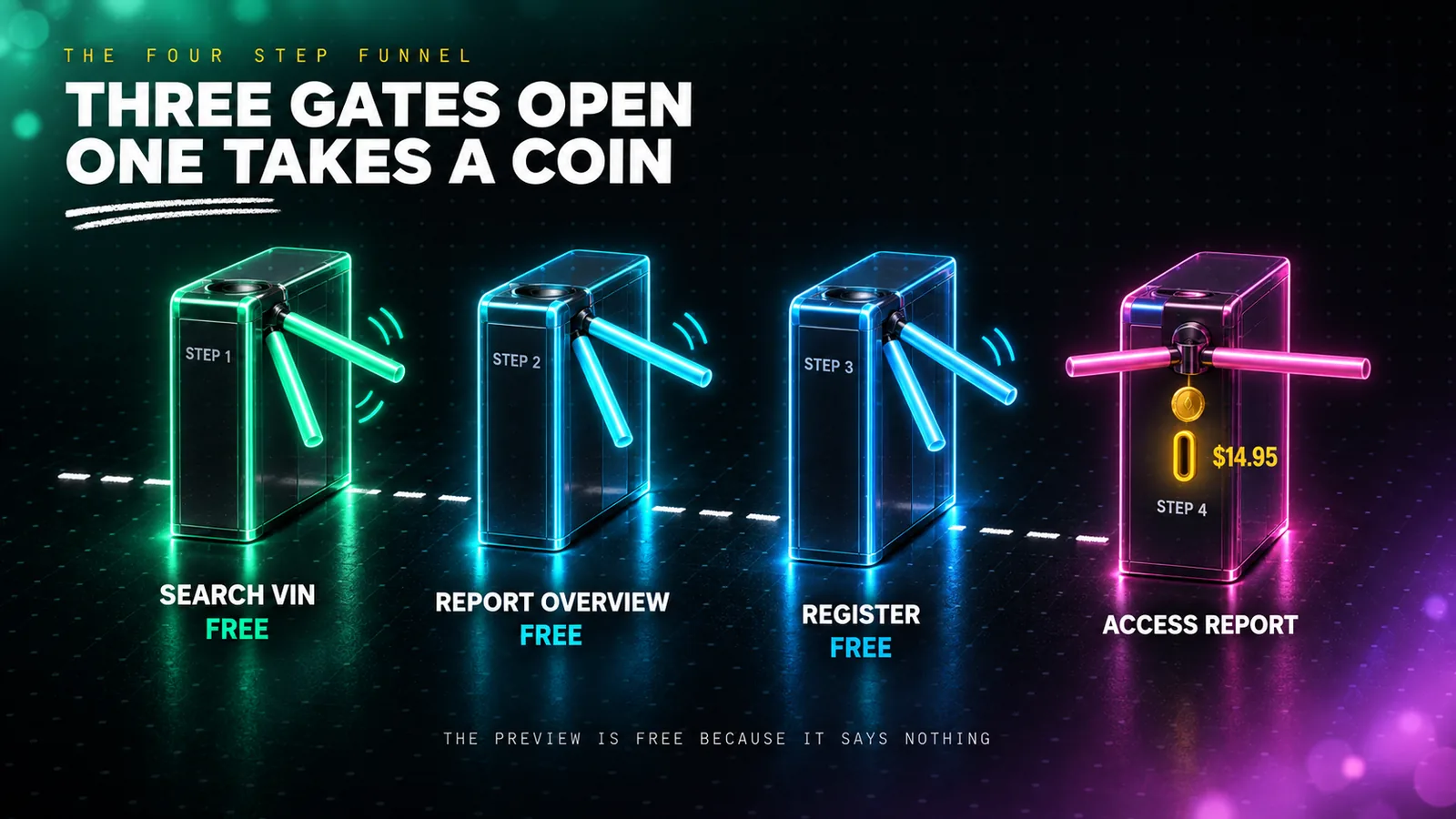
The funnel has four steps and the vendor labels them on screen: Search VIN, Report Overview, Register, Access Report.
Step one is free. You paste a VIN and the site validates it, rejecting anything that is not 17 characters or does not decode to a post 1980 manufacturer.
Step two is a loading interstitial that names the records it claims to be scanning, one after another, while a progress animation runs.
It lists sixteen categories in sequence: accident history, branded title history, car theft history, number of previous owners, lien and finance records, sale records, lemon check, flood vehicle records, taxi, lease and police use, mileage rollback, total loss insurance write off, DMV title information, salvage and reconstruction records, towing and reposition events, safety recalls and vehicle specification.
That list is the single most persuasive thing on the site, because watching sixteen named databases tick past makes the search feel expensive. Hold it in mind for two sections, because the screen that follows it reports on six of those sixteen and says the same thing about all six.
Step three is the preview, which the vendor calls the report overview. This is the screen that decides whether you pay, and it is the screen this review spends the most time on.
Step four hands you to ClickBank. The package chooser posts to a ClickBank order form, which is where the price, the tax and the refund terms finally appear.
The whole path took under two minutes in a scripted browser. It is a clean funnel, well built, and it does one thing extremely well, which is turn a curious VIN lookup into a checkout.
VinCheckUp is not an approved NMVTIS data provider
The National Motor Vehicle Title Information System is a federal database holding title and brand history for vehicles titled in the United States. States, insurers and salvage yards are required by law to report into it.
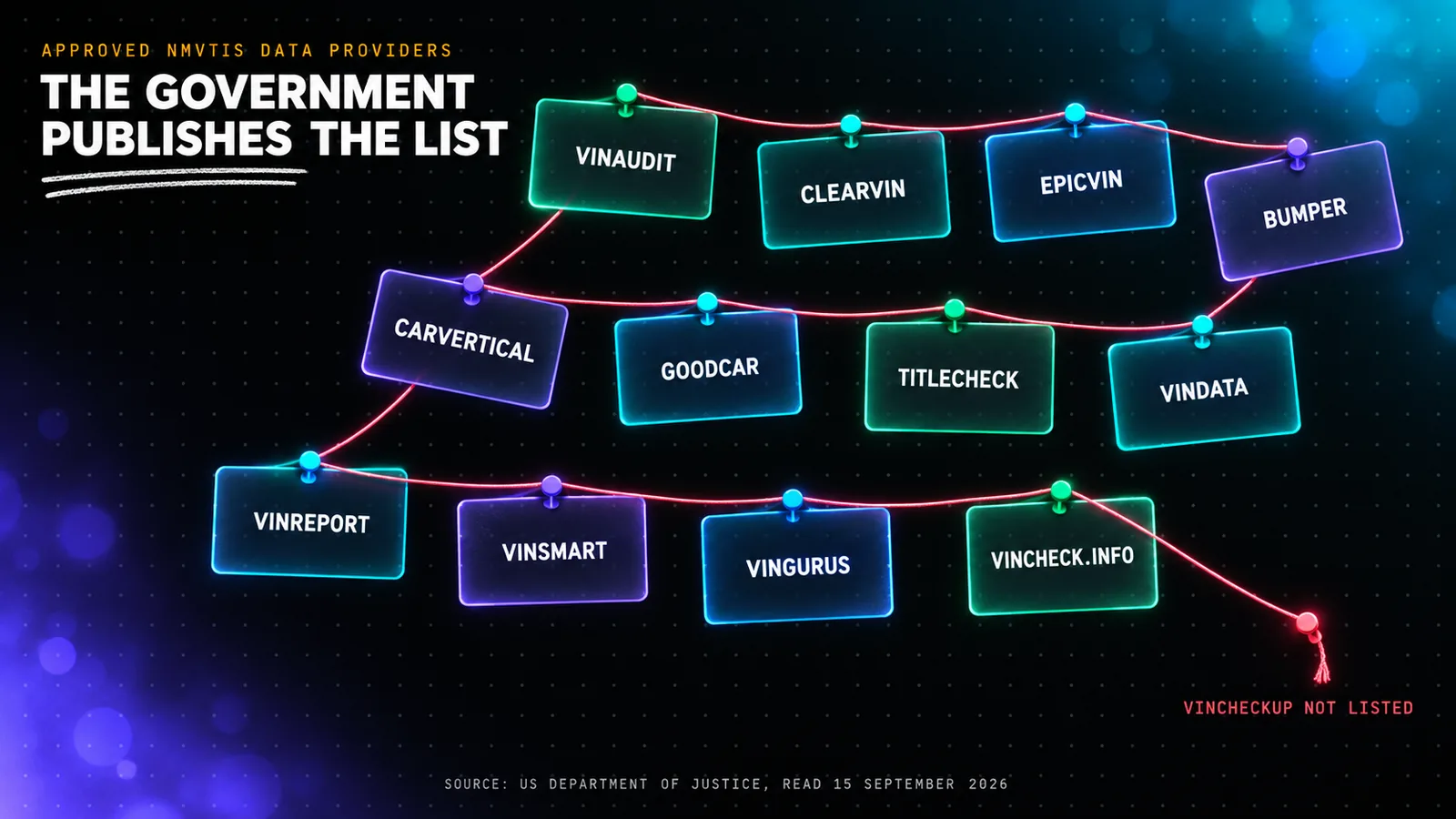
Consumers cannot query it directly. Access is sold through businesses the Department of Justice has approved, and the Department publishes the complete list at vehiclehistory.bja.ojp.gov.
That page is explicit about what it covers. It describes itself as the list of "ALL businesses approved to provide NMVTIS vehicle history reports to public and commercial consumers".
When I read that page on 15 September 2026, vincheckup.com did not appear on it. Not as an approved provider, and not as one of the affiliated additional websites the page lists underneath each provider.
Here is the sentence to take away. VinCheckUp advertises NMVTIS data to consumers and does not appear on the Justice Department's published list of businesses approved to sell it.
The approved names on that page, for reference, are Bumper, BeenVerified, Carsforsale, VehicleHistoryReport, carVertical, CheckThatVIN, ClearVIN, EpicVIN, VinGurus, VinInspect, GoodCar, InfoTracer, RecordsFinder, StateRecords, TitleCheck.us, VinAudit, VinCheck.Info, VINData, VinReport and VINsmart.
Note one of those. VinCheck.Info is approved and is a single character away from the brand you are reading about. It belongs to VinAudit, which is also approved. VinCheckUp is neither.
I checked whether this was a recent delisting rather than a permanent absence, because those are very different stories. Archived copies of the same Justice Department page from 26 March 2020 and 4 March 2021 also return zero mentions of vincheckup.
Meanwhile the vendor makes the claim in three separate places. The sales page offers "real-time Federal Gov't Title & Total Loss data". The pricing page says reports "contain title event and accident data gathered from NMVTIS".
And the FAQ goes furthest, stating that "primarily most of the records and data we obtain from NMVTS", misspelling the system's own name, before adding "We pay for each record, but since we buy data in bulk, we can pass on the savings".
That last line is the vendor confirming it is a reseller. Put next to the Vin, Inc. reference in the terms, the picture is consistent: VinCheckUp buys NMVTIS derived records from somebody who does hold approval.
I am not claiming the data is fabricated. I am claiming something narrower and more checkable, which is that the one federal register that exists to tell consumers who is allowed to sell them this data does not list the company selling it to them.
The reason that register exists at all is worth a sentence. Approval is not a badge, it is a set of obligations: an approved provider agrees to supply NMVTIS reports to the public consistent with federal requirements, and the Justice Department publishes a Consumer Access Product Disclaimer setting out what those reports must and must not claim.
A buyer who purchases from a listed provider has a named, accountable counterparty and a federal page confirming it. A buyer who purchases from an unlisted reseller has the reseller's word.
That is the whole of the difference, and for a $14.95 purchase it may not feel like much. It starts to matter when the report says nothing and you want to know who to escalate to.
Every review currently ranking for this product repeats the NMVTIS claim as a mark of legitimacy. Not one of them opened the list.
The editing note VinCheckUp left live on its own funnel
The VinCheckUp funnel ships a line of text that reads, in full and verbatim, "[Copied from EpicVIN] A VinCheckUp Vehicle History Report will reveal:". It is an unremoved editing note, it names a competitor, and it is live on the page every affiliate visitor passes through.
You reach it by submitting a valid VIN, which loads a page at vincheckup.com/cb/loading. Partway down that page sits a heading, "What Can You Expect From Our Reports", and the note is the line of body text directly beneath it.
Nobody else reviewing this product has published it, and there is a reason: it is in the served page markup rather than the visible copy, so you only see it if you read the source.
Somebody pasted a block of copy from a competitor, bracketed a reminder of where it came from, and shipped it to production without deleting the reminder.
I saw it on both of the VINs that passed validation, so it is not a one off render. I have the served page markup and a screenshot, taken on 15 September 2026.
EpicVIN, the source named in the note, is on the Justice Department's approved provider list. VinCheckUp is not. The paragraph describing what a VinCheckUp report will reveal was taken from a company that actually holds the approval.
This is the same class of find as an unedited template placeholder, and it carries the same weight. It tells you how much care went into the pages sitting between your VIN and your card details.
VinCheckUp pricing: what you actually pay
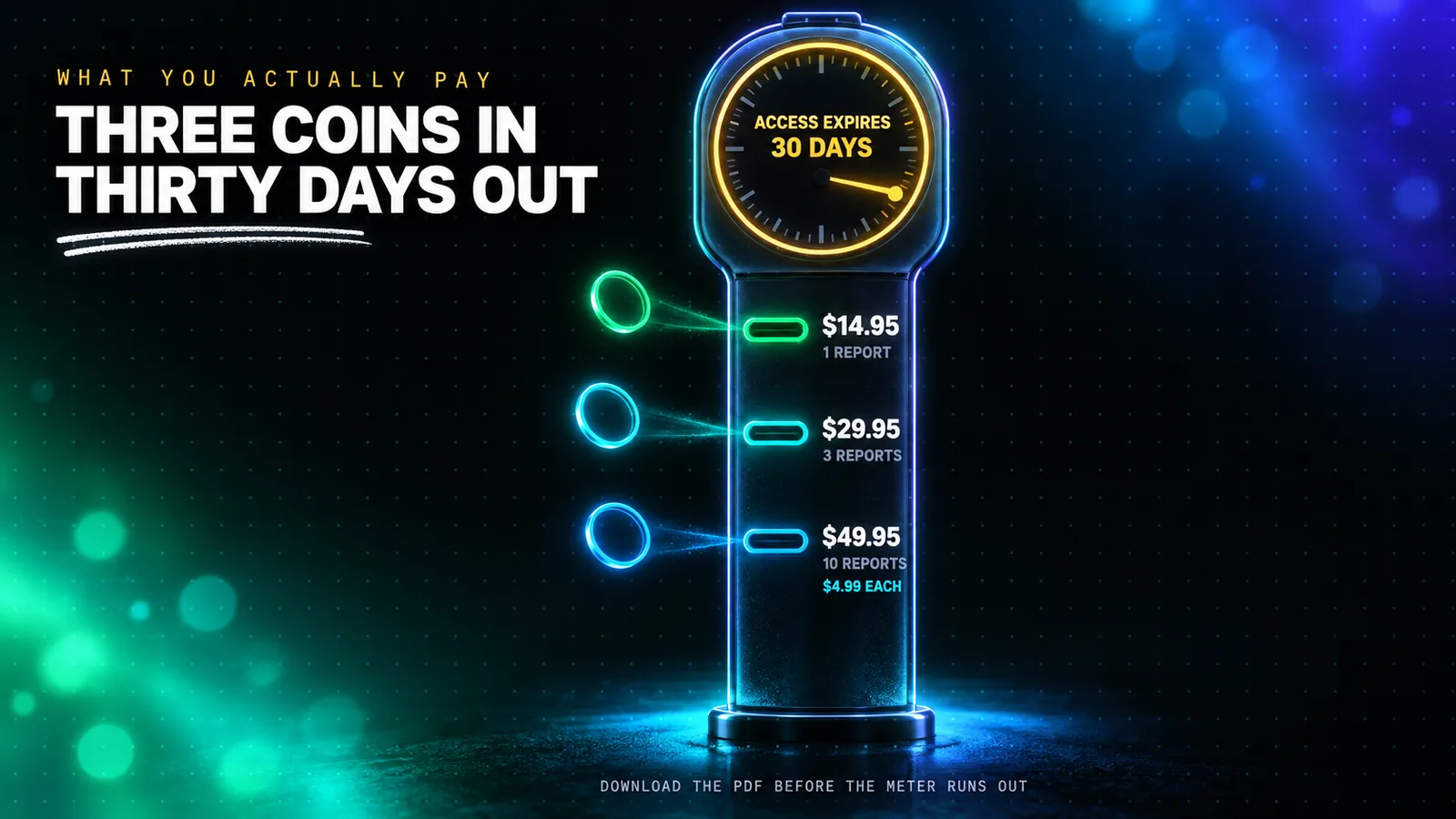
VinCheckUp costs $14.95 for one report through the affiliate funnel, $29.95 for three and $49.95 for ten. Billing is one time with no subscription, and member area access expires 30 days after purchase.
The bundles are the only part of the pricing that is straightforwardly good. Ten reports at $4.99 each is genuinely cheap for anyone screening a list of cars rather than checking one.
The 30 day access pass is the detail buyers miss. You are not buying a permanent document, you are buying a month of access to it, and the vendor's FAQ states the membership "will automatically deactivate when your 30-day access pass expires".
Download the PDF the day you buy it. The pricing page confirms reports stay downloadable for 30 days from purchase, so the file is yours to keep if you actually take it.
At checkout there is one order bump, a three report bundle for an extra $29.95, which takes the maximum single transaction to $44.90. There is no upsell ladder after purchase, which is a real mark in its favour next to most ClickBank software.
If you want to see the current offer for yourself, the funnel is at VinCheckUp's ClickBank page. Read the order form before you type a card number, because that is where the real terms live.
One number for Indian readers, since this site's audience skews that way. The ClickBank order form rendered for an Indian visitor showed Rs 1,597.99 plus Rs 287.64 tax, a total of Rs 1,885.63.
That tax line is 18 percent GST, and the implied exchange rate of 106.89 rupees to the dollar sat 11.7 percent above the market rate of 95.67 the same day. Delivered cost is about $19.71 on a $14.95 sticker, roughly 32 percent over.
Why VinCheckUp shows you two different prices
Because the affiliate funnel was never updated after the public price went up, and both pages are still live.
The public pricing page lists a single report at $19.95. The ClickBank funnel that affiliate traffic lands on lists the same single report at $14.95. The three and ten report tiers are identical on both.
Archived copies explain it. The single report price sat at $14.95 on the public page from at least September 2019 through January 2023, and had risen to $19.95 by August 2024, where it remains.
The affiliate route kept the old number. So the only VinCheckUp discount that actually exists is an accident of neglect, and the cheapest way to buy this product is the route the vendor pays a commission on, which is an unusual position for a vendor to leave itself in.
There is a second fingerprint of the same neglect. The public pricing page advertises three reports at "$29.95 instead of $44.85" and ten at "$49.95 instead of $149.50".
Those anchors are three and ten multiples of $14.95, the retired price. Against the current $19.95 the comparisons would be $59.85 and $199.50. The discount is understated rather than inflated, which suggests nobody has looked at the page rather than that anyone is being clever.
I have seen the opposite of this elsewhere in the same marketplace, where Speechelo's upgrade page put a monthly and a one time price side by side and buyers reported picking the wrong one by accident. Here the stale page works in the buyer's favour, provided the buyer arrives through the cheaper door.
I ran two VINs through VinCheckUp and the specifications came back wrong
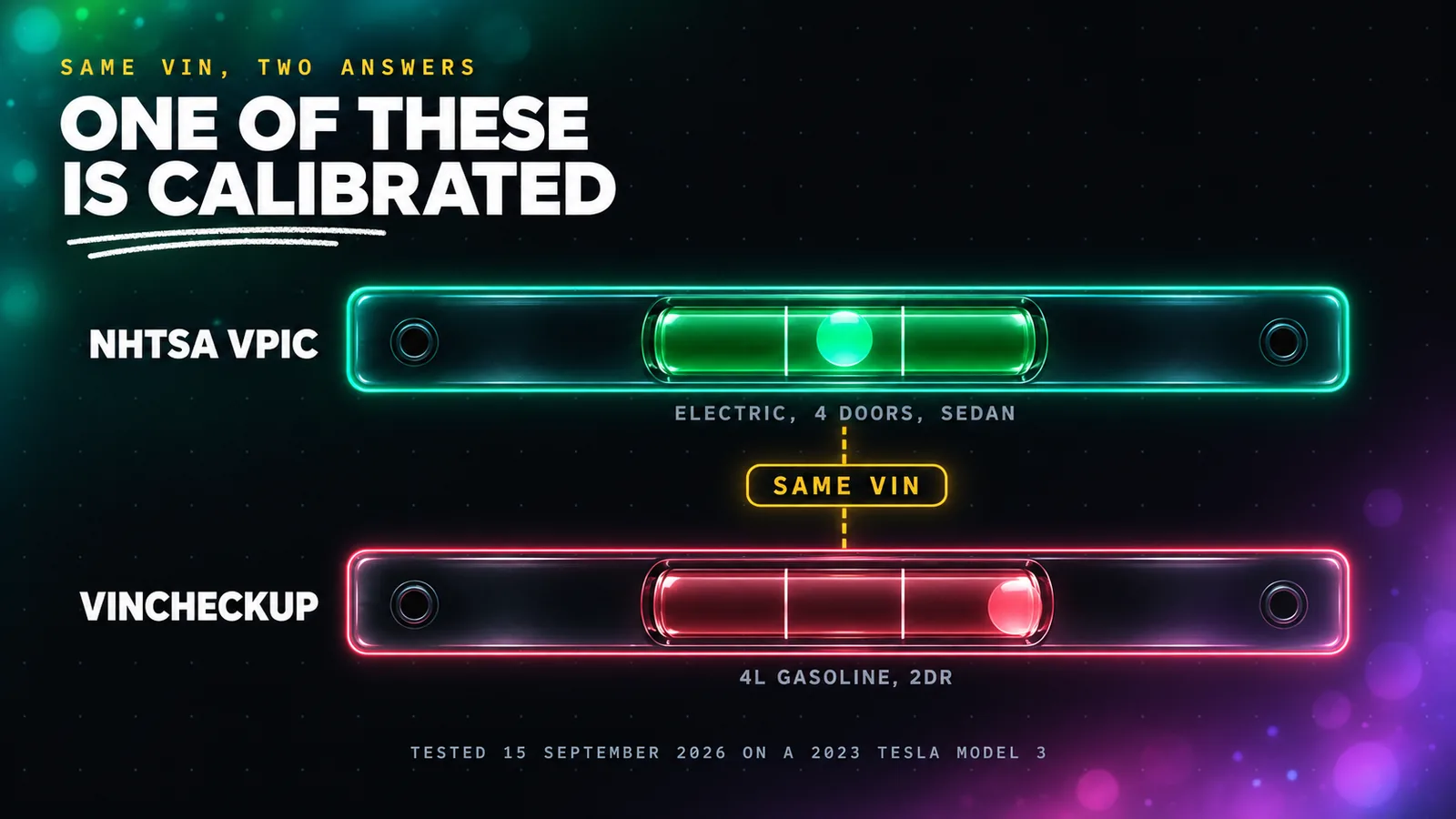
I entered two VINs into the free VinCheckUp search on 15 September 2026 and compared the vehicle specifications it returned against NHTSA vPIC, the US Department of Transportation's own free VIN decoding service.
The first was a 2023 Tesla Model 3. VinCheckUp returned "4L Gasoline", printed "2DR" and "SEDAN 4-DR" on the same card, and gave no indication anywhere that the car was electric.
The free NHTSA vPIC API returned, for the same seventeen characters, fuel type primary Electric, electrification level BEV, body class Sedan/Saloon, doors 4.
The second was a 2003 Honda Accord EX V6 coupe. VinCheckUp again returned "4L Gasoline". NHTSA returned six cylinders and a displacement of 2.9988 litres, which is the 3.0 litre V6 that engine actually is.
The same string appeared for a battery electric car and for a three litre petrol V6. That is the signature of a hardcoded value rather than decoded data, and it means the specification panel is not reading the VIN printed next to it.
This matters more than it first appears. The specification block is the only part of the report you can check against the car on the driveway, so it is the part that tells you whether to trust the parts you cannot check.
Buyers have been saying this for a while. The recurring Trustpilot complaint about incorrect door counts, engine types and fuel capacities is not a misunderstanding of the product, it is a description of what it returns.
What the VinCheckUp preview actually tells you about your car
Nothing. That is not a rhetorical flourish, it is the result of running the test.
I put four VINs through the funnel. Two failed validation. The two that passed, the 2023 Tesla and the 2003 Honda, produced previews that were identical on every history field.
Both cars came back reading exactly this, field for field:
- Accident History: Information Available
- Problem Checklist: Information Available
- Odometer Check: Information Available
- Junk / Salvage / Total Loss: Information Available
- Number of Owners: Information Available
A twenty three year old Honda coupe and a three year old Tesla do not have the same history profile. What they have in common is that the preview is not reporting on them.
"Information Available" is not a finding. It is a label that appears whether or not there is anything behind it, and the reader is invited to read it as a warning.
Exactly one field varied between the two cars: the recall count, 24 for the Honda and 12 for the Tesla. That is a real number tied to the real vehicle, and it is the only figure in the entire preview that changes when the vehicle does.
It is also free. NHTSA's public recall API returns a count of 24 for a 2003 Honda Accord, the same figure, at no cost and with no account.
This is the mechanism behind the most common complaint about the product, that the preview implies problems the paid report then does not contain. The preview never implied anything specific in the first place.
Is VinCheckUp free? What the free search really gives you
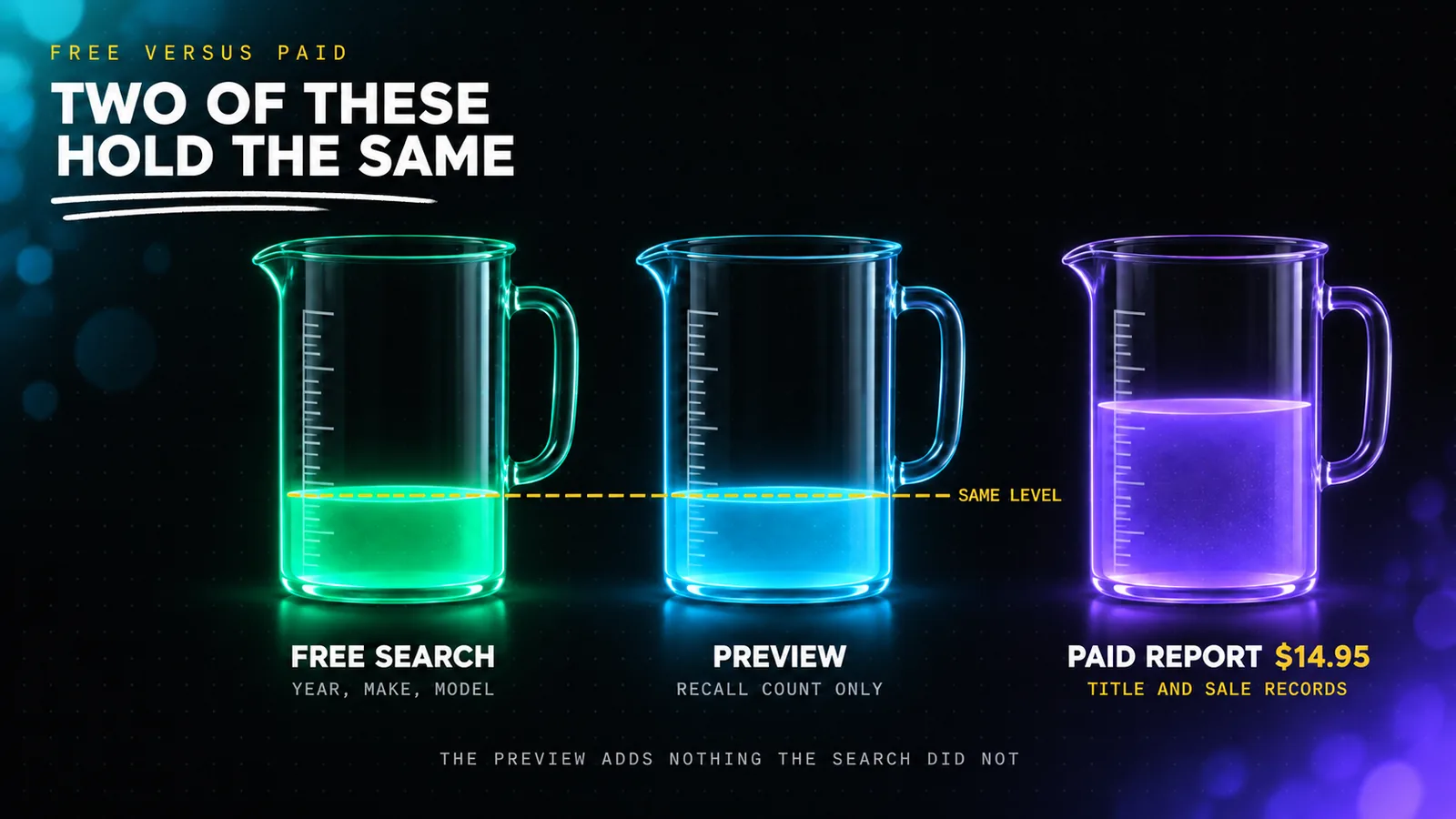
The VIN search is free, the preview is free, and neither contains anything specific to your vehicle beyond year, make, model and a recall count. Everything the product actually sells sits behind the $14.95 payment.
This trips people up because the site's own page title is "Free VIN Number Search and Get Vehicle History Report", which reads as a promise of a free report rather than a free search.
What you genuinely get without paying is worth stating precisely. A validity check on the VIN, a decode to year, make and model, a body style, and the number of open manufacturer recalls.
What you do not get is any title brand, any accident record, any odometer reading, any owner count, any salvage flag and any theft record. Those six things are what a vehicle history report exists to tell you.
The honest framing is that VinCheckUp's free tier is a VIN decoder with a recall lookup attached. That is a useful thing to have, and two US government services already provide it for nothing.
So the answer to "is VinCheckUp free" is yes, in the sense that a dealership forecourt is free. You can stand on it and look at things. Nothing you came for is included.
Is VinCheckUp legit? What real buyers say
VinCheckUp is a real service that takes payment and delivers a report, so it is not a scam in the fraud sense. It is rated 1.3 out of 5 across 61 Trustpilot reviews, with 91 percent at one star, which is the worst buyer verdict of any product reviewed on this site.
The full distribution, read on 15 September 2026, runs 3 percent at five stars, 2 percent at four, 2 percent at three, 2 percent at two and 91 percent at one. The Trustpilot profile notes that the company has not replied to negative reviews.
A second aggregator, smartcustomer.com, shows 2.0 out of 5 across 27 reviews. Different sample, different scale, same direction.
The fair caveat applies here as everywhere. Trustpilot skews negative on one time purchases, because a satisfied buyer of a $15 document has no reason to come back and say so, while a disappointed one does.
That caveat does not rescue a 91 percent one star rate. A comparable one time ClickBank purchase in this series scored 4.6 out of 5 across 344 reviews under exactly the same sampling bias, so the bias is not what is producing this number.
The complaint themes reported by buyers are consistent, and they line up with what I verified myself. Reports arriving with fields reading "N/A" and "NO RECORDS FOUND" where the preview implied content.
Specification errors of the kind I reproduced. Accidents documented by a dealer or a DMV that did not appear in the report. And support answering refund requests with a form letter rather than a decision.
I am attributing those to buyers rather than asserting them, because I did not buy a report. What I can assert is the part I tested, and the part I tested matches what they describe.
What VinCheckUp tells affiliates, and what it tells buyers
VinCheckUp tells affiliates it has a "Low average refund rate, below 3%" while its buyers rate it 1.3 out of 5. Both can be true, and which one you believe changes what you think you are buying.
The vendor runs a recruitment page for affiliates at the same domain, and it is the most revealing document on the site, because it is the only one written for people selling the product rather than buying it.
It opens with a question. "Tired of promoting digital products that overpromise, underperform + have high refunds rates?"
It is a fair description of a real problem, and it reads differently once you have run the product.
The page then makes three claims worth holding against the buyer facing evidence. "65% Commission for all referred sales NO exceptions!", the refund rate line above, and the summary "Great Product, High Reward, No Risk, Big Opportunity."
That refund rate against a Trustpilot score of 1.3 out of 5 is not necessarily a contradiction, and I want to be precise about why. Most unhappy buyers of a $15 document do not file for a refund. They write a review and move on.
So both numbers can be true at once, and together they describe something specific: a product cheap enough that dissatisfaction converts into a one star rating rather than a chargeback. That is the commercial logic of the price point, and it is worth understanding before you decide the low refund rate is reassurance.
One more detail: a testimonial on that page quotes being "happy with the $9.95 pricing", a third price that matches no tier the product currently sells.
The ClickBank numbers add a last piece. As of 15 September 2026 the listing shows a gravity of 8.60, an average initial sale value of $11.34, and an average rebill of zero, which confirms the no subscription claim.
Sixty five percent of the $14.95 single report is $9.72. The reported average of $11.34 sits above that, which implies the typical buyer takes more than one report. That is arithmetic on two published figures rather than anything the vendor has disclosed, and I am labelling it as such.
VinCheckUp vs Carfax vs AutoCheck
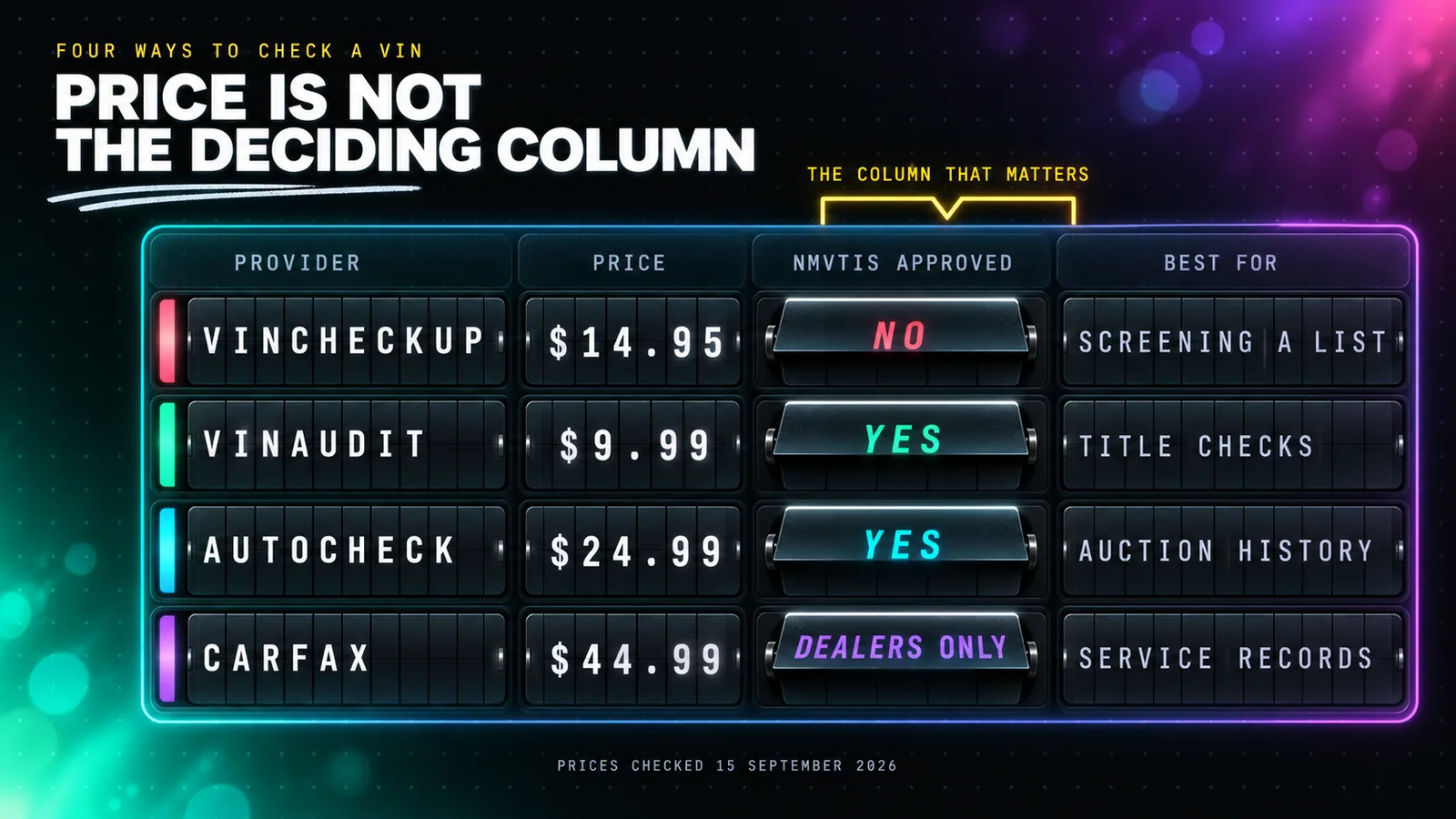
VinAudit undercuts VinCheckUp at both price tiers and is on the approved list, Carfax and AutoCheck each keep their report price behind a VIN entry form, and VinCheckUp is the only one of the four the Justice Department has never listed at all.
VinAudit is the closest genuine comparison, because it sells the same kind of title focused report at the same kind of low price. It publishes that price openly: vinaudit.com lists $9.99 for a single report, $19.99 for five and $29.99 for ten, checked 16 September 2026.
Do the division and the comparison reorders itself. VinAudit's ten pack works out at $3.00 a VIN against VinCheckUp's $4.99, and its single report is $9.99 against $14.95.
So the approved provider is cheaper than the unapproved one at every tier.
Carfax is the most complete report in this group and its advantage is the service network. Dealers, service centres and repair shops report into it, which is how it surfaces maintenance history that title based sources never see.
Carfax does not publish a report price on any page I could load, and its purchase flow asks for a VIN before it quotes. The only sourced figure I have is VinCheckUp's own comparison page, which says competitors charge "as much as $44.95 per report".
AutoCheck, which is Experian's product, is best known for auction records and the AutoCheck Score, a single number summarising a vehicle's history. It does not publish a price on a loadable page either.
Both of those premium names carry the same NMVTIS restriction, and it is the opposite of what people assume. The Justice Department page states plainly that consumers cannot receive NMVTIS reports from Carfax or Experian at all, because both supply that data only to dealerships. Their consumer products are built on their own networks instead.
The way to use this comparison is to be honest about what you are buying. If you want maintenance and service history, only Carfax has it. If you want title brands, salvage flags and odometer rollback checks cheaply, VinAudit, ClearVIN and EpicVIN all sell that and all appear on the approved list.
What is left for VinCheckUp is the argument the next section tests: that it is the cheap way to screen a long list. That argument now has to get past a $3.00 per VIN approved provider.
The best case for VinCheckUp, and why VinAudit breaks it
The strongest argument anyone makes for VinCheckUp is cheap bulk screening, and it stops working the moment you check what an approved provider charges. VinAudit sells ten reports for $29.99, which is $3.00 a VIN against VinCheckUp's $4.99, and VinAudit is on the Justice Department's list.
The case deserves setting out properly first, because it is a real one. If you are looking at twenty used cars on a marketplace and trying to eliminate fifteen before you spend a Saturday driving to viewings, per VIN cost matters more than per report depth.
For that trade to work, two things have to be true. The report has to catch the obvious disqualifiers, and you have to buy a proper report on the one or two cars that survive.
Buyer accounts suggest VinCheckUp does catch some title brands and salvage flags, which are the disqualifiers that matter most: a salvage title, a rebuilt title, or an odometer rollback. The specification errors are irritating but they are not what you are screening on, because the listing already told you what the car is.
So the argument is sound in shape. It just picks the wrong product. Screening twenty VINs costs $99.90 at VinCheckUp's ten pack rate and $59.98 at VinAudit's, and only one of those two companies appears on the federal register of businesses approved to sell you the data.
There is no tier at which this reverses. VinCheckUp is $14.95 for one report against VinAudit's $9.99, and $4.99 a VIN in bulk against $3.00.
The second problem is that the free stack in the next section eliminates a good share of the same cars for nothing, and NICB VINCheck covers theft and salvage specifically. Run those first and whatever filter you are paying for gets smaller again.
Free VinCheckUp alternatives worth trying first
Three free services cover everything VinCheckUp's free tier offers and part of what its paid tier claims: NHTSA vPIC decodes the VIN, NHTSA's recall lookup lists open recalls, and NICB VINCheck flags insurer theft and salvage records. None needs an account and none costs anything.
NHTSA vPIC is the Department of Transportation's VIN decoder. It returns make, model, year, trim, body class, doors, drive type, engine displacement, cylinder count and fuel type, and it is the service that got both of my test vehicles right.
NHTSA's recall lookup returns open manufacturer recalls by vehicle or by VIN, free. It is the source of the only real number in the VinCheckUp preview, and you can query it directly.
NICB VINCheck is run by the National Insurance Crime Bureau and checks whether a vehicle has been reported stolen and unrecovered, or reported as a salvage or flood loss, by participating insurers.
NICB is careful about its own limits and you should be too. It states it draws on insurers representing 92 percent of US earned premium, that it is limited to five searches per IP address in 24 hours, and that it "is not a comprehensive vehicle history report".
That is the free tier of due diligence and it is genuinely good. A decoded spec sheet, an open recall list and an insurer theft and salvage check, for nothing, on every car on your shortlist.
If you still need a title history after those three, buy one, but buy it from a provider on the approved list. VinAudit, ClearVIN, EpicVIN, Bumper and carVertical all sell consumer NMVTIS reports and all appear on the Justice Department page.
What VinCheckUp does not cover
VinCheckUp covers US titled vehicles from the 1981 model year onward and very little else. Pre 1981 cars, Canadian vehicles, owner identities and some commercial vehicles are all outside it. The gaps are not hidden, but they are scattered across four different pages, so here they are in one place.
Vehicles built before 1981 are out. The search rejects them at validation, because the 17 character VIN standard only applies from the 1981 model year onward.
Canada is effectively out, which matters because it is one of the more common searches attached to this brand. The vendor describes its coverage as US states, NMVTIS holds records on vehicles titled in the United States, and a Canadian car never titled in the US will return almost nothing.
Owner identity is out, correctly and by law. The FAQ states that reports exclude owner names and identifying information under federal privacy rules, which is the right answer and not a criticism.
Some commercial vehicles are out. NMVTIS itself notes that vehicles held in a separate state database rather than the primary title record may not be included.
Anything a mechanic would find is out. No vehicle history report from any provider substitutes for a pre purchase inspection, and both NMVTIS and NICB say so in their own words.
The honest summary is that VinCheckUp covers US titled vehicles from the 1981 model year onward and is thin to useless outside that. So is most of this category. Most of this category says so more clearly.
Who VinCheckUp is for, and who should skip it
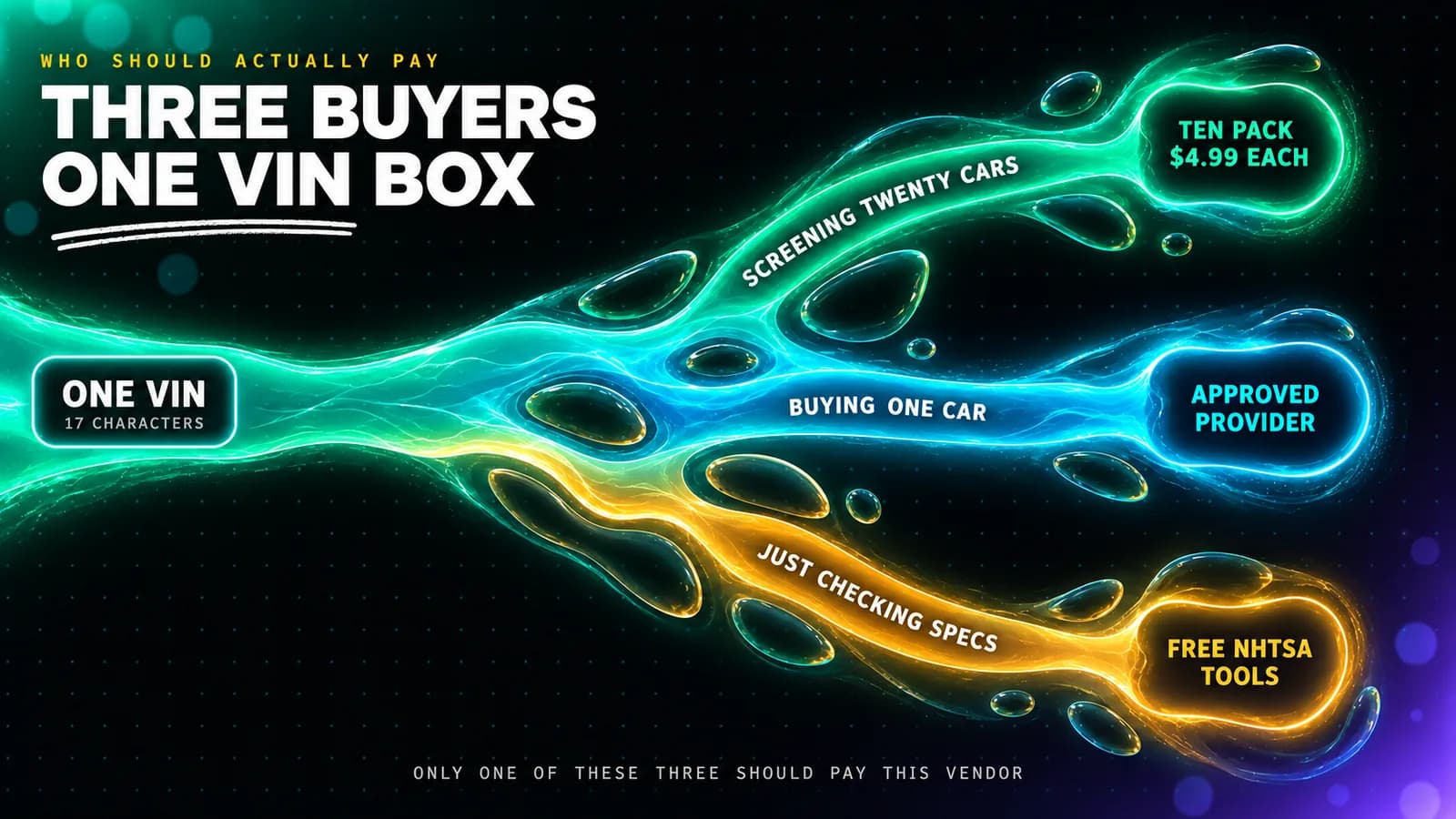
Buy an approved provider's ten pack if you are actively shopping and you want to knock out the obviously branded cars before spending time on viewings. That is the job VinCheckUp is sold for, and VinAudit does it for $3.00 a VIN.
Skip it and use the free tools if you want to know what a car is rather than what has happened to it. NHTSA decodes the VIN and lists the recalls for nothing, and it does both more accurately.
Skip it and pay an approved provider if you have found the car you intend to buy. VinAudit is $9.99 against VinCheckUp's $14.95, so at that point you are choosing the listed provider and saving money doing it.
Skip it entirely if you are outside the United States and the vehicle has never been US titled. There is no version of this product that helps you.
The group I would push hardest away from this purchase is first time used car buyers. They are the most likely to read "Information Available" as reassurance, the most likely to treat a clean looking report as permission to skip an inspection, and the least able to absorb being wrong.
If that is you, the sequence in the next section costs nothing and protects you better than this report will.
How to check any VIN properly in ten minutes
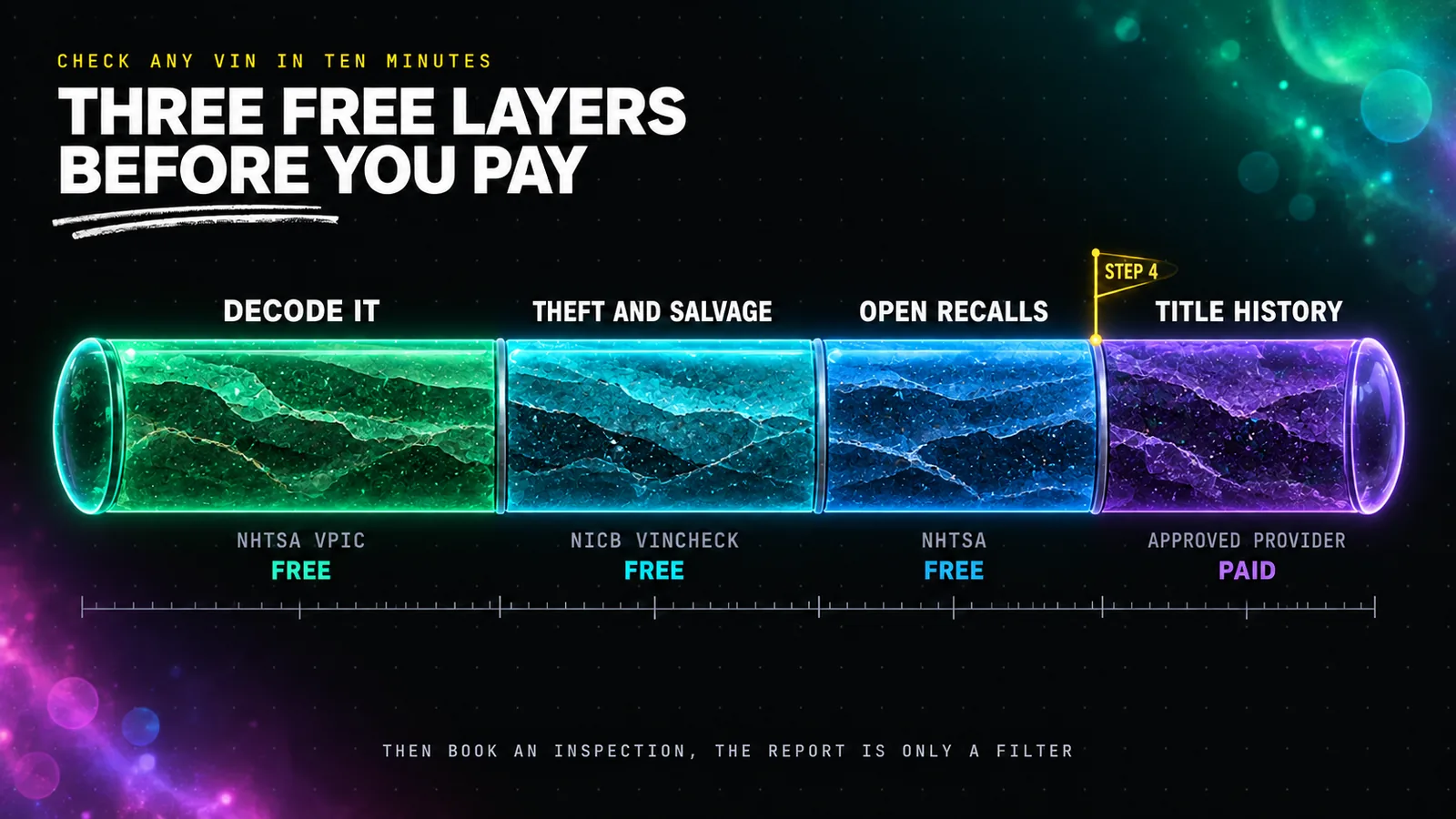
Decode the VIN at NHTSA vPIC, check theft and salvage at NICB VINCheck, check open recalls at NHTSA, then buy a title history from an approved provider. The first three steps are free, they take about ten minutes, and in that order they eliminate the most cars the fastest.
Step one, decode it. Run the VIN through NHTSA vPIC and confirm the year, make, model, body style, doors, engine and fuel type match the listing. A mismatch here ends the conversation before anything else matters.
Step two, check theft and salvage. Run it through NICB VINCheck. You get five a day per IP address, it covers insurers representing most of the US market, and a hit here is usually fatal to the purchase.
Step three, check open recalls. NHTSA's recall lookup tells you what the manufacturer has not yet fixed. Open airbag and fuel system recalls are both common and free to have repaired, so this is a bargaining point rather than a rejection.
Step four, and only now, buy a title history. By this point you have spent nothing and eliminated most of the list. Buy that report from a provider on the Justice Department's approved list, then read the brand history, the odometer trail and the owner count.
Then book an inspection. Every source in this article, including the federal ones, says the same thing: a history report is a filter and a mechanic is the decision.
The reason this sequence matters is that it inverts the funnel every vehicle report vendor builds. They want the payment before the free checks. Doing the free checks first is what tells you whether the payment is worth making at all.
VinCheckUp refund policy, and how to buy without regret
Your refund window is 60 days, not the four weeks the vendor's own terms claim, because ClickBank is the retailer of record on this checkout and its guarantee is the one printed at the point of sale.
The ClickBank order form for this product states that "ClickBank will allow for the return or replacement of any product within 60 days from the date of purchase". Your bank statement will read CLKBANK*VinCheckUp.
The vendor's terms page tells a different and worse story. It offers a "30-day satisfaction guarantee for first-time subscribers", then in the same paragraph says "Our refund policy is limited to four weeks" and that no refund can be issued after that.
Those two figures contradict each other by two days, and both contradict the 60 days at checkout. Under ClickBank's operating terms a seller may set any window from no refunds up to sixty days, and this seller has evidently registered the maximum while publishing something shorter.
The same terms page attaches a condition the checkout does not. It restricts the satisfaction guarantee to "customers subscribing for the first time", and withdraws it from anyone the vendor considers in breach of its own policies.
That is a discretionary refund policy dressed as a guarantee, and it is a further reason to treat the ClickBank window as the one that counts.
This is the second product in this series where the small print understated the buyer's protection rather than overstating it. The AI Media Machine review found the same inversion, a sales page advertising 30 days against a 60 day checkout.
So if you are going to buy it anyway, buy it defensively. Go through the ClickBank funnel rather than the public pricing page, because it is five dollars cheaper for the same report.
Download the PDF the day it arrives, before the 30 day access pass expires. Run the free NHTSA decode on the same VIN and compare the specification block, because that is the fastest way to see whether the report is reading your car.
And diarise day fifty. If the report comes back thin, request the refund through ClickBank order support with the order number from your receipt email rather than through the vendor, because slow vendor replies are one of the recurring buyer complaints.
VinCheckUp review: the final verdict
I would not buy it, and I would not recommend it to somebody buying a car.
The reason is not the price, which is fair, or the interface, which is fine, or the absence of a subscription, which is genuinely better than most of this marketplace. It is that the product's central claim to authority does not survive one click.
VinCheckUp sells NMVTIS data to consumers. The Department of Justice publishes the list of businesses approved to do exactly that. VinCheckUp is not on it and, as far as the archives go back, never has been.
Everything else I found points the same way. A preview returning identical lines for a 2003 Honda and a 2023 Tesla.
A specification panel calling a battery electric car a 4 litre petrol. A competitor's name left inside a copied paragraph on the vendor's own funnel.
A 1.3 out of 5 Trustpilot score with no company replies. A terms page telling you your refund rights are shorter than they actually are.
The one case anyone makes for it, the ten pack as a cheap screening filter, does not survive contact with VinAudit's published prices. An approved provider screens the same twenty cars for $59.98 against VinCheckUp's $99.90.
If you want a title history from this marketplace, buy from a name on the approved list. If you want to know what your car is, the government will tell you for nothing and get it right. And if you are going to buy this one anyway, the ClickBank route is cheaper and carries the longer refund window.
Verdict: not recommended. I could not find a buyer this is the right purchase for, because the cheaper option at every tier is also the one on the federal list.
This is the first review in Consumer Data Tools, a new section for VIN lookups, background searches and public records services. The question it asks of every product is the one this article opened with: where does the data actually come from, and does anybody official agree.
That question is cheap to ask and it keeps producing answers. It is the same one that turned up an undocumented usage cap inside a voice generator and an export format that never arrived in an ebook tool, and it is the first thing I will check on whatever lands here next.
FAQ
- Is VinCheckUp an approved NMVTIS data provider?
- No. The US Department of Justice publishes the list of every business approved to sell NMVTIS vehicle history reports to consumers, and vincheckup.com is not on it. Archived copies of the same page from March 2020 and March 2021 do not list it either, so this is not a recent delisting. VinCheckUp's own terms name a third party, Vin, Inc., as the authorised provider of its NMVTIS data.
- How much does VinCheckUp cost?
- It depends which door you come through. The ClickBank funnel sells a single report for $14.95, while the public pricing page on the same site lists $19.95 for the same thing. Both routes offer three reports for $29.95 and ten for $49.95. Checkout adds one optional $29.95 bundle, so the most you can spend in a single transaction is $44.90. There is no subscription.
- Is VinCheckUp legit or a scam?
- It is a real product that takes real payments and delivers a real report, so scam is the wrong word. The problem is accuracy and framing. It rated 1.3 out of 5 across 61 Trustpilot reviews when I checked, with 91 percent of them one star, and the company had not replied to the negative ones. The most common complaint is that the paid report contains less than the free preview implies.
- Is VinCheckUp free?
- The VIN search is free and so is the preview, but the preview contains no findings. Every history field it shows reads Information Available whichever vehicle you enter, and the only real number in it is the recall count, which NHTSA publishes free through its own public API. To see anything specific to your car you have to pay.
- Is VinCheckUp as good as Carfax?
- No. Carfax pulls from a dealer and service network that VinCheckUp has no equivalent of, and it is the more complete report by a wide margin. VinCheckUp is cheaper, but so is VinAudit, which sells a single report for $9.99 and is on the Justice Department's approved list. VinCheckUp is not, its specification data was wrong on both vehicles I tested, and its buyer reviews are among the worst in the category.
- Can you get a refund from VinCheckUp?
- Your sources disagree, so use the stronger one. The ClickBank order form for this product states that ClickBank will allow a return or replacement within 60 days of purchase. VinCheckUp's own terms page says the refund policy is limited to four weeks. ClickBank is the retailer of record on that checkout, so request the refund through ClickBank order support using the order number on your receipt email.
- Does VinCheckUp work in Canada?
- Not meaningfully. VinCheckUp describes its coverage as US states, its data sources are US titling agencies and US insurers, and NMVTIS itself only holds records on vehicles titled in the United States. A Canadian vehicle that has never been titled in the US will produce almost nothing. Canadian buyers are better served by a provider that actually holds Canadian registry data.
- What should I use instead of VinCheckUp?
- Start with the free government stack. The NHTSA vPIC decoder returns your car's real specifications, its recall API lists open recalls by vehicle, and NICB VINCheck flags insurer theft and salvage records at five searches per IP per day. If you still need a title history, buy it from an approved provider. VinAudit is on the Justice Department's list and charges $9.99 for one report and $29.99 for ten, which is less than VinCheckUp at both tiers.