
note
Affiliate disclosure: this review contains affiliate links to WallStreet Forex Robot. If you buy through one, I earn a commission at no extra cost to you.
Nobody paid for this review, I was not given a free copy, and nothing critical below was softened for the commission. How I handle affiliate links is covered in the disclaimer.
Most reviews of automated trading software argue about whether the strategy is any good. That argument is usually unwinnable, because neither side can see inside the robot.
There is a better question, and it is one you can answer from your desk. What evidence does the vendor publish, and does that evidence say what the sales page says it says?
WallStreet Forex Robot 3.0 Domination is unusually good to ask this of, because its vendor publishes more raw evidence than almost anyone in the category. Twenty six MetaTrader Strategy Tester reports sit on the site, each one a machine-generated file with a header full of numbers nobody wrote by hand.
I downloaded all twenty six.
Every one of them reports the same modelling quality, to the same two decimal places. Every one of them modelled fewer than two price updates per bar. And the eight belonging to the robot this page actually sells all stop in November 2021, on a site headlined "ready for 2026 market conditions".
That is the spine of this WallStreet Forex Robot review. The rest of what I found, a guarantee quietly halved and a flagship track record running on a demo account, stopped reading as separate complaints once I had the dates.
Is WallStreet Forex Robot worth it? The short answer
WallStreet Forex Robot is hard to recommend at $297, mainly because the evidence supporting it is nearly five years old and was generated at the lowest fidelity MetaTrader offers. The robot is real and its live results are positive, but the marketing rests on figures the vendor has not refreshed since 2021.
Here is the verdict before the sections that justify it.
It is not a scam. FXautomater has sold since 2012, the licence server works, the member area is real, and the 30-day guarantee is stated honestly and matches what ClickBank's checkout says.
But the headline numbers are stale. The "$588k" and "$2420k" figures on the sales page come from specific files I opened, and those files stop on 5 November 2021.
And the proof of live trading is thinner than advertised. The page claims "rigorous Real-Money Accounts trading", while the only Myfxbook account published for the flagship robot is labelled Demo by Myfxbook itself.
If you still want it, the Premium Pack at $297 is the only tier that makes arithmetic sense, and the thirty days is your entire test window.
WallStreet Forex Robot at a glance
Everything below was checked on 20 September 2026 and comes from the vendor's own pages or ClickBank's order form.
- Product: WallStreet Forex Robot 3.0 Domination, an Expert Advisor for MetaTrader 4 and MetaTrader 5
- Vendor: FXautomater, trading on ClickBank under the nickname
fxexpertssince 15 February 2012 - Price: Starter Pack $247, Premium Pack $297, Ultimate Pack $367, all one-time. Single robots $217
- What the packs differ on: Starter licenses one Expert Advisor, Premium licenses five, Ultimate licenses five plus an indicator and doubles the account allowance
- Licensing: one real-money account per Expert Advisor on Premium, two per Expert Advisor on Ultimate, unlimited demo accounts on every tier
- Pairs and timeframe: EURUSD, GBPUSD, USDJPY, USDCHF, USDCAD, NZDUSD, AUDUSD and EURJPY, on the M15 chart
- Guarantee: 30 days, confirmed on both the vendor's page and the ClickBank order form
- Statement descriptor:
CLKBANK*WSULTIMATEPACKorCLKBANK*WSPREMIUMPACK - Published evidence: 26 Strategy Tester reports and 10 public Myfxbook accounts
- ClickBank marketplace figures: gravity 2.10, average $84.64 per sale, no rebills
WallStreet Forex Robot pros and cons
The honest version of both lists. Nothing here is softened, and nothing is invented to balance the page.
What it genuinely has going for it:
- It publishes raw evidence. Twenty six full Strategy Tester reports and ten public Myfxbook accounts is more disclosure than most competitors offer, and it is the reason a review like this one is even possible.
- It is not a martingale system. The robot does not double down into losses by default, which puts it in a lower risk class than a large share of the retail Expert Advisor market.
- Fourteen years of releases. Version 3.0 Domination v1.3 is a real product line with a version history, not a launch that vanished.
- The guarantee is stated accurately. Thirty days on the vendor's page, thirty days at ClickBank's checkout, no contradiction between them.
- The live demo account beats its own backtest on profit factor, 1.77 against 1.32, which is the opposite of what usually happens.
What should give you pause:
- Every flagship backtest ends in November 2021, marketed under a "ready for 2026" headline.
- All 26 reports show 90.00 percent modelling quality, which is the arithmetic ceiling for one-minute data, not a high score.
- The backtests assume a fixed 10-point spread with no commission and no slippage, on a strategy that needs tight spreads to work.
- The guarantee was cut from 60 days to 30 in late 2025, and several reviews ranking today still quote the old figure.
- "100% Guaranteed Long-Term Profits" is printed as a product feature on a page that elsewhere says past results guarantee nothing.
- The Starter Pack is a trap. It costs $247 and licenses one robot, while $297 licenses five.
- The countdown timer reads 00:00:00 on every page of the site and the sale never ends.
How I researched this WallStreet Forex Robot review
I did not buy this robot, I was not given a copy, and I have not traded it. Claiming otherwise would be the easiest thing in this article to fake and the least useful thing in it.
What I did instead was treat the vendor's own published files as the primary source, because machine-generated files are harder to spin than marketing copy.
I downloaded all 26 Strategy Tester reports from the vendor's backtests page and parsed the header block out of each one: instrument, period, model, bars in test, ticks modelled, modelling quality, spread, profit factor and drawdown.
I read the ten public Myfxbook accounts the sales page links to. Those pages render in JavaScript behind a bot wall, so I loaded them in a real browser rather than trusting a text fetch.
I pulled archived copies of the sales page from January 2022, March 2024, June 2025, October 2025, January 2026, April 2026 and July 2026, and compared the price table and the guarantee wording across all of them.
I loaded the ClickBank order form for two of the three packs with an Indian locale, which is where the tax line, the exchange rate and the real refund window are printed.
Where a number is an estimate, I say so. Where two sources disagree, I give you both and say which one I would act on.
What WallStreet Forex Robot 3.0 actually is
WallStreet Forex Robot is an Expert Advisor, which is a program written in MetaQuotes' own language that runs inside the MetaTrader terminal and places trades on your broker account without you being present to approve them.
Most traders call these things forex EAs, trading bots or forex robots interchangeably, and the file you receive is an .ex4 for MT4 or an .ex5 for MT5.
It is not a signal service and it is not a copy-trading arrangement. The code runs on your machine, or on a virtual server you rent, and it talks to your broker as though it were you.
The strategy is described as a short-term system on the M15 chart, trading eight major currency pairs, with dynamically calculated stop loss and take profit levels rather than fixed ones.
Risk management is left to you. Lot size, margin and how much of the account any one robot is allowed to touch are all settings you choose, and the defaults in the supplied set files are the vendor's opinion, not a rule.
Critically, it is not a martingale. Martingale systems recover losses by increasing position size, which produces beautiful equity curves until the one day they do not. This robot does not do that by default, and that is a genuine point in its favour.
The vendor wraps several products into the same purchase. Alongside the flagship you get WallStreet Asia, WallStreet Recovery PRO, WallStreet GOLD Trader and WallStreet CRYPTO, depending on which pack you buy.
That bundling matters more than it first appears, because as you will see, the newer bundled robots have fresher evidence behind them than the robot the page is named after.
Who is behind WallStreet Forex Robot
The vendor is FXautomater, a Bulgarian developer that has been publishing MetaTrader Expert Advisors since around 2010 and selling on ClickBank under the nickname fxexperts since 15 February 2012.
They are not anonymous and they are not new. The same team sells Forex Diamond EA, Forex Gold Investor, Infinity Trader EA, Crypto Investor EA, Gold Scalper PRO and Trend Matrix EA, each on its own domain, each at $267 or $217 from a struck-through anchor price.
Longevity is worth something here. A vendor that has maintained a licence server, a member area and a support desk for fourteen years is a different proposition from a launch that appears and disappears in a quarter.
It also sets a standard. A team with that much history has no technical excuse for a flagship product whose performance evidence stopped being updated in 2021, particularly when the same team updated the evidence for its newer products in 2025 and 2026.
The company describes itself as "the most trusted EA vendor on the forex market". That is the sort of claim no outside source can confirm, and I am reporting it as a claim rather than as a fact.
How the WallStreet Forex Robot workflow actually goes
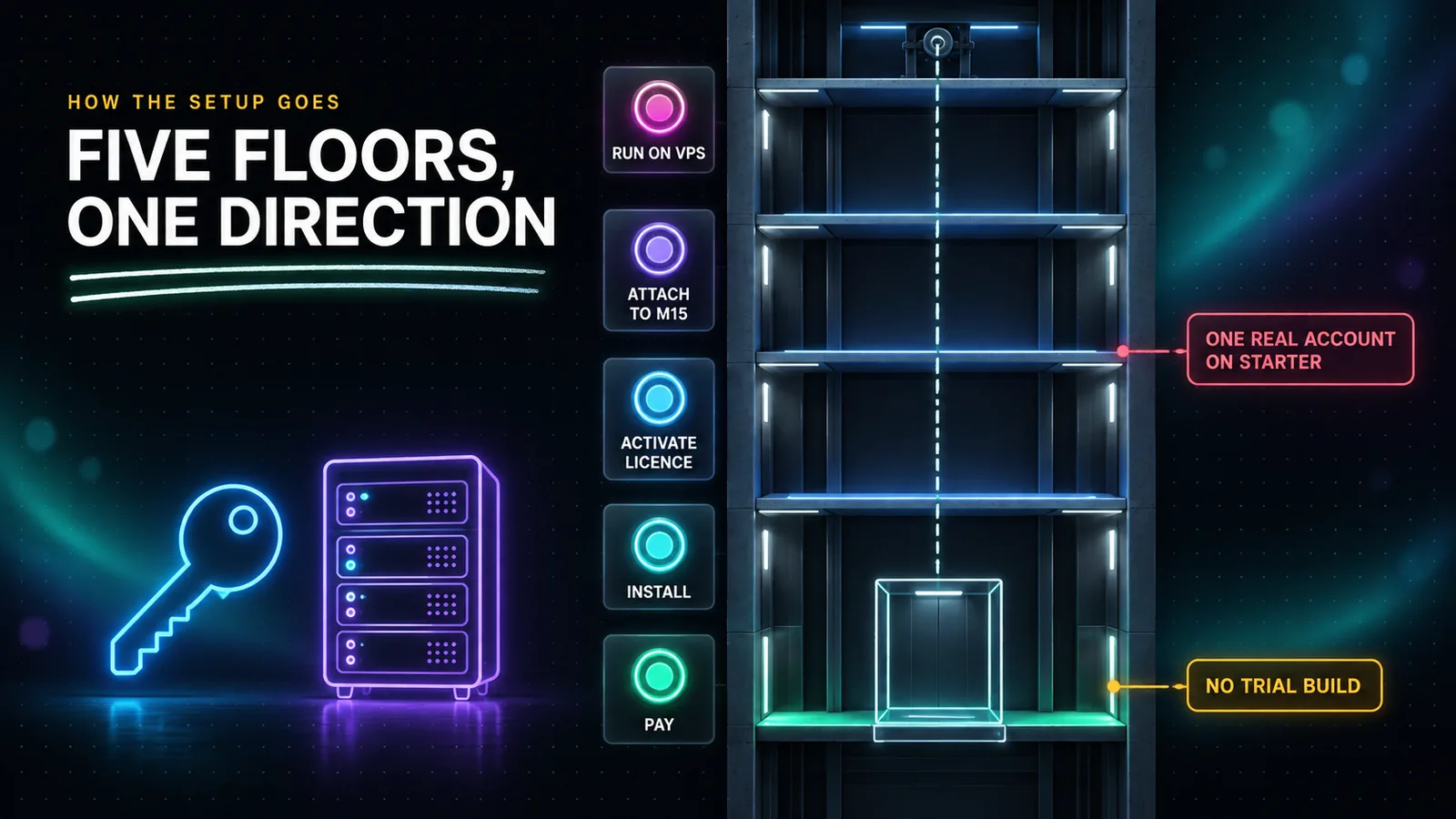
The buying and setup sequence is short, and it is worth knowing before you pay because two of the steps constrain you in ways the sales page does not emphasise.
Step one, you pay and receive a download. There is no trial and no demo build. The first time you can run this software is after the money has left your account.
Step two, you install into MetaTrader. The .ex4 or .ex5 file goes into the terminal's Experts folder, and you restart the platform.
Step three, you activate against the licence server. This is where the account limit bites.
On the Starter Pack you may register one real-money account. On Premium it is one per robot, on Ultimate two per robot. Demo accounts are unlimited on every tier.
Step four, you attach it to an M15 chart and load the supplied set file for your pair and broker.
Step five, you leave it running. In practice this means a virtual private server, because the robot cannot trade while your laptop is asleep. That is a recurring cost the sales page does not carry, typically $10 to $30 a month.
The friction worth noting is step one. Because there is no demo build, your thirty day refund window is the only opportunity you will ever get to test this robot before committing to it.
The WallStreet Forex Robot backtests stop in November 2021
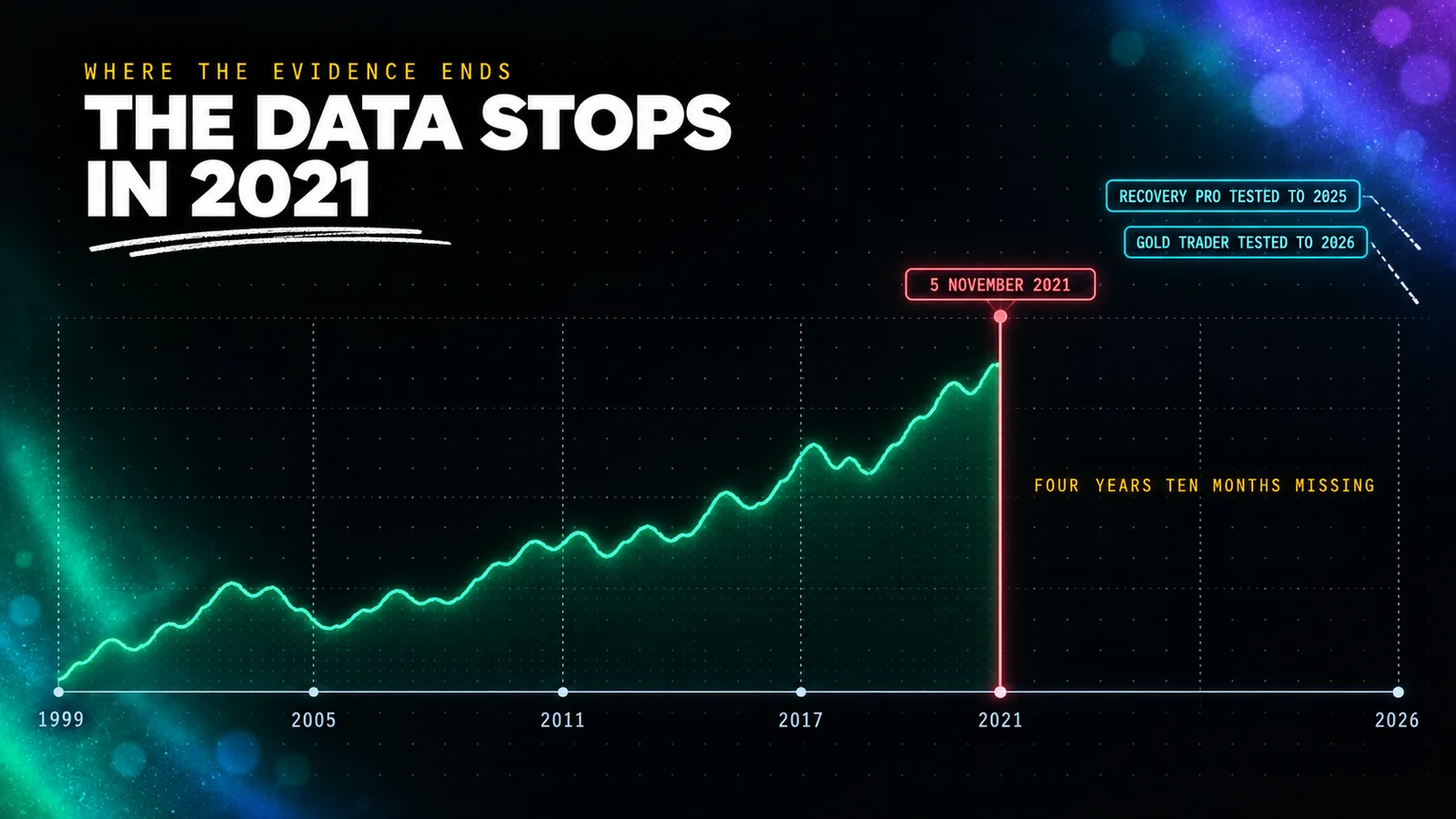
Every performance figure on the sales page comes from a Strategy Tester report that stopped collecting data on 5 November 2021, nearly five years before the page that displays it claims the robot is "ready for 2026 market conditions".
That is the finding, and it is checkable in about four minutes.
The vendor publishes a backtests page linking 26 full MetaTrader reports. Eight of them belong to WallStreet Forex Robot 3.0 Domination v1.3, and their test periods end between 3 and 5 November 2021.
The headline cards on the sales page are those exact files. Not similar figures, the same figures.
- EUR/USD With MM: $588k, profit factor 1.32, max drawdown 10.29%. That is
EURUSD-MM3.htm, to the decimal. "MM" is money management, meaning the test compounded its lot size as the balance grew. - GBP/USD With MM: $2420k, profit factor 1.54, max drawdown 5.91%. That is
GBPUSD-MM3.htm. - USD/JPY With MM: $1715k, profit factor 1.59, max drawdown 7.10%. That is
USDJPY-MM3.htm. - USD/CAD With MM: $1101k, profit factor 1.30, max drawdown 11.05%. That is
USDCAD-MM3.htm.
The four fixed-lot cards map the same way. Every number the page advertises is a number from a file that has not moved since 2021.
The label on those cards reads "22-YEAR BACKTEST", and that is accurate. The tests run from January 1999 to November 2021. What the label does not say is that the twenty two years ended almost five years ago.
Now the part that makes this hard to defend. The same vendor updated the evidence for its other products. WallStreet Recovery PRO's reports run to 20 October 2025, and WallStreet GOLD Trader's run to 1 September 2026, nineteen days before I checked.
So this is not a capability problem, a data problem, or a company that stopped working. The robots FXautomater sells alongside the flagship have current backtests. The flagship does not.
Four years and ten months are missing from the evidence for the product the page is named after, and those particular years included the fastest interest rate cycle in four decades.
What 90 percent modelling quality actually means
A modelling quality of 90.00 percent is not a high score, it is the maximum figure MetaTrader will print for a backtest generated from one-minute bars. Reading it as ninety out of a hundred is the single most common mistake made about Expert Advisor backtests.
All 26 of this vendor's reports state "Modelling quality 90.00%". Identical, to two decimal places, across four different robots tested in three different years.
That consistency is the tell. A figure a robot earned would vary between instruments and test periods; a ceiling does not move.
MetaQuotes publishes the formula in its own developer documentation. Modelling quality is calculated as ((0.25*(StartGen-StartBar) + 0.5*(StartGenM1-StartGen) + 0.9*(HistoryTotal-StartGenM1)) / (HistoryTotal-StartBar))*100%.
Read the coefficients. The 0.9 multiplier applies to the stretch of the test modelled from minute bars, so a test modelled entirely from minute bars resolves to 0.9, which prints as 90.00 percent.
It cannot print higher. Reaching 99 percent requires real tick data, which MetaTrader does not generate on its own.
The tick counts confirm it. The flagship EURUSD report states 8,096,472 bars in test and 15,860,923 ticks modelled, which is 1.96 price updates per bar. Across all 26 reports that ratio sits between 1.91 and 1.99.
MetaQuotes defines "ticks modelled" as "the size of the modeled sequence", where each record represents a bar state rather than a real market print. Two synthetic updates per bar is interpolation, and the report calls this model "Every tick (the most precise method based on all available least timeframes)".
Then there is the spread. The major-pair tests assume a fixed 10-point spread, with no commission and no slippage, the gap between the price a robot asks for and the price it actually gets. The Asia crosses assume 20 to 50 points, ETH assumes 250 and BTC assumes 820.
For a system whose average winning trade is worth roughly 8 pips, a fixed best-case spread and zero slippage is not a small assumption. It is most of the margin.
None of this proves the robot loses money. It does mean the published backtests are a low-fidelity simulation under favourable conditions, and they should be read as an upper bound rather than as a track record.
The WallStreet CRYPTO backtest ends three weeks before the crash
The bundled robots have their own reports, and two of them are worth separating out because the test windows were chosen in ways the sales page never mentions.
WallStreet CRYPTO's Bitcoin backtest runs from 8 January 2021 to 21 October 2021. That is nine and a half months, and all of it sits inside the 2021 bull market.
Bitcoin set its record high the month after that test ended, and the decline that followed through 2022 took it down by roughly three quarters. None of that is in the report.
The Ethereum reports are the same shape, running from 28 December 2020 to the same 21 October 2021 cut-off. Ten months, one direction.
A trend-following system tested only across a rise will look excellent. That is the textbook setup for curve fitting, where a strategy's settings are tuned until they fit one stretch of history and then fail on the next.
That is not a criticism of the robot's code, it is a statement about what a nine month sample can and cannot tell you, and the honest word for a result like that is untested, not proven.
The spread assumptions in those same files deserve a look too. The Bitcoin tests assume a fixed 820 point spread and the Ethereum tests a fixed 250, held constant for the entire period.
Crypto spreads are not constant. They widen sharply in exactly the volatile conditions a short-term system trades into, and a fixed figure removes that risk from the simulation entirely.
The Asia reports are the opposite problem. They run a full 22 years, from January 1999 to November 2021, but assume 20 points on EURGBP and EURCHF and 50 points on GBPCAD and GBPCHF, which are the crosses where real spreads are widest and least stable.
So across the bundle the pattern holds in both directions. Where the test period is long, the execution assumptions are generous. Where the execution assumptions are closer to plausible, the test period is short and one-sided.
None of the five robots has a published backtest that is both long and realistic about costs, and that is the fairest single sentence I can write about the vendor's evidence as a whole.
WallStreet Forex Robot pricing: what you actually pay
WallStreet Forex Robot sells in three one-time packs. On 20 September 2026 the Starter Pack was $247, the Premium Pack $297 and the Ultimate Pack $367, each shown against a struck-through anchor price of $497, $1,520 and $1,640.
Individual robots are sold separately at $217 each, against a $447 anchor.
There are no upsells after checkout and no rebills. ClickBank reports an average rebill total of $0.00 for this vendor, which matches the vendor's "one-time payment" labelling, and that is worth saying plainly because recurring charges are the usual complaint in this category.
What the sales page does not tell you is that the anchor prices have been rewritten over the years. In January 2022 the Premium Pack's "regular price" was $897. By March 2024 the same pack's "regular price" was $1,520, a 69 percent increase in a number nobody has ever paid.
The discount percentage is reverse-engineered from whichever anchor is convenient, which is a pattern I have documented before on AI Media Machine, where a price held still for 26 months while the claimed saving moved freely.
The live price moves too, and not in the direction the countdown implies. Archived copies show the Premium Pack at $267 through most of 2026 and at $247 in January. Today, during a "MEGA SALE", it is $297.
The permanent sale is currently charging thirty dollars more than the same pack's standing price for most of this year.If you want to check the current figure yourself rather than trust mine, it is on the WallStreet Forex Robot order page. Prices in this category rotate, and mine is a snapshot.
One more line for readers in India, since that is where a good share of this site's audience sits. ClickBank's order form rendered for an Indian buyer prices the Ultimate Pack at Rs 39,308.56 plus Rs 7,075.54 tax, a total of Rs 46,384.10. That tax line is exactly 18.00 percent GST.
That implies an exchange rate of 107.11 rupees to the dollar against a market rate of 95.99 the same day, an 11.58 percent spread. The delivered cost is about $483 on a $367 sticker, roughly 32 percent over. The Premium Pack lands at the identical 32 percent premium.
The Starter Pack is a decoy, and the maths says so
The single most useful thing in this review costs you nothing and takes ten seconds. Never buy the Starter Pack.
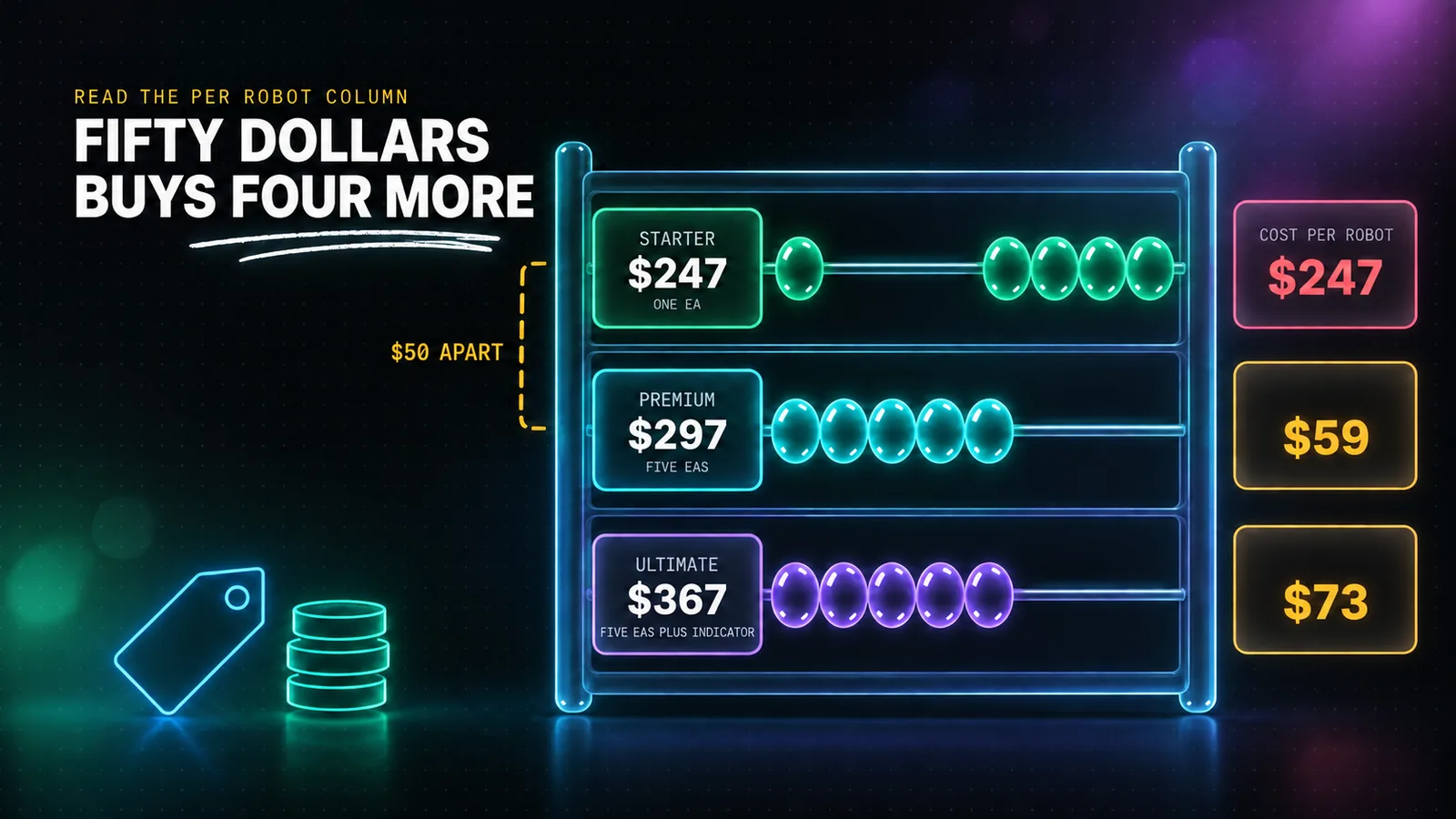
The Starter Pack is $247 and licenses one Expert Advisor. The Premium Pack is $297 and licenses five.
Fifty dollars more buys four additional robots. Per robot, that is $247 against $59.
The package table makes this easy to miss, and I suspect that is the point. The Starter column displays all six products with tick marks beside them, so it reads as though you are getting the lot. The line that corrects it sits below the ticks and says "Included in Total: 1 EA".
The Ultimate Pack at $367 is a more genuine decision. It adds the CRYPTO indicator and doubles the real-money account allowance from one per robot to two, which matters only if you intend to run the same robot on two live accounts.
For most buyers the choice is between Premium and nothing, and the $120 gap between Starter and Ultimate buys far less than the $50 gap between Starter and Premium.
Entry tiers that exist to make the next tier look generous are common enough, but this one is unusually stark. The Starter tier is not crippled or restricted, it simply delivers one fifth of the product for eighty three percent of the price.
The WallStreet Forex Robot guarantee was cut from sixty days to thirty
The current guarantee is thirty days, and both the vendor and ClickBank agree on that, which is more than I can say for most products I have reviewed.
The vendor's page states "30-Day 100% Money-Back Guarantee" in five places. ClickBank's order form states that it "will allow for the return or replacement of any product within 30 days from the date of purchase". No contradiction, no small print undercutting the advertisement.
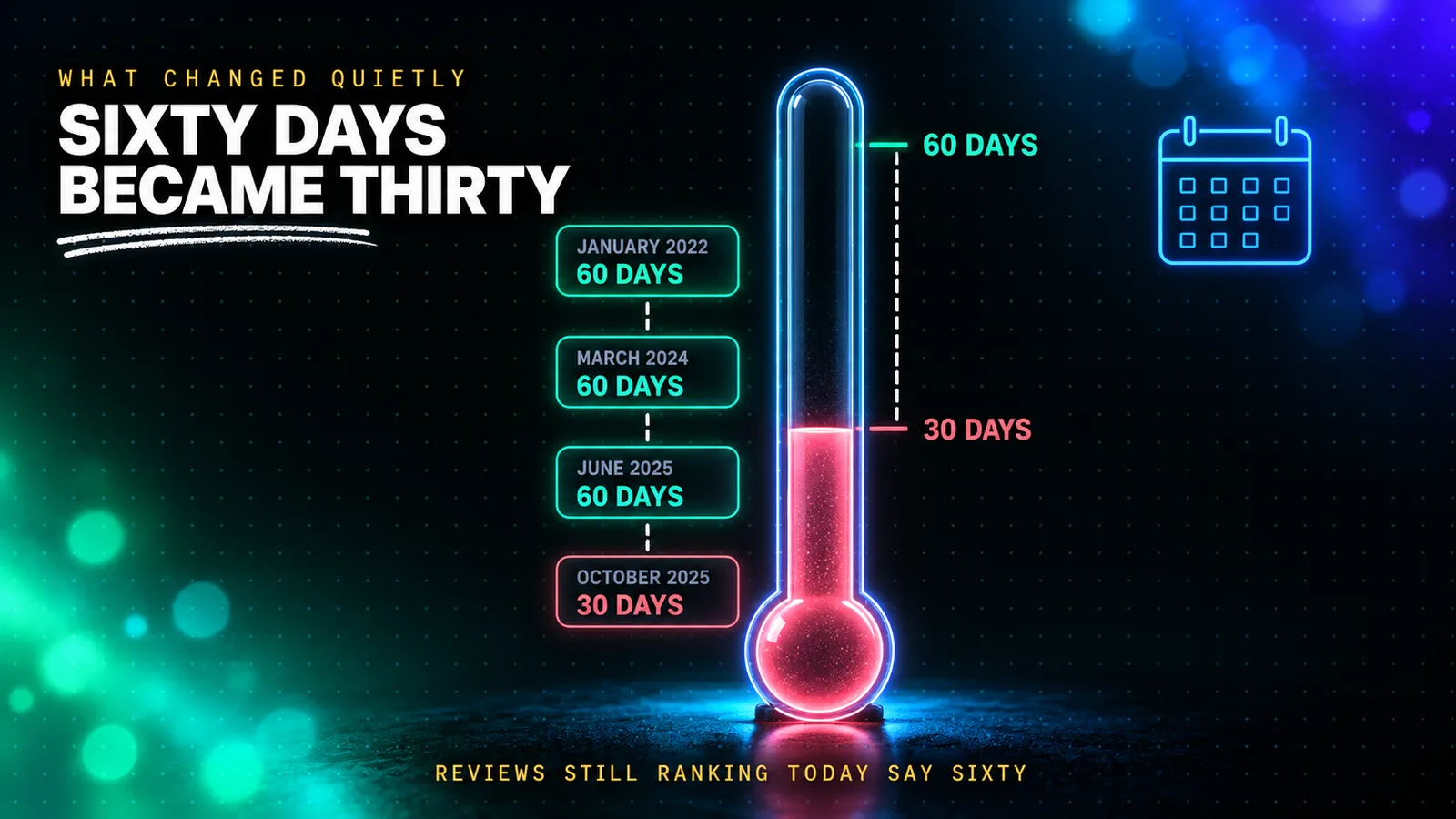
What nobody has published is that this number used to be double.
Archived copies of the same sales page show a 60-Day 100% Money Back guarantee in January 2022, March 2024 and as recently as June 2025. By October 2025 the same page read thirty days, and it has read thirty days ever since.
The buyer protection on this product was quietly halved somewhere between June and October 2025, and the sales page never mentioned the change.This has a practical consequence for anyone researching the purchase. Several of the reviews ranking on page one today still state a 60-day guarantee, because it was true when they wrote it and they have not rechecked.
If you buy on the strength of one of those pages expecting two months to evaluate, you have thirty days. Diarise day twenty five.
It is worth being fair about the context. ClickBank's own operating terms let a seller set anywhere from no refunds at all up to sixty days, so thirty is legitimate and it is well inside the normal range. This is not a rule being broken.
It is simply a reduction in what you get, applied silently, on a product whose entire value proposition requires you to test it before the window closes. With no demo build available, those thirty days are the whole of your evaluation.
What the WallStreet Forex Robot Myfxbook accounts actually show
The sales page links ten public Myfxbook accounts under headings like "Fully Verified Myfxbook Account", and says the robot "CONQUERED 20 Years of brutal testing PLUS rigorous Real-Money Accounts trading".
Those pages sit behind a bot wall and render entirely in JavaScript, so I loaded them in a real browser. Here is what they say.
Only one of the ten belongs to WallStreet Forex Robot 3.0. The other nine track Recovery PRO, GOLD Trader and CRYPTO, which are different products in the same bundle.
And that one account is a demo. Myfxbook's own header on the WallStreet Forex Robot EURUSD account reads "Demo (USD), IC, Technical, Automated, 1:500, MetaTrader 4".
So the robot the page is named after is evidenced by a demo account, on a page advertising real-money trading. To be precise about what that does and does not mean: the account is genuinely tracked, genuinely automated and genuinely updating, and a demo account still executes against live prices. It just is not real money.
The numbers on it are respectable and worth reading properly. Across 503 trades it shows a gain of 98.24 percent on a $1,000 balance, a monthly average of 1.77 percent, a maximum drawdown of 13.07 percent and a profit factor of 1.77.
That profit factor is better than the 1.32 its own EURUSD backtest produced, which is a genuine point in the robot's favour and the opposite of the usual pattern.
Two numbers temper it. The Sharpe ratio, which measures return against volatility, reads 0.13, and the average win is 8.15 pips against an average loss of 27.56 pips.
The strategy only works because it wins roughly 87 percent of the time, so a modest fall in that win rate flips the whole thing negative.
The average trade lasts 10 hours 43 minutes, which is not scalping whatever the marketing says.
The two accounts that genuinely are real money belong to the other robots, and they are small. Recovery PRO REAL shows A$638 deposited with a 41.67 percent drawdown, nearly double what its own backtest predicted. GOLD Trader Real shows $515 deposited across 131 trades.
The vendor's real-money evidence involves less deposited capital than the software costs.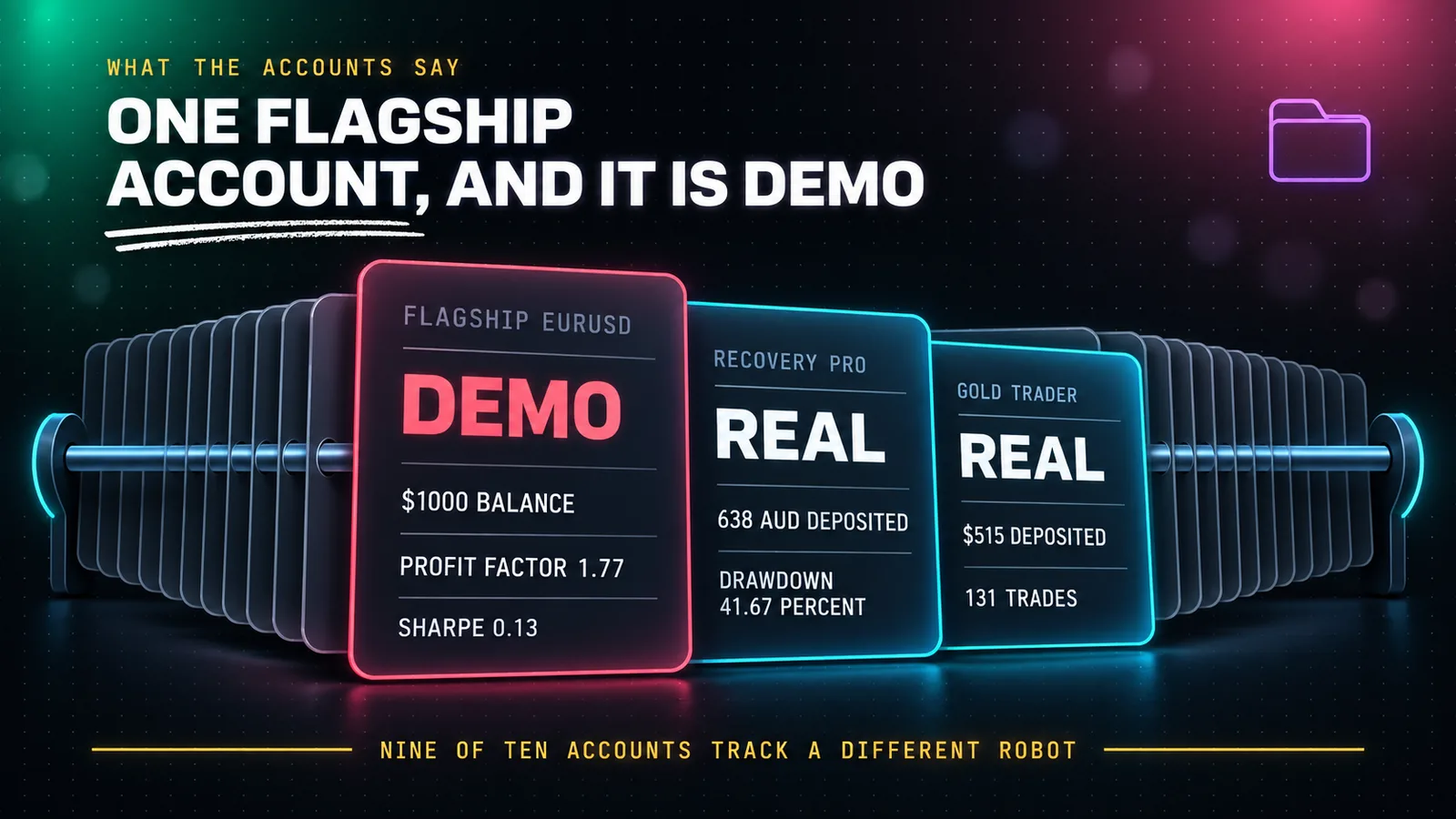
What the marketplace numbers say about who actually buys this
ClickBank publishes marketplace figures for every product it sells, and the ones attached to this listing describe something small, old and steady rather than something being pushed hard. That matters mostly for how you should read the other reviews you find.
Gravity is 2.10. Gravity approximates how many distinct affiliates made a sale recently, so a figure near two means the promotional side of this product is close to dormant. For scale, the busiest listings on the platform run into the nineties.
The average sale is $84.64, with an average rebill total of $0.00. The zero confirms the one-time billing, and the $84.64 is the affiliate's cut rather than the price.
That second number is worth one piece of arithmetic. If the typical buyer takes the $297 Premium Pack, an $84.64 average commission implies a rate in the region of 28 percent, which is modest for a digital product where 50 to 75 percent is the norm.
I am labelling that an inference from two published figures rather than a vendor disclosure, because the vendor does not state its commission rate publicly and the mix of packs sold is unknown.
The listing dates from 15 February 2012, which makes it one of the older products on the platform. ClickBank trackers record a gap in the middle of that run and a relisting in 2022, so it has not been continuous, but a vendor still selling under the same nickname fourteen years on is a real signal.
Put those together and a coherent picture emerges. This is not a launch being pushed hard by affiliates chasing a new offer. It is a long-lived product selling quietly to people who searched for it by name.
A dormant affiliate lane also explains the state of the search results. Most pages ranking for this product were written years ago and left alone, which is exactly what their stale prices and outdated 60-day guarantee figures demonstrate.
It also explains the thin buyer record. A product selling steadily but slowly for fourteen years accumulates few public reviews, which is the next thing worth looking at.
Is WallStreet Forex Robot legit? What real buyers say
WallStreet Forex Robot is a legitimate product in the narrow sense that matters legally: a real company takes your money, delivers working software, honours a stated guarantee and has done so for fourteen years. Nothing I found suggests otherwise.
The buyer evidence, though, is too thin to draw conclusions from, and I would rather say that than manufacture a consensus.
Trustpilot holds only six reviews for wallstreet-forex.com, scoring 2.4 out of 5, with 83 percent of them one star. The recurring themes are account losses within a few months, slow support replies and scepticism about the published results.
Six reviews is not a sample. It is an anecdote with a number attached, and anyone quoting "2.4 out of 5" without that caveat is misleading you.
For contrast, the Sqribble review on this site covered a product with 344 Trustpilot reviews scoring 4.6, which is a number you can actually reason about. Six is not.
The forum record is more useful and roughly matches the score's direction. Complaints on ForexPeaceArmy cluster on performance falling short of the marketing rather than on non-delivery or refund refusal, which is a meaningfully different class of complaint.
The specialist review sites that rank for this product are mostly positive, and it is worth knowing why before you weight them. Nearly all of them carry affiliate links to it, one is a virtual server host selling hosting to buyers, and one is the vendor's own reseller.
Two of them also get basic facts wrong. One states the price as $227 and the guarantee as 60 days; another lists the packs at $197, $267 and $367. Those were all true at some point in the past two years and none of them is true today, which tells you how recently they checked.
The fair summary is that this product has no scandal attached to it and no meaningful independent verification either. That is not the same as a clean record, and it is not the same as a bad one.
WallStreet Forex Robot vs Forex Fury vs the MQL5 Market
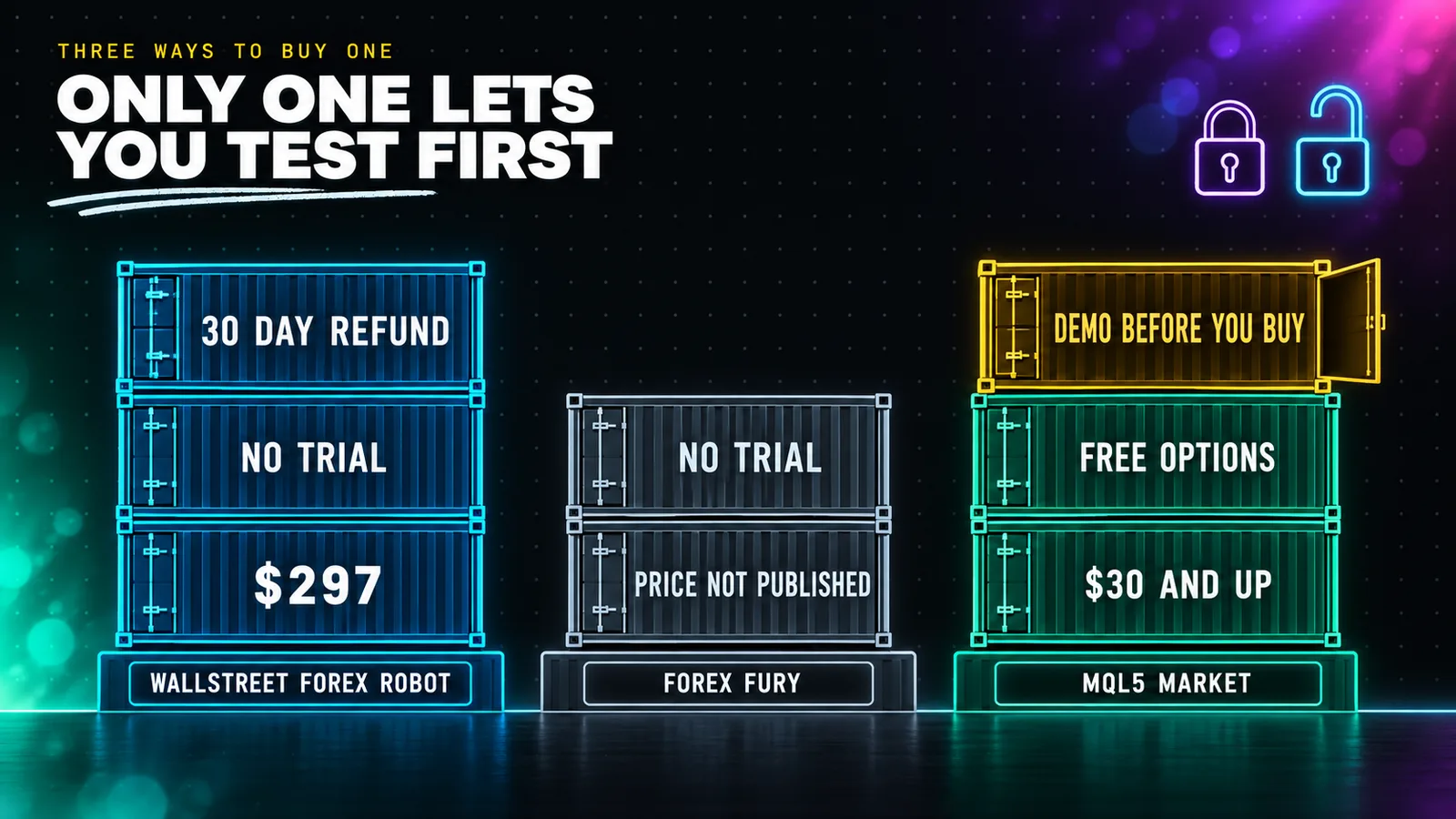
The comparison that matters here is not between two robots. It is between three ways of buying one, and only one of them lets you test before you pay.
WallStreet Forex Robot, $297 for the Premium Pack. Sold direct, no trial build, no demo version. You can read the vendor's backtests and Myfxbook accounts before buying, and that is the entire body of evidence available to you. Thirty day guarantee.
Forex Fury, its closest direct competitor by search volume, is harder to compare because it publishes no price at all. I checked its home page, its 2026 product page and its FAQ on 20 September 2026 and found no figure on any of them. Its FAQ confirms lifetime access with no recurring fees, and answers "Not at this time" on whether a free trial exists.
A competitor that hides its price is not a better option, and I am naming that rather than guessing a number.
The MQL5 Market is the genuine alternative, and it changes the shape of the decision. It is MetaQuotes' own marketplace, built into the MetaTrader terminal, listing thousands of Expert Advisors from roughly $30 to several thousand dollars, with free ones alongside them.
The difference is structural. MetaQuotes' documentation states that "every Expert Advisor offered on MQL5 Market has a demo version available", and that before buying, an Expert Advisor "can and should be carefully run in all unfavorable modes".
That is the thing a direct-sold robot cannot offer. On the MQL5 Market you run the actual robot in your own Strategy Tester, against your own broker's data, at whatever modelling quality your data supports, before any money changes hands.
Buying direct means the first run happens after payment, and your only protection is the refund window. Buying through the MQL5 Market means the test happens first.
That is not an argument that MQL5 Market robots are better. Plenty are worse. It is an argument that you get to find out which before you pay, and that is worth more than any backtest a vendor hands you.
The one honest argument for buying WallStreet Forex Robot
There is a real case here, and it is narrower than the sales page suggests but it is not nothing.
It rests on the bundle, not the flagship.
For $297, the Premium Pack licenses five Expert Advisors at $59 each. Two of those five, Recovery PRO and GOLD Trader, have backtests dated 2025 and 2026 and real-money Myfxbook accounts behind them, small as those accounts are.
Bought individually those same robots are $217 each, so five would cost $1,085. The pack is genuinely cheaper, and unlike the struck-through anchor prices, that comparison uses two figures the vendor actually charges today.
Set against the MQL5 Market, where mid-range Expert Advisors commonly run $100 to $500 each, $59 per robot from a vendor with a fourteen year history is not obviously bad value.
The case therefore goes like this. If you already run MetaTrader on a virtual server, already have a raw-spread broker account, already understand that no robot is a salary, and you want five systems to evaluate on demo accounts for the price of one, the Premium Pack is a defensible purchase.
Note what that argument does not include. It does not include the flagship robot's 2021 backtests, the 90 percent modelling quality, or the $2420k headline. None of those should move you.
And it depends entirely on you actually doing the evaluation. Demo accounts are unlimited on every tier, which means you can run all five on demo, for thirty days, and request a refund if they disappoint. That is the honest way to buy this.
Anyone buying because the page promises "100% Guaranteed Long-Term Profits" is buying the wrong thing, and that phrase is printed as a product feature on a page that elsewhere admits past results guarantee nothing.
Free WallStreet Forex Robot alternatives worth trying first
Before spending $297, there are three free things that answer most of the questions this purchase is meant to answer.
The MQL5 Market's free Expert Advisors. MetaQuotes' own marketplace lists free robots alongside paid ones, downloadable straight into the terminal. They are not better than commercial products, but they cost nothing and they teach you what an Expert Advisor's behaviour actually feels like on a chart.
The demo version of any paid MQL5 Market robot. This is the important one. Every paid Expert Advisor on that marketplace ships a demo you can run in the Strategy Tester first. If you want to know whether automated trading suits you, run three demos for a week before buying anything.
A free Myfxbook account. Myfxbook is free to use, and it is the same service the vendor uses to publish its own results. Connect your own demo or live account and you get the verified statistics, drawdown figures and Sharpe ratio that this review spent several paragraphs extracting from someone else's page.
That third one reframes the whole exercise. The reason a vendor's Myfxbook link carries weight is that the data is independently recorded. You can have exactly the same instrument pointed at your own trading, for nothing.
And a fourth, free, that costs only time. MetaTrader's own Strategy Tester will run any robot you already own against your broker's history. If you download better quality tick data, you can generate the 99 percent modelling quality backtest that the vendor's own reports never reach.
Do those four things and you will be a considerably better judge of whether $297 is worth spending than any review, including this one, can make you.
Who WallStreet Forex Robot is for, and who should skip it
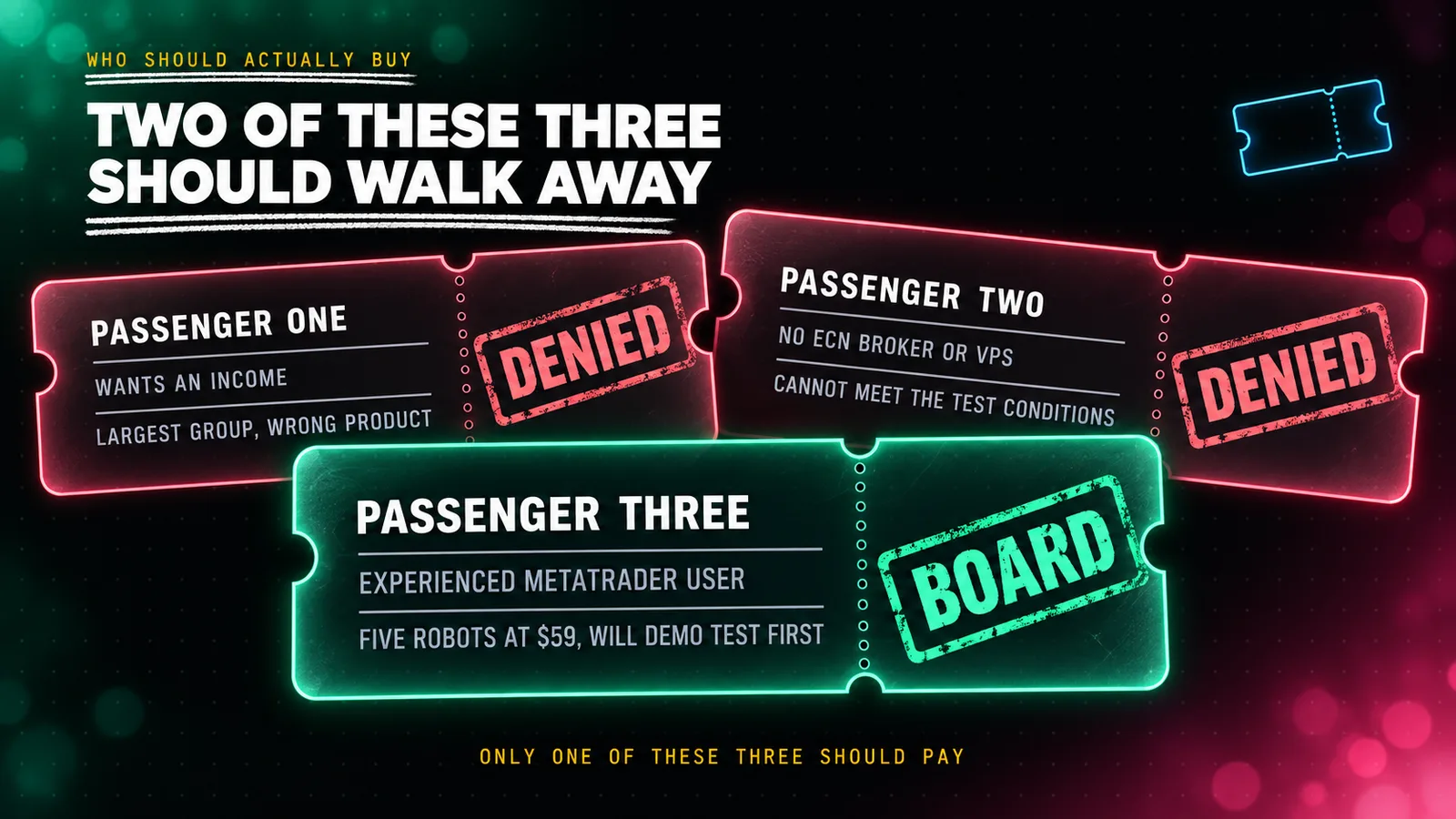
Skip it entirely if you are hoping it will replace an income. This is the largest group of people who buy products like this one, and the page's "100% Guaranteed Long-Term Profits" line is aimed squarely at them. The vendor's own best live evidence is a demo account averaging 1.77 percent a month on a thousand dollars.
Skip it if you do not already have a raw-spread or ECN broker account. The backtests assume a fixed 10-point spread with no commission, roughly the best conditions available. On a standard account with wider variable spreads, an 8 pip average winner gives up a large share of its edge before the trade opens.
Skip it if you will not rent a virtual server. The robot cannot trade while your machine is asleep, and $10 to $30 a month of hosting is a real part of the cost that the sales page does not include.
Consider it if you are an experienced MetaTrader user who wants five systems to evaluate at $59 each, who will run them on demo accounts first, and who treats the thirty days as a genuine test rather than a formality.
Consider it if you want the newer robots specifically. Recovery PRO and GOLD Trader have current backtests and real-money accounts, and they come in the same pack as the flagship whose evidence does not.
For everyone else, the MQL5 Market's demo-before-you-buy model answers the same question for nothing.
How to read any forex robot backtest in ten minutes
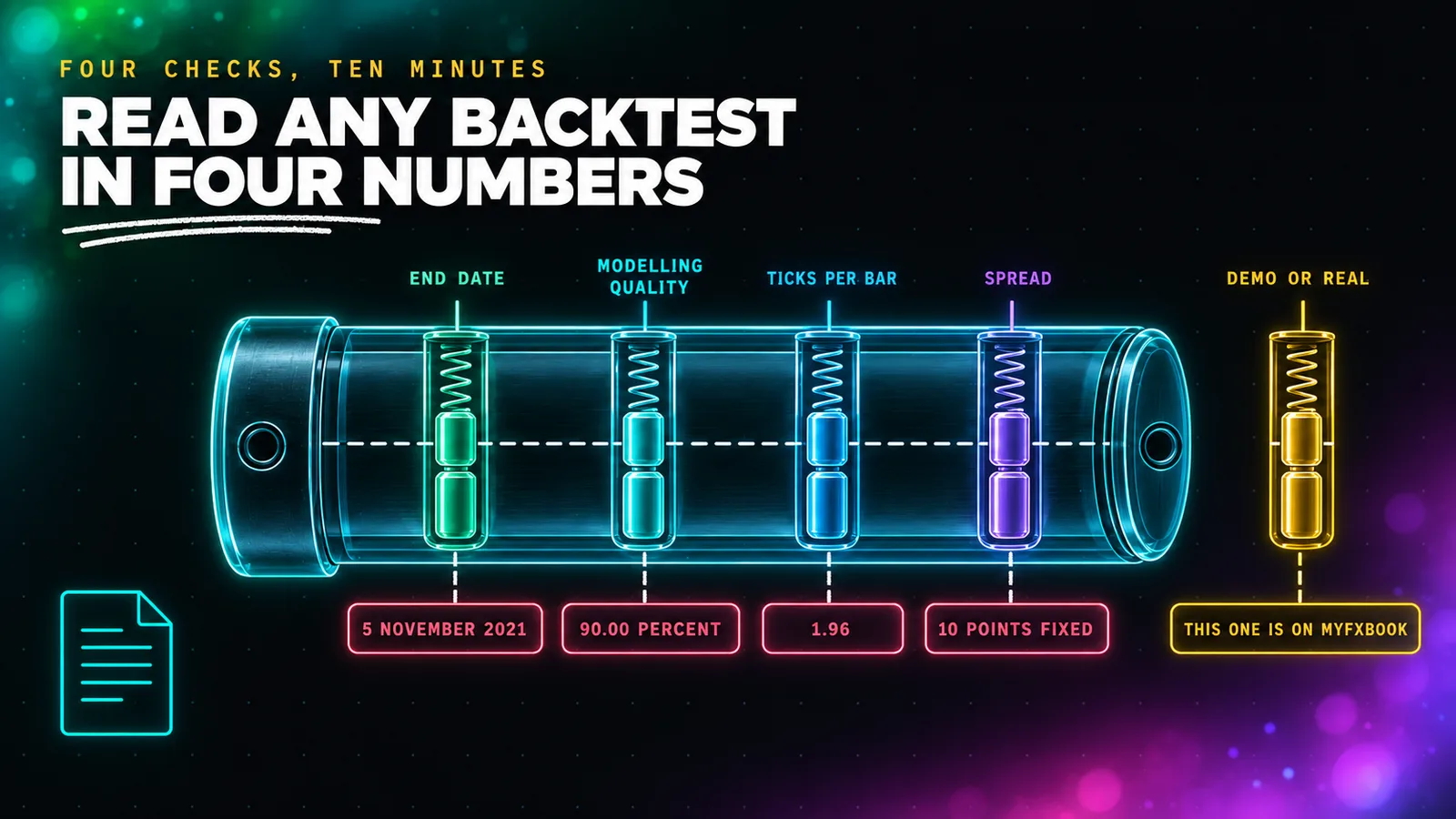
This is the part worth keeping regardless of whether you buy anything. Four checks, in order, on any Expert Advisor backtest you are ever shown. All four are in the report header, and all four take seconds.
Check one, the end date. Find the "Period" line and read the right-hand date. If it is more than a year old, the vendor is showing you a market that no longer exists. WallStreet Forex Robot's flagship reports end 5 November 2021.
Check two, the modelling quality. If it says 90.00 percent, the test was built from one-minute bars, because MetaQuotes' formula caps that method at exactly 0.9. Only 99 percent means real tick data, which you have to supply yourself. Treat 90.00 as the entry requirement, not as a pass mark.
Check three, the ticks per bar. Divide "Ticks modelled" by "Bars in test". A genuine tick-data run gives you tens of price updates per bar.
Under two means interpolation. Every report I pulled from this vendor sits between 1.91 and 1.99.
Check four, the spread. Find the "Spread" figure. If it is a small fixed number with no commission line, the test assumed best-case execution for its entire duration. Compare it against what your broker actually charges, then ask whether the strategy's average winning trade survives the difference.
If a backtest fails all four, it is a marketing asset rather than a measurement. If it passes all four, you have something worth reasoning about.
None of the four replaces the test that actually counts, which is forward testing: running the robot on a demo account against prices it has never seen. A backtest is in-sample by definition, and only out of sample results tell you whether the settings were fitted to history or found something real.
There is a fifth check that lives outside the report. Open the Myfxbook account and read the account type line. Demo and Real are printed in the same place, in the same font, and the difference is the whole point.
This is the same method I used on VinCheckUp, where a vendor's claim collapsed against the public register that governs it. The principle carries across categories: find the source the vendor is citing and read it yourself, because the citation is almost never checked.
WallStreet Forex Robot refund policy, and how to buy without regret
The refund window is thirty days from purchase, stated identically by the vendor and by ClickBank, and ClickBank is the retailer of record so its wording is the one that governs.
That is short for this kind of product, and it was twice as long fifteen months ago, so treat it as the binding constraint on the whole purchase.
If you decide to buy, here is the sequence that protects you.
One, buy the Premium Pack, not the Starter Pack. Fifty dollars more licenses four extra robots. There is no scenario where Starter is the right choice.
Two, diarise day twenty five. Not day thirty. Refund requests go through ClickBank's order lookup using the order number on your receipt email, and leaving it to the final day gives you no room if support is slow.
Three, register demo accounts first. Demo accounts are unlimited on every tier and do not consume your real-money licence slots. Run all five robots on demo for the first two weeks before risking anything.
Four, run your own backtest before you trust theirs. You will have the actual .ex4 files. Point the Strategy Tester at your own broker's history and see what the numbers look like at your spreads rather than at a fixed 10 points.
Five, keep the receipt email. The statement descriptor is CLKBANK*WSPREMIUMPACK or CLKBANK*WSULTIMATEPACK, which is what you will search your bank statement for.
If you want to start that clock, the WallStreet Forex Robot Premium Pack is the tier to take. If you are in India, remember the delivered cost runs about 32 percent over the dollar sticker once GST and the exchange spread are applied.
WallStreet Forex Robot review: the final verdict
I would not buy WallStreet Forex Robot at $297 on the strength of what its sales page shows you, because what it shows you is a set of 2021 backtests generated at the lowest fidelity MetaTrader produces, presented under a 2026 headline.
That is the verdict, and it is a judgement about the evidence rather than an accusation about the software.
What pushes it negative is the combination, not any single item.
Flagship backtests frozen in November 2021 while the same vendor refreshed its other products in 2025 and 2026. A 90.00 percent modelling quality that is a ceiling, not a score.
A fixed 10-point spread on a strategy with an 8 pip average winner. A guarantee halved in silence, and "100% Guaranteed Long-Term Profits" printed as a product feature.
What keeps it from being an outright rejection is also real. The vendor publishes more verifiable evidence than most of its competitors, which is the only reason this review could be written at all.
The robot is not a martingale, the guarantee is stated honestly, there are no rebills, the company has traded for fourteen years, and the flagship's live profit factor of 1.77 is better than its own backtest predicted.
So: conditional, and the condition is strict. If you are an experienced MetaTrader user with an ECN account and a virtual server, who wants five robots at $59 each, who will demo-test all of them inside thirty days and refund without hesitation if they disappoint, then the Premium Pack is a defensible $297.
If you are anyone else, and particularly if any part of you is buying this because a page promised guaranteed profits, the MQL5 Market will let you test a robot before you pay for it, and that is the better place to start.
The one thing I would not do is buy this on the numbers the sales page leads with. Open the report headers yourself. They take four minutes and they are more honest than the page that links to them.
This is the first review in the Trading Software section, where the question is always the same one: what does the vendor's own published evidence actually say, and does it survive being read carefully? If you found the backtest checks useful, the same method applied to a different category produced the Speechelo licence finding, where the vendor's support desk contradicted its own marketing.
FAQ
- Is WallStreet Forex Robot a scam?
- No. It is a real Expert Advisor from a vendor that has been selling since 2012, with a working licence server, a member area and continuing releases. The problem is the evidence, not the existence of the product. Every performance figure on the sales page comes from backtests that stopped in November 2021, and the only Myfxbook account published for the flagship robot is a demo account.
- How much does WallStreet Forex Robot cost?
- On the day I checked it was $247 for the Starter Pack, $297 for the Premium Pack and $367 for the Ultimate Pack, all one-time payments. Individual robots are $217 each. The Starter Pack is poor value because it licenses only one Expert Advisor, while the Premium Pack at $50 more licenses five. Prices rotate, so check the current figure before buying.
- What is the WallStreet Forex Robot refund policy?
- Thirty days. Both the vendor's own page and the ClickBank order form state a 30-day money-back guarantee, so the two sources agree. Note that this was cut in half: archived copies of the same site showed a 60-day guarantee as recently as June 2025. Several reviews still ranking today quote the old 60-day figure, so do not rely on them.
- Does WallStreet Forex Robot actually work?
- Its public demo account shows a real edge but a thin one. Across 503 trades it returned 98.24 percent on a $1,000 demo balance with a profit factor of 1.77 and a Sharpe ratio of 0.13. The average winning trade made 8.15 pips and the average losing trade lost 27.56 pips, so the result depends entirely on winning far more often than losing.
- Why do the WallStreet Forex Robot backtests only show 90 percent modelling quality?
- Because 90 percent is the ceiling, not a score. MetaQuotes publishes the formula MetaTrader uses, and it applies a 0.9 coefficient to any stretch of test that was modelled from one-minute bars. A backtest built entirely from one-minute data therefore cannot report more than 90.00 percent, which is exactly what all 26 of the vendor's published reports show.
- Is WallStreet Forex Robot on the MQL5 Market?
- No, and that matters more than it sounds. Expert Advisors sold through MetaQuotes' own MQL5 Market ship a free demo version, so you can run the actual robot in your own Strategy Tester before paying. WallStreet Forex Robot is sold direct, so the only performance evidence available before purchase is the vendor's own, and your refund window is the only real test.
- What broker do you need for WallStreet Forex Robot?
- A raw-spread or ECN account. The published backtests assume a fixed 10-point spread on the major pairs with no commission and no slippage, which is close to the best case any broker can offer. On a standard account with wider variable spreads, the robot's average 8.15 pip winner loses a meaningful share of its edge before the trade is even open.
- What are the best free alternatives to WallStreet Forex Robot?
- Start with MetaQuotes' own MQL5 Market, which lists free Expert Advisors alongside paid ones and lets you demo-test every paid product in the Strategy Tester first. Pair it with a free Myfxbook account so you are tracking your own verified results rather than reading someone else's. Both are free, and together they answer the question a sales page cannot.